


Obesity, inflammatory markers, and endometrial cancer risk: a prospective case-control study
- PMID: 20843938
- PMCID: PMC2966326
- DOI: 10.1677/ERC-10-0053
Obesity, inflammatory markers, and endometrial cancer risk: a prospective case-control study
Abstract
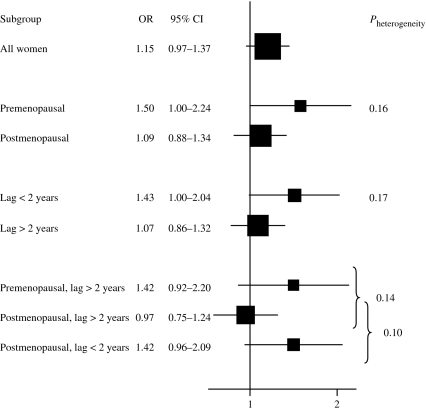
Obesity, a major risk factor for endometrial cancer, is a low-grade inflammatory state characterized by elevated concentrations of cytokines and acute phase reactants. The current study had two aims: first to investigate the associations of C-reactive protein (CRP), interleukin 6 (IL6), and IL1 receptor antagonist (IL1Ra) with endometrial cancer risk and second to examine to which extent these markers can influence the association between obesity and endometrial cancer. We conducted a case-control study, nested within the European Prospective Investigation into Cancer and Nutrition, which comprised 305 incident cases of endometrial cancer and 574 matched controls. CRP, IL6, and IL1Ra were measured in prospectively collected blood specimens by immunoassays. Data were analyzed using conditional logistic regression. All statistical tests were two-sided, and P values <0.05 were considered statistically significant. We observed a significant increase in risk of endometrial cancer with elevated levels of CRP (odds ratio (OR) for top versus bottom quartile: 1.58, 95% confidence interval (CI): 1.03-2.41, P(trend)=0.02), IL6 (OR for top versus bottom quartile: 1.66, 95% CI: 1.08-2.54, P(trend)=0.008), and IL1Ra (OR for top versus bottom quartile: 1.82, 95% CI: 1.22-2.73, P(trend)=0.004). After adjustment for body mass index (BMI), the estimates were strongly reduced and became non-significant. The association between BMI and endometrial cancer was also substantially attenuated (∼10-20%) after adjustment for inflammatory markers, even when the effects of C-peptide or estrone had already been taken into account. We provided epidemiological evidence that chronic inflammation might mediate the association between obesity and endometrial cancer and that endometrial carcinogenesis could be promoted by an inflammatory milieu.
Figures
References
-
- Allen NE, Key TJ, Dossus L, Rinaldi S, Cust A, Lukanova A, Peeters PH, Onland-Moret NC, Lahmann PH, Berrino F, et al. Endogenous sex hormones and endometrial cancer risk in women in the European Prospective Investigation into Cancer and Nutrition (EPIC) Endocrine-Related Cancer. 2008;15:485–497. doi: 10.1677/ERC-07-0064. - DOI - PMC - PubMed
-
- Bastard JP, Maachi M, Van Nhieu JT, Jardel C, Bruckert E, Grimaldi A, Robert JJ, Capeau J, Hainque B. Adipose tissue IL-6 content correlates with resistance to insulin activation of glucose uptake both in vivo and in vitro. Journal of Clinical Endocrinology and Metabolism. 2002;87:2084–2089. doi: 10.1210/jc.87.5.2084. - DOI - PubMed
-
- Bellone S, Watts K, Cane’ S, Palmieri M, Cannon MJ, Burnett A, Roman JJ, Pecorelli S, Santin AD. High serum levels of interleukin-6 in endometrial carcinoma are associated with uterine serous papillary histology, a highly aggressive and chemotherapy-resistant variant of endometrial cancer. Gynecologic Oncology. 2005;98:92–98. doi: 10.1016/j.ygyno.2005.03.016. - DOI - PubMed
Publication types
MeSH terms
Substances
Grants and funding
LinkOut - more resources
Full Text Sources
Other Literature Sources
Medical
Research Materials
Miscellaneous
