


Caffeine consumption during pregnancy and risk of preterm birth: a meta-analysis
- PMID: 20844077
- PMCID: PMC2954446
- DOI: 10.3945/ajcn.2010.29789
Caffeine consumption during pregnancy and risk of preterm birth: a meta-analysis
Abstract
Background: The effect of caffeine intake during pregnancy on the risk of preterm delivery has been studied for the past 3 decades with inconsistent results.
Objective: We performed a meta-analysis examining the association between caffeine consumption during pregnancy and risk of preterm birth.
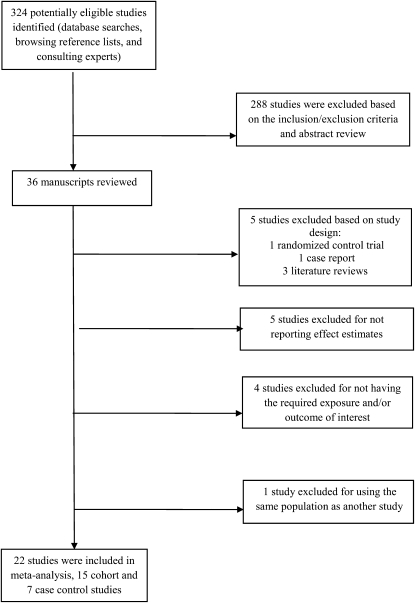
Design: We searched MEDLINE and EMBASE articles published between 1966 and July 2010, cross-referenced reference lists of the retrieved articles, and identified 15 cohort and 7 case-control studies that met inclusion criteria for this meta-analysis.
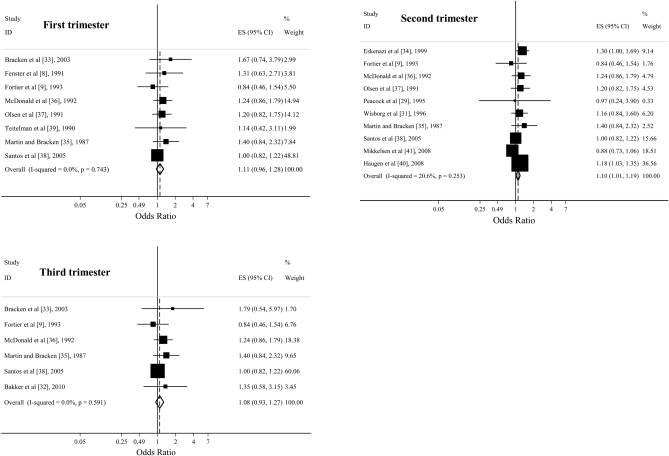
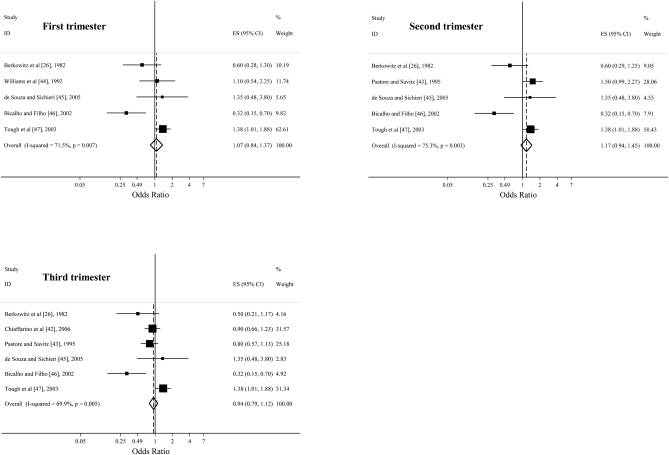
Results: The combined odds ratios (ORs) obtained by using fixed-effects models for cohort studies were 1.11 (95% CI: 0.96, 1.28), 1.10 (95% CI: 1.01, 1.19), and 1.08 (95% CI: 0.93, 1.27) for risk of preterm birth comparing the highest with the lowest level of caffeine intake (or no intake) (mg/d) during the first, second, and third trimesters, respectively. Results for the case-control studies yielded no associations for the first (OR: 1.07; 95% CI: 0.84, 1.37), second (OR: 1.17; 95% CI: 0.94, 1.45), or third (OR: 0.94; 95% CI: 0.79, 1.12) trimesters. No overall heterogeneity was found by region, publication decade, exposure and outcome assessment, caffeine sources, or adjustment for confounding, which was largely driven by individual studies.
Conclusion: In this meta-analysis, we observed no important association between caffeine intake during pregnancy and the risk of preterm birth for cohort and case-control studies.
Figures
References
-
- Hamilton BE, Martin JA, Ventura SJ. 14 May 14 2009. Available from: www.cdc.gov/nchs/products/pubs/pubd/hestats/prelimbirths05/prelimbirths0... (cited 14 May 2009.)
-
- Saigal S, Doyle LW. An overview of mortality and sequelae of preterm birth from infancy to adulthood. Lancet 2008;371:261–9 - PubMed
-
- Irving RJ, Belton NR, Elton RA, Walker BR. Adult cardiovascular risk factors in premature babies. Lancet 2000;355:2135–6 - PubMed
-
- Hofman PL, Regan F, Jackson WE, et al. Premature birth and later insulin resistance. N Engl J Med 2004;351:2179–86 - PubMed
Publication types
MeSH terms
Substances
LinkOut - more resources
Full Text Sources
Medical
Miscellaneous
