. 2010 Nov;299(5):C1068-78.
doi: 10.1152/ajpcell.00225.2010. Epub 2010 Sep 15.

Role of epoxyeicosatrienoic acids as autocrine metabolites in glutamate-mediated K+ signaling in perivascular astrocytes

Affiliations

Role of epoxyeicosatrienoic acids as autocrine metabolites in glutamate-mediated K+ signaling in perivascular astrocytes

Haruki Higashimori et al. Am J Physiol Cell Physiol. 2010 Nov.

Abstract

Epoxyeicosatrienoic acids (EETs), synthesized and released by astrocytes in response to glutamate, are known to play a pivotal role in neurovascular coupling. In vascular smooth muscle cells (VSMC), EETs activate large-conductance, Ca(2+)-activated K(+) (BK) channels resulting in hyperpolarization and vasodilation. However, the functional role and mechanism of action for glial-derived EETs are still to be determined. In this study, we evaluated the effect of the synthetic EET analog 11-nonyloxy-undec-8(Z)-enoic acid (NUD-GA) on outward K(+) currents mediated by calcium-activated K(+) channels. Addition of NUD-GA significantly increased intracellular Ca(2+) and outward K(+) currents in perivascular astrocytes. NUD-GA-induced currents were significantly inhibited by BK channel blockers paxilline and tetraethylammonium (TEA) (23.4 ± 2.4%; P < 0.0005). Similarly, NUD-GA-induced currents were also significantly inhibited in the presence of the small-conductance Ca(2+)-activated K(+) channel inhibitor apamin along with a combination of blockers against glutamate receptors (12.8 ± 2.70%; P < 0.05). No changes in outward currents were observed in the presence of the channel blocker for intermediate-conductance K(+) channels TRAM-34. Blockade of the endogenous production of EETs with N-methylsulfonyl-6-(2-propargyloxyphenyl)hexanamide (MS-PPOH) significantly blunted (dl)-1-aminocyclopentane-trans-1,3-dicarboxylic acid (t-ACPD)-induced outward K(+) currents (P < 0.05; n = 6). Both NUD-GA and t-ACPD significantly increased BK channel single open probability; the later was blocked following MS-PPOH incubation. Our data supports the idea that EETs are potent K(+) channel modulators in cortical perivascular astrocytes and further suggest that these metabolites may participate in NVC by modulating the levels of K(+) released at the gliovascular space.


Figures
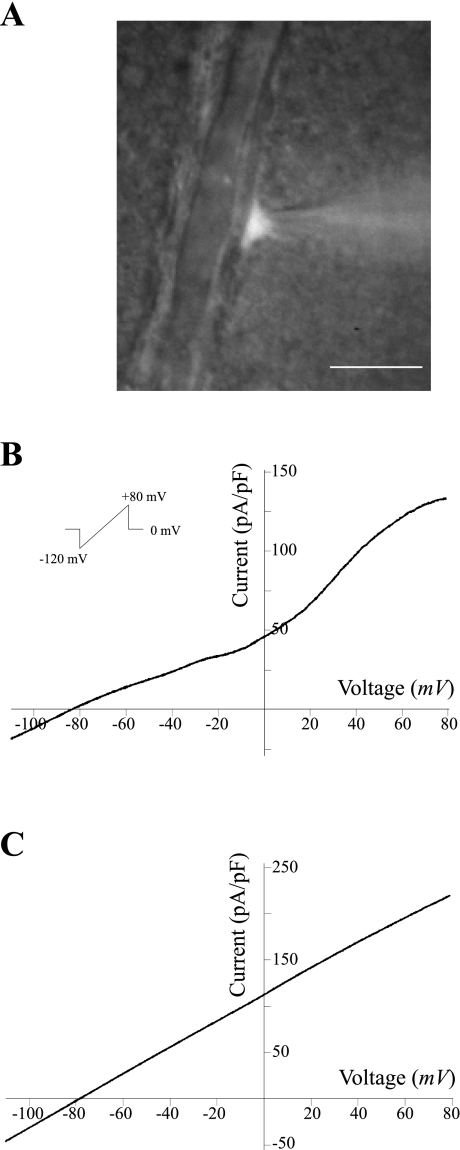
Fig. 1.
Fig. 1.
Representative whole cell current profiles from cortical perivascular astrocytes. A: differential interference contrast (DIC) image of a Lucifer yellow-filled astrocyte in direct contact to an intraparenchymal arteriole. Calibration bar, 10 μm. Representative voltage-dependent (B) and linear membrane currents (C) in response to a ramp protocol from −120 to +80 mV.
Fig. 2.
Fig. 2.
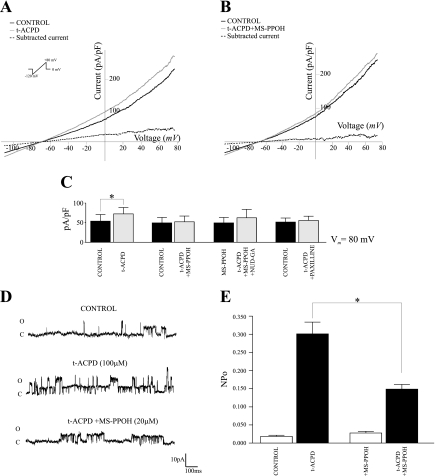
Effect of endogenous epoxyeicosatrienoic acids (EETs) on outward currents induced by activation of metabotropic glutamate receptors (mGluR) in perivascular astrocytes. (dl)-1-Aminocyclopentane-trans-1,3-dicarboxylic acid (t-ACPD)-induced (100 μM) outward currents in the absence (A) and presence (B) of the CYP epoxygenase substrate inhibitor N-methylsulfonyl-6-(2-propargyloxyphenyl)hexanamide (MS-PPOH) (20 μM) (solid black line: control, solid gray line: t-ACPD, dashed line: subtracted current) are shown. C: summary data of averaged peak currents (pA/pF) at Vm = 80 mV induced by t-ACPD in the presence and absence of MS-PPOH and the large-conductance, Ca2+-activated K+ (BK) channel blocker paxilline. D: representative traces of single BK channel activation induced by t-ACPD in the presence and absence of MS-PPOH. E: changes in single channel open probability (NPo) induced by t-ACPD in the presence and absence of MS-PPOH (*P < 0.05, n = 4).
Fig. 3.
Fig. 3.
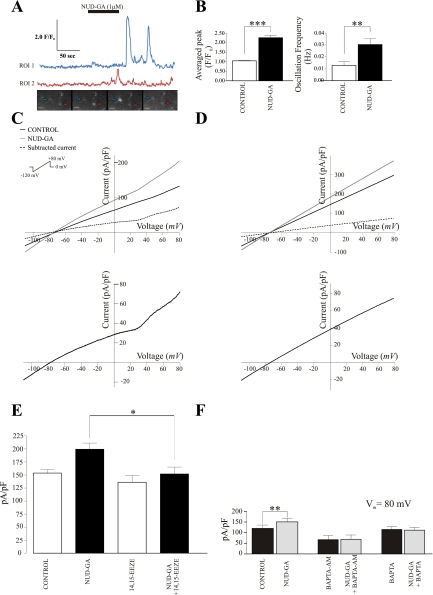
Calcium and electrophysiological responses of cortical astrocytes to the EET agonist 11-nonyloxy-undec-8(Z)-enoic acid (NUD-GA). A: NUD-GA-induced calcium transients in cortical astrocytes, representative traces and fluorescence images are shown. B: summary data of NUD-GA-induced changes in averaged peak F/F0 (***P < 0.0001, n = 11) and calcium oscillation frequency (**P < 0.01, n = 11). C and D: representative NUD-GA-induced outward voltage-dependent and linear membrane currents in response to a ramp protocol from −120 to +80 mV in perivascular astrocytes, respectively. The corresponding subtracted currents for C and D are shown below. E: summary data of peak currents (pA/pF) at +80 mV under control conditions, in the presence of NUD-GA, in the presence of 14,15-epoxyeicosa-5(Z)-enoic acid (14,15-EEZE) and in the presence of 14,15-EEZE and NUD-GA (*P < 0.005, n = 7). F: summary data of peak currents (pA/pF) at +80 mV in the presence and absence of the calcium chelator BAPTA (**P < 0.05, n = 5). Calibration bar, 10 μm.
Fig. 4.
Fig. 4.
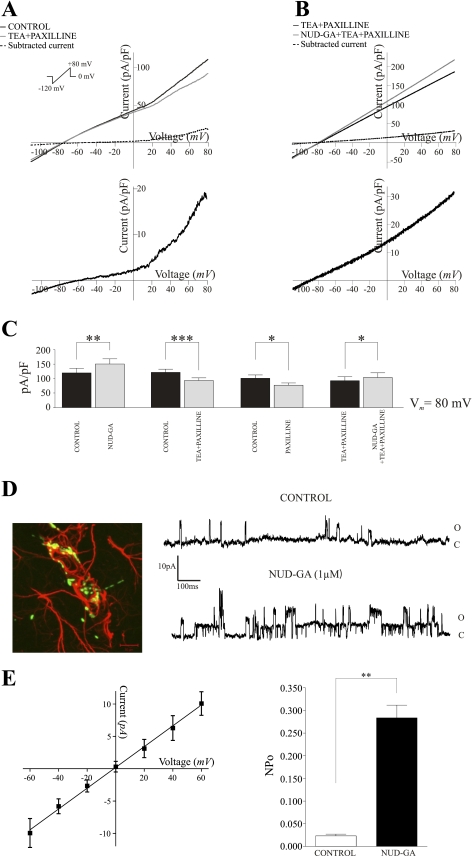
Contribution of BK channels to NUD-GA-induced outward currents. A: representative current profiles of perivascular astrocytes in the presence and absence of the BK channel blocker paxilline (2 μM) and tetraethylammonium (TEA, 1 mM) in response to a ramp protocol from −120 to +80 mV (P < 0.001, n = 11). Subtracted currents are shown below. B: representative NUD-GA-induced outward K+ currents from an astrocyte in the presence of the BK channel blocker paxilline and TEA. Corresponding subtract currents are shown below. C: summary data of peak currents at +80 mV in the presence (*P < 0.05, n = 7) and absence of BK channel blockers.**P < 0.01; ***P < 0.001 D: left, immunolabeling against BK channels (green) and the astrocyte marker glial fibrillary acidic protein (GFAP) (red) (scale bar = 10 μm); right, representative single channel activity from an astrocytic endfoot in the absence and presence of NUD-GA, O, open state and C, closed state. E: left, averaged current-voltage relationship for BK channels expressed in astrocytic endfeet; right, NUD-GA-induced increased in NPo (**P < 0.01, n = 4).
Fig. 5.
Fig. 5.
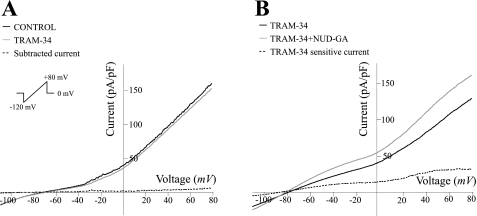
Lack of contribution of intermediate conductance (IK) channels to NUD-GA-induced outward currents. A: representative ramp profile of a perivascular astrocyte in the presence and absence of the IK channel blocker TRAM-34 (1 μM). B: representative ramp profile of a perivascular astrocyte in the presence and absence of NUD-GA in the presense of TRAM-34.
Fig. 6.
Fig. 6.
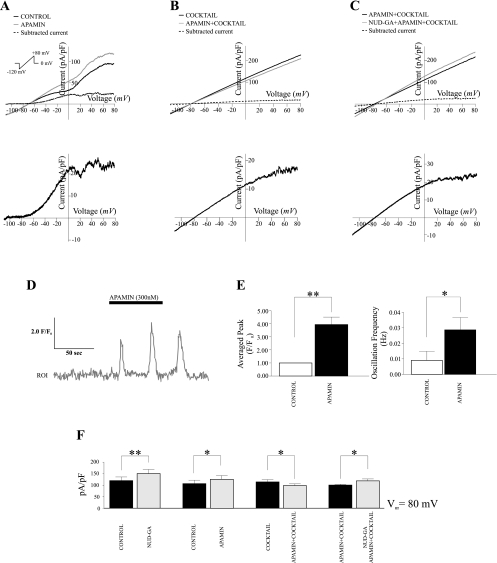
Contribution of small conductance (SK) channels to NUD-GA-induced outward currents. A: representative ramp profiles of perivascular astrocytes in the presence and absence of the SK channel blocker apamin (300 nM) (P < 0.05, n = 7), subtracted currents are shown below. B: representative ramp profiles of perivascular astrocytes in the presence of tetradotoxin (TTX) (0.5 μM) and glutamate receptor blockers kyneurenic acid (1 mM), LY-367385 (50 μM), and 2-methyl-6-phenylethynylpyridine hydrochloride (MPEP, 100 μM) with or without apamin. C: NUD-GA-induced outward currents in the presence of apamin and combined inhibitors against ionotropic and metabotropic GluR. D: representative calcium trace showing apamin-induced calcium oscillations in astrocytes. E: summary data of apamin-induced changes in averaged peak F/F0 and calcium oscillation frequency from cortical astrocytes (**P < 0.01, n = 7). F: summary data of averaged peak currents at +80 mV in the presence and absence of NUD-GA, combined inhibitors against ionotropic and metabotropic GluR and the SK channel blocker apamin. *P < 0.05.

References

    1. Ai D, Fu Y, Guo D, Tanaka H, Wang N, Tang C, Hammock BD, Shyy JY, Zhu Y. Angiotensin II up-regulates soluble epoxide hydrolase in vascular endothelium in vitro and in vivo. Proc Natl Acad Sci USA 104: 9018–9023, 2007 - PMC - PubMed
    1. Alkayed NJ, Birks EK, Narayanan J, Petrie KA, Kohler-Cabot AE, Harder DR. Role of P-450 arachidonic acid epoxygenase in the response of cerebral blood flow to glutamate in rats. Stroke 28: 1066–1072, 1997 - PubMed
    1. Alkayed NJ, Narayanan J, Gebremedhin D, Medhora M, Roman RJ, Harder DR. Molecular characterization of an arachidonic acid epoxygenase in rat brain astrocytes. Stroke 27: 971–979, 1996 - PubMed
    1. Amruthesh SC, Falck JR, Ellis EF. Brain synthesis and cerebrovascular action of epoxygenase metabolites of arachidonic acid. J Neurochem 58: 503–510, 1992 - PubMed
    1. Armstrong WE, Rubrum A, Teruyama R, Bond CT, Adelman JP. Immunocytochemical localization of small-conductance, calcium-dependent potassium channels in astrocytes of the rat supraoptic nucleus. J Comp Neurol 491: 175–185, 2005 - PubMed

Publication types

MeSH terms

LinkOut - more resources