. 2010 Sep 14;6(9):2866-2871.
doi: 10.1021/ct1003077. Epub 2010 Aug 24.

How Can Hydrophobic Association Be Enthalpy Driven?

Affiliations
Free PMC article

How Can Hydrophobic Association Be Enthalpy Driven?

Piotr Setny et al. J Chem Theory Comput. .
Free PMC article

Abstract

Hydrophobic association is often recognized as being driven by favorable entropic contributions. Here, using explicit solvent molecular dynamics simulations we investigate binding in a model hydrophobic receptor-ligand system which appears, instead, to be driven by enthalpy and opposed by entropy. We use the temperature dependence of the potential of mean force to analyze the thermodynamic contributions along the association coordinate. Relating such contributions to the ongoing changes in system hydration allows us to demonstrate that the overall binding thermodynamics is determined by the expulsion of disorganized water from the receptor cavity. Our model study sheds light on the solvent-induced driving forces for receptor-ligand association of general, transferable relevance for biological systems with poorly hydrated binding sites.


Figures
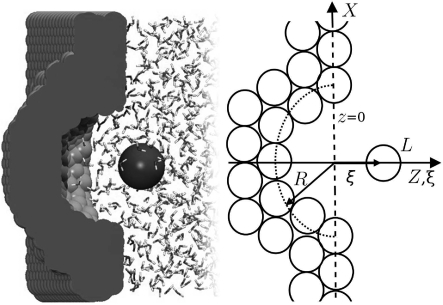
Figure 1
Figure 1
Snapshot and schematic representation of the explicitly solvated hemispherical cavity and spherical ligand (L) used in this study. Note that (ξ = 0) corresponds to the wall surface.
Figure 2
Figure 2
Water density distribution maps for key snapshots along ξ. Color coding is normalized such that ρ* = 1 corresponds to bulk water density of 998 g/L.
Figure 3
Figure 3
(Thermo)dynamics of pocket hydration. (A) Average cavity occupancy along ξ. <N> is the average number of water oxygens located at Z < 0. (B) Free energy and its entropy component as functions of pocket occupancy, N (note different energy scale for each profile).
Figure 4
Figure 4
Thermodynamic contributions along the binding coordinate. (A) Relative Gibbs free energy, G (red), enthalpy, H (blue), and entropic term, −TS (green), and their uncertainties (vertical bars; eq 5). (B) Water contribution to the Gibbs free energy, GW (orange), and decomposed interaction energies: cavity−ligand, UCL (thin black), ligand−water, ULW (green), cavity−water, UCW (black), and water−water, UWW (cyan).

References

    1. Lum K.; Luzar A. Phys. Rev. E: Stat. Phys., Plasmas, Fluids, Relat. Interdiscip. Top. 1997, 56, R6283–R6286. - PubMed
    1. Rajamani S.; Truskett T. M.; Garde S. Proc. Natl. Acad. Sci. U.S.A. 2005, 102, 9475–9480. - PMC - PubMed
    1. Ashbaugh H. S.; Pratt L. R. Rev. Mod. Phys. 2006, 78, 156–178.
    1. Meyer E. E.; Rosenberg K. J.; Israelachvili J. Proc. Natl. Acad. Sci. U.S.A. 2006, 103, 15739–15746. - PMC - PubMed
    1. Chandler D. Phys. Rev. E: Stat. Phys., Plasmas, Fluids, Relat. Interdiscip. Top. 1993, 48, 2898–2905. - PubMed