


Continued improved wear with an annealed highly cross-linked polyethylene
- PMID: 20844996
- PMCID: PMC3032874
- DOI: 10.1007/s11999-010-1556-5
Continued improved wear with an annealed highly cross-linked polyethylene
Abstract
Background: Highly cross-linked polyethylene (HXLPE), created by disrupting the molecular structure of polyethylene, then through the application of heat, encourages creation of new cross-links in the process, resulting in a material with improved wear resistance. The impetuses for this new technology were the unsatisfactory wear properties and subsequent osteolysis of noncross-linked polyethylene. A 72% reduction in wear using highly cross-linked polyethylenes (HXLPE) compared with conventional polyethylene at 5 years was described previously. The longest term followup studies on HXLPE range from 2 to 6 years.
Questions/purposes: We therefore addressed the following questions: (1) Does the improvement in wear observed at the earlier followup continue to 7 to 10 years? (2) What is the incidence of osteolysis in this group of patients and in the control group?
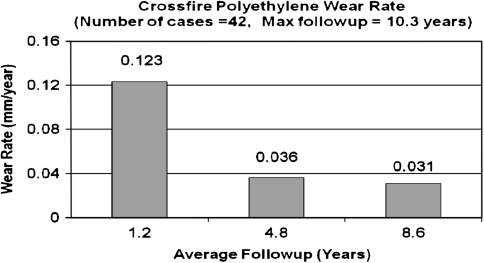
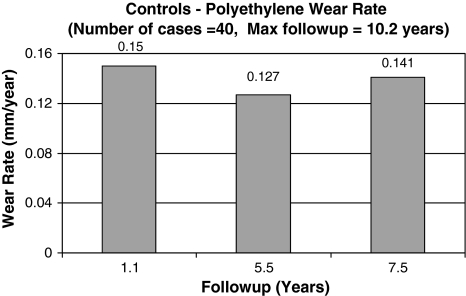
Methods: We retrospectively reviewed 38 prospectively followed patients who had 42 hips with an annealed HXLPE who were followed a minimum of 7 years (average, 8.6 years; SD=1; range, 7-10.3 years). Wear and osteolysis were compared with those of a control group of 39 patients (40 hips) from a US Investigational Device Exemption (IDE) prospective, randomized study begun in 1996 with conventional polyethylene and followed for a minimum of 6 years (average, 7.5 years; SD=1.1; range, 6-10.2 years). Linear head penetration was measured from AP radiographs at early, 1-year, 5-year, and most recent followups.
Results: At the average followup, annual linear wear was 0.031 mm (SD=0.014) for the HXLPE and 0.141 mm (SD=0.080) for the control group, a 78% reduction. No mechanical failure of the polyethylene was noted in either group. Incidence of osteolysis was 50% in the control group (all lesions confined to proximal Gruen Zones 1 and 7) compared with no cases in the investigational group.
Conclusions: We observed an improvement in wear and no mechanical failures with this annealed material.
Level of evidence: Level III, therapeutic study. See Guidelines for Authors for a complete description of levels of evidence.
Figures

References
-
- Bragdon CR, Kwon YM, Geller JA, Greene ME, Freiberg AA, Harris WH, Malchau H. Minimum 6-year followup of highly cross-linked polyethylene in THA. Clin Orthop Relat Res. 2007;465:122–127. - PubMed
-
- Bragdon CR, Malchau H, Yuan X, Perinchief R, Kärrholm J, Börlin N, Estok DM, Harris WH. Experimental assessment of precision and accuracy of radiostereometric analysis for the determination of polyethylene wear in a total hip replacement model. J Orthop Res. 2002;20:688–695. doi: 10.1016/S0736-0266(01)00171-1. - DOI - PubMed
Publication types
MeSH terms
Substances
LinkOut - more resources
Full Text Sources
Medical
