. 2010 Sep 16:11:72.
doi: 10.1186/1471-2199-11-72.

Effects on mitochondrial transcription of manipulating mTERF protein levels in cultured human HEK293 cells

Affiliations

Effects on mitochondrial transcription of manipulating mTERF protein levels in cultured human HEK293 cells

Anne K Hyvärinen et al. BMC Mol Biol. .

Abstract

Background: Based on its activities in vitro, the mammalian mitochondrial transcription termination factor mTERF has been proposed to regulate mitochondrial transcription by favouring termination at its high-affinity binding immediately downstream of the rDNA segment of mitochondrial DNA, and initiation selectively at the PH1 site of the heavy-strand promoter. This defines an rDNA transcription unit distinct from the 'global' heavy-strand transcription unit initiating at PH2. However, evidence that the relative activities of the two heavy-strand transcription units are modulated by mTERF in vivo is thus far lacking.

Results: To test this hypothesis, we engineered human HEK293-derived cells for over-expression or knockdown of mTERF, and measured the steady-state levels of transcripts belonging to different transcription units, namely tRNALeu(UUR) and ND1 mRNA for the PH2 transcription unit, and tRNAPhe plus 12S and 16S rRNA for the PH1 transcription unit. The relative levels of 16S rRNA and ND1 mRNA were the same under all conditions tested, although mTERF knockdown resulted in increased levels of transcripts of 12S rRNA. The amount of tRNAPhe relative to tRNALeu(UUR) was unaffected by mTERF over-expression, altered only slightly by mTERF knockdown, and was unchanged during recovery from ethidium bromide-induced depletion of mitochondrial RNA. mTERF overexpression or knockdown produced a substantial shift (3-5-fold) in the relative abundance of antisense transcripts either side of its high-affinity binding site.

Conclusions: mTERF protein levels materially affect the amount of readthrough transcription on the antisense strand of mtDNA, whilst the effects on sense-strand transcripts are complex, and suggest the influence of compensatory mechanisms.


Figures
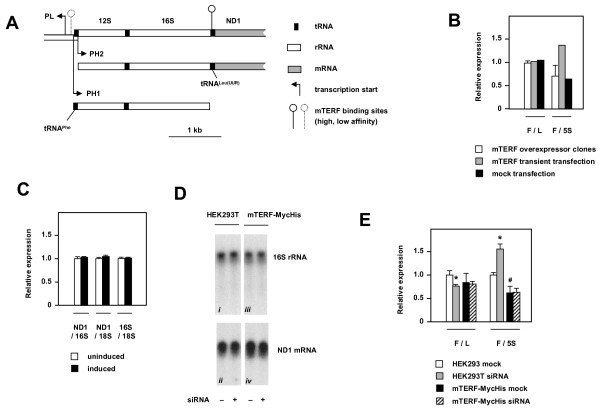
Figure 1
Figure 1
Manipulation of mTERF expression has minimal effects on steady-state levels of mature mitochondrial RNAs. (A) Schematic diagram of the promoter and rDNA region of human mtDNA. Because mTERF binding dictates the use of alternate transcriptional start sites and terminators, tRNAPhe and tRNALeu(UUR) fall into separate transcription units (PH1 and PH2 respectively). (B) Relative expression of mitochondrial transcripts in cells overexpressing mTERF, based on phosphorimaging of Northern blots probed successively for mitochondrial tRNAPhe and tRNALeu(UUR) and for 5S rRNA. Data (means ± SD) are signal ratios of tRNAPhe to tRNALeu(UUR) (F/L) and tRNAPhe to 5S rRNA (F/5S) for the mTERF-overexpressing clones shown in Additional File 1, Fig. S1, normalized to the corresponding ratio in cells stably transfected with empty-vector. Bars shown alongside are based on single reference experiments, using HEK293T cells transiently transfected with the same construct, or mock-transfected. (C) Q-RT-PCR analysis (means ± SD) of mitochondrial transcript levels, plus cytosolic18S rRNA, as indicated, in Flp-In™ T-Rex™-293 cells over-expressing mTERF-MycHis after doxycyclin induction for 3 d (or not induced). Data were normalized, in each case, to the corresponding ratio for uninduced cells. (D) Relative expression of mitochondrial transcripts in cells knocked down for mTERF, as indicated. – denotes mock-transfection. Northern blot probed successively for 16S rRNA and ND1 mRNA, as shown. The panels represent non-adjacent pairs of lanes from the same exposure of the same gel. (E) Relative expression of mitochondrial transcripts in cells knocked down for mTERF, as indicated, calculated from Northern blot data as in (B), normalized to the corresponding ratio in mock-transfected HEK293T cells. * indicates significant differences from the corresponding mock-transfected cells, and # a significant difference between cell-lines (t-test, p values as in text). For original blots see Additional File 1, Fig. S1C. Note that additional Q-RT-PCR data on levels of 12S rRNA gene transcripts are shown in Fig. 3.
Figure 2
Figure 2
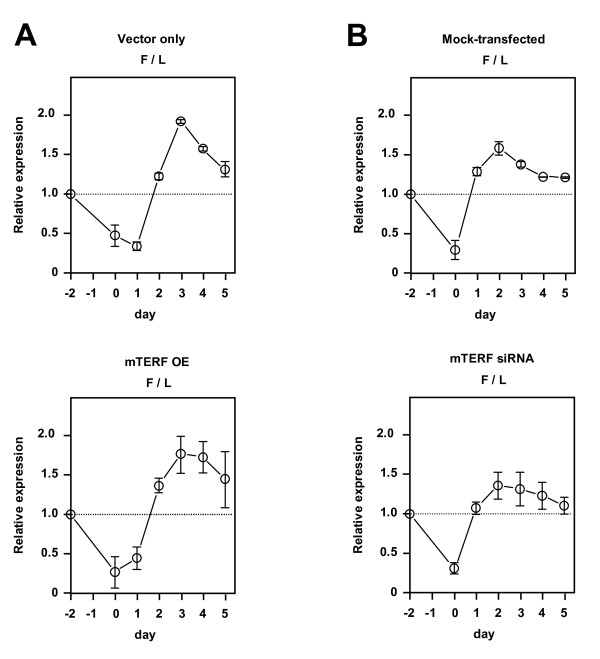
Manipulation of mTERF expression has minimal effects on levels of mature mitochondrial RNAs during recovery from EtBr-induced depletion. Relative expression of mitochondrial transcripts in cells overexpressing mTERF, based on phosphorimaging of Northern blots probed successively for mitochondrial tRNAPhe and tRNALeu(UUR). Data (means ± SD) are ratios of tRNAPhe to tRNALeu(UUR) (F/L) normalized to the ratio at the start of the experiment (time-point –2 d). (A) Cells stably transfected with empty-vector (as shown in Additional File 1, Fig. S1B) or mTERF overexpression (OE) construct (clone 3, as shown in Additional File 1, Fig. S1). Overexpressor clones 1 and 2 gave similar results: sample blots shown in Additional File 1, Fig. S2A. (B) Cells treated with mTERF-specific siRNA (or mock-transfected) prior to the addition of EtBr (day –2) and again 2 days after removal of EtBr (day 2). Days 1-5 indicate the period of subsequent recovery. For equivalent data on ratio of tRNAPhe to 5S rRNA from the same experiment see Additional File 1, Fig. S2B, C.
Figure 3
Figure 3
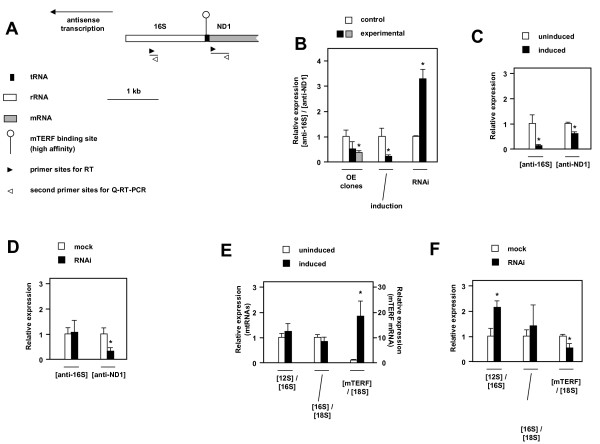
Manipulation of mTERF expression affects relative levels of antisense transcripts of the 16S rRNA and ND1 genes. (A) Schematic diagram of 16S rDNA-ND1 region of human mtDNA. For full details of primer sequences and location, see Additional File 1, Table S1. (B) Relative steady-state levels of anti-16S and anti-ND1 transcripts, determined by Q-RT-PCR using proximity probe hybridization (probe sets R1, N1 and C1 for normalization), after various manipulations of mTERF expression, i.e. two mTERF overexpressor clones (OE) compared with vector-transfected cells, doxycyclin-induced versus uninduced Flp-In™ T-Rex™-293 cells transfected with mTERF expression construct, and HEK293T cells transfected with mTERF-targeted shRNA versus mock-transfected cells. In each case, data were normalized to the corresponding control cells. * denotes statistically significant differences from control cells (t test, p < 0.02). (C, D) Relative changes in anti-16S and anti-ND1 transcripts, based on replotting of data from the experiment of panel B for each transcript individually, (C) following induced expression of mTERF in Flp-In™ T-Rex™-293 cells and (D) in HEK293T cells transfected with mTERF-targeted shRNA versus mock-transfected cells. Data were normalized to values for corresponding untreated control cells, using 18S as internal normalization standard. * denotes statistically significant differences from corresponding control cells (t test, p < 0.01). (E, F) Relative steady-state levels of 12S, 16S and 18S sense-strand transcripts, as determined by Q-RT-PCR using of proximity probe hybridization (primer sets T1, R2, C1 respectively, as described in Additional File 1, Table S1), and of mTERF mRNA relative to 18S rRNA (probes sets M1 and C1, see Additional File 1, Table S1), (E) following induced expression of mTERF in Flp-In™ T-Rex™-293 cells and (F) in HEK293T cells transfected with mTERF-targeted shRNA versus mock-transfected cells. * denotes statistically significant differences (t test, p < 0.02). See also Additional File 1, Fig. S3.

References

    1. Asin-Cayuela J, Gustafsson CM. Mitochondrial transcription and its regulation in mammalian cells. Trends Biochem Sci. 2007;32:111–117. doi: 10.1016/j.tibs.2007.01.003. - DOI - PubMed
    1. Montoya J, Gaines GL, Attardi G. The pattern of transcription of the human mitochondrial rRNA genes reveals two overlapping transcription units. Cell. 1983;34:151–159. doi: 10.1016/0092-8674(83)90145-9. - DOI - PubMed
    1. Van Etten RA, Bird JW, Clayton DA. Identification of the 3'-ends of the two mouse mitochondrial ribosomal RNAs. The 3'-end of 16 S ribosomal RNA contains nucleotides encoded by the gene for transfer RNALeuUUR. J Biol Chem. 1983;258:10104–10110. - PubMed
    1. Gaines G, Attardi G. Intercalating drugs and low temperatures inhibit synthesis and processing of ribosomal RNA in isolated human mitochondria. J Mol Biol. 1984;172:451–466. doi: 10.1016/S0022-2836(84)80017-0. - DOI - PubMed
    1. Gaines G, Rossi C, Attardi G. Markedly different ATP requirements for rRNA synthesis and mtDNA light strand transcription versus mRNA synthesis in isolated human mitochondria. J Biol Chem. 1987;262:1907–1915. - PubMed

Publication types

MeSH terms

LinkOut - more resources