. 2010 Sep 16:11:118.
doi: 10.1186/1471-2202-11-118.

Practice effects in healthy adults: a longitudinal study on frequent repetitive cognitive testing

Affiliations

Practice effects in healthy adults: a longitudinal study on frequent repetitive cognitive testing

Claudia Bartels et al. BMC Neurosci. .

Abstract

Background: Cognitive deterioration is a core symptom of many neuropsychiatric disorders and target of increasing significance for novel treatment strategies. Hence, its reliable capture in long-term follow-up studies is prerequisite for recording the natural course of diseases and for estimating potential benefits of therapeutic interventions. Since repeated neuropsychological testing is required for respective longitudinal study designs, occurrence, time pattern and magnitude of practice effects on cognition have to be understood first under healthy good-performance conditions to enable design optimization and result interpretation in disease trials.

Methods: Healthy adults (N = 36; 47.3 ± 12.0 years; mean IQ 127.0 ± 14.1; 58% males) completed 7 testing sessions, distributed asymmetrically from high to low frequency, over 1 year (baseline, weeks 2-3, 6, 9, months 3, 6, 12). The neuropsychological test battery covered 6 major cognitive domains by several well-established tests each.

Results: Most tests exhibited a similar pattern upon repetition: (1) Clinically relevant practice effects during high-frequency testing until month 3 (Cohen's d 0.36-1.19), most pronounced early on, and (2) a performance plateau thereafter upon low-frequency testing. Few tests were non-susceptible to practice or limited by ceiling effects. Influence of confounding variables (age, IQ, personality) was minor.

Conclusions: Practice effects are prominent particularly in the early phase of high-frequency repetitive cognitive testing of healthy well-performing subjects. An optimal combination and timing of tests, as extractable from this study, will aid in controlling their impact. Moreover, normative data for serial testing may now be collected to assess normal learning curves as important comparative readout of pathological cognitive processes.


Figures
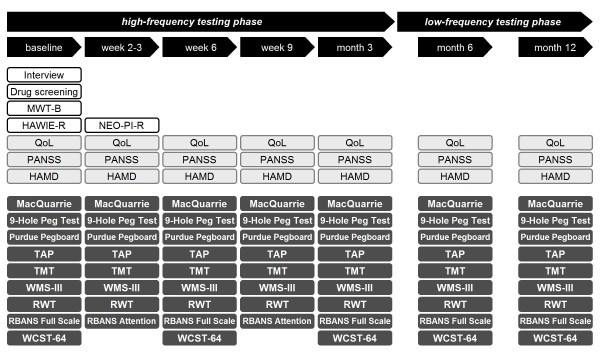
Figure 1
Figure 1
Study design comprising a comprehensive cross-sectional baseline evaluation and 2 longitudinal phases with high-frequency followed by low-frequency testing. With a semi-structured interview, sociodemographic variables and medical history were collected. Drug screening: Urine samples of all subjects were tested for ethanol, cannabinoids, benzodiazepines and cocaine at baseline, and tests were repeated randomly afterwards. MWT-B, Mehrfachwahl-Wortschatz-Intelligenz-Test (premorbid intelligence measure); HAWIE-R, revised German version of the Wechsler Adult Intelligence Scale (subtests Information, Similarities, Picture Completion, Block Design); NEO-PI-R, revised NEO Personality Inventory; QoL, quality of life visual-analogue scale; PANSS, Positive and Negative Syndrome Scale; HAMD, Hamilton Rating Scale for Depression; MacQuarrie; MacQuarrie Tapping and Dotting tests; Purdue Pegboard, Purdue Pegboard Test, TAP, Test for Attentional Performance (subtests Alertness, Visual Scanning, Working Memory, Flexibility); TMT, Trail Making Test (A and B); WMS-III, Wechsler Memory Scale - 3rd edition (subtest Letter Number Sequencing); RWT, Regensburger Wortflüssigkeitstest (subtest phonemic verbal fluency); RBANS, Repeatable Battery for the Assessment of Neuropsychological Status (Full Scale, complete RBANS performed; Attention, RBANS Attention subtests only); WCST-64, Wisconsin Card Sorting Test - 64 Card Version.
Figure 2
Figure 2
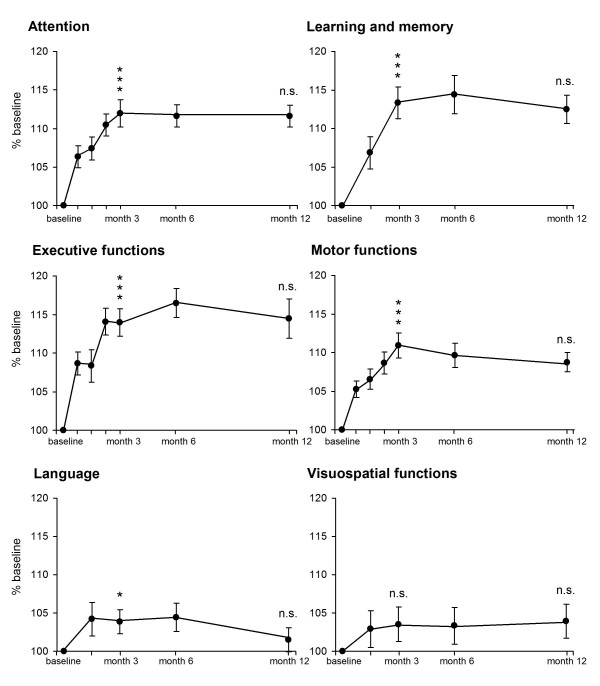
Pattern of practice effects in cognitive domains over time. Data of all single tests (always expressed as % individual baseline of the respective test), representing one particular cognitive domain, were combined to yield respective super-ordinate cognitive mean curves. In almost all cognitive domains, changes in total test scores over time exhibit a similar practice pattern: significant improvement during the high-frequency testing phase and stabilization of performance during the low-frequency testing phase. Most pronounced score increases are seen in executive functions as well as in learning and memory, whereas changes in visuospatial performance fail to reach significance. Significance refers to a main effect of time determined with ANOVA for repeated measures, including all testing time-points from baseline to month 3, or from month 3 to month 12, respectively. Mean ± SEM given. ***p < 0.001; *p < 0.05; n.s., not significant.
Figure 3
Figure 3
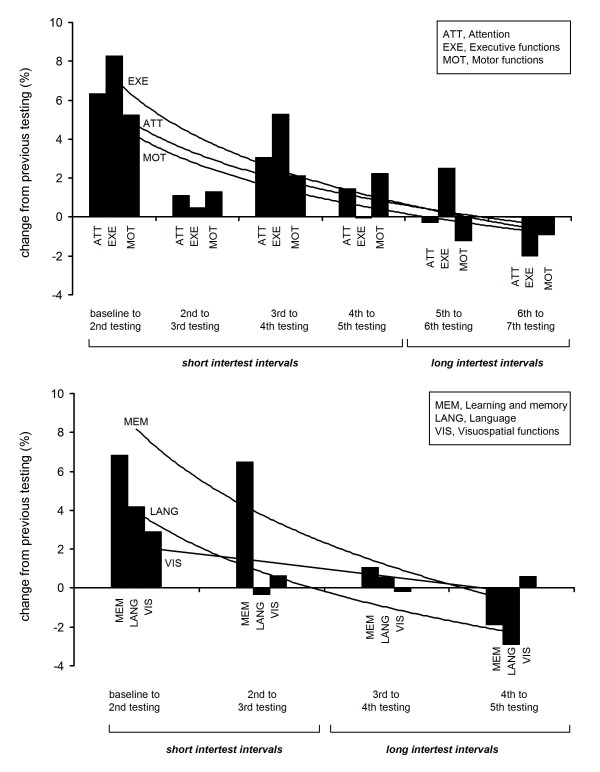
Distribution of practice effects: Changes from one testing to the next. All cognitive domains (respective single tests grouped as described in Figure 2) show most pronounced improvement in performance from baseline to the 2nd testing time-point. At late testing time-points with long intertest intervals (5th to 6th, and 6th to 7th testing), test scores show a slight tendency to decrease. Mean of % change given. Lines indicate logarithmic trends.
Figure 4
Figure 4
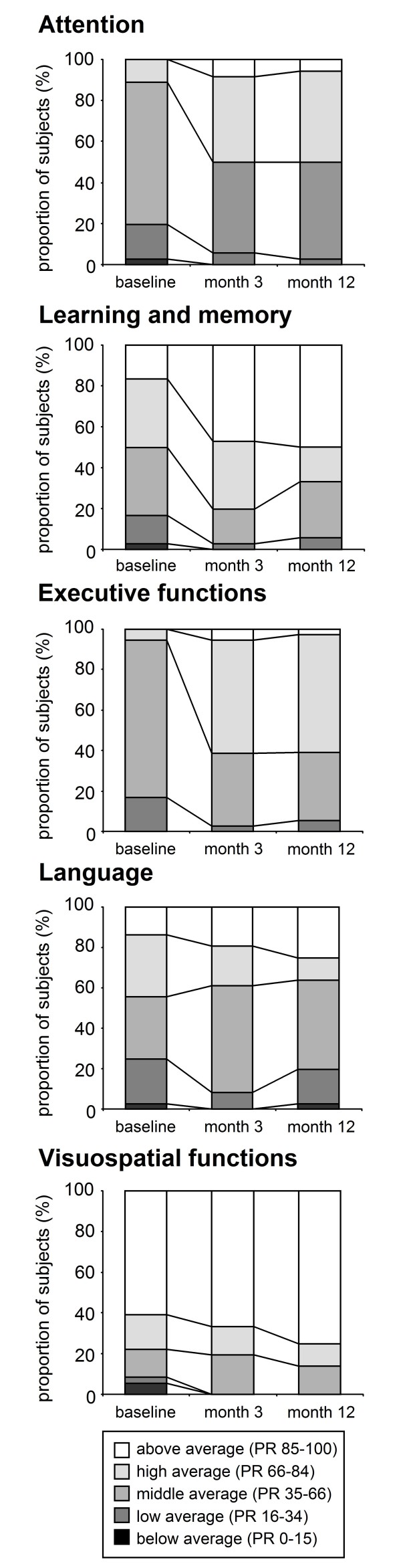
Magnitude of practice effects: development of clinical classification over 1 year. Clinical classification of baseline performance shows that cognitive performance is distributed across all categories (below- to above-average percentile ranks, PR) despite a high-IQ sample of healthy individuals. In all depicted cognitive domains, score gains lead to better clinical classification over time (selected time-points months 3 and 12 presented) without reaching upper limits for most subjects. Only in visuospatial functions, the majority of subjects achieved highest scores already at baseline with only modest subsequent changes, altogether pointing to a ceiling effect. Clinical classifications of individual performance are based on test-specific normative data and averaged by cognitive domains. For executive functions, normative data of RWT phonemic verbal fluency is unavailable. Data on motor tests are not presented due to insufficient normative data.

References

    1. Green MF. What are the functional consequences of neurocognitive deficits in schizophrenia? Am J Psychiatry. 1996;153:321–330. - PubMed
    1. Ritsner MS. Predicting quality of life impairment in chronic schizophrenia from cognitive variables. Qual Life Res. 2007;16:929–937. doi: 10.1007/s11136-007-9195-3. - DOI - PubMed
    1. Farias ST, Harrell E, Neumann C, Houtz A. The relationship between neuropsychological performance and daily functioning in individuals with Alzheimer's disease: ecological validity of neuropsychological tests. Arch Clin Neuropsychol. 2003;18:655–672. - PubMed
    1. Nys GM, van Zandvoort MJ, van der Worp HB, de Haan EH, de Kort PL, Jansen BP, Kappelle LJ. Early cognitive impairment predicts long-term depressive symptoms and quality of life after stroke. J Neurol Sci. 2006;247:149–156. doi: 10.1016/j.jns.2006.04.005. - DOI - PubMed
    1. McCaffrey RJ, Duff K, Westervelt HJ. Practitioner's guide to evaluating change with neuropsychological assessment instruments. New York: Kluwer Academic/Plenum Publishers; 2000.

Publication types

MeSH terms