Review
. 2010 Sep 21;56(13):1001-12.
doi: 10.1016/j.jacc.2010.03.083.

Iron overload cardiomyopathy: better understanding of an increasing disorder

Affiliations
Review

Iron overload cardiomyopathy: better understanding of an increasing disorder

Pradeep Gujja et al. J Am Coll Cardiol. .

Abstract

The prevalence of iron overload cardiomyopathy (IOC) is increasing. The spectrum of symptoms of IOC is varied. Early in the disease process, patients may be asymptomatic, whereas severely overloaded patients can have terminal heart failure complaints that are refractory to treatment. It has been shown that early recognition and intervention may alter outcomes. Biochemical markers and tissue biopsy, which have traditionally been used to diagnose and guide therapy, are not sensitive enough to detect early cardiac iron deposition. Newer diagnostic modalities such as magnetic resonance imaging are noninvasive and can assess quantitative cardiac iron load. Phlebotomy and chelating drugs are suboptimal means of treating IOC; hence, the roles of gene therapy, hepcidin, and calcium channel blockers are being actively investigated. There is a need for the development of clinical guidelines in order to improve the management of this emerging complex disease.


Figures

Figure 1
Figure 1. Iron Kinetics. Heme is absorbed by Heme carrier protein-1 (HCP-1) and released from iron by hemoxygenase-1 (HO-1), but heme uptake overall still remains controversial
Non heme iron is reduced by duodenal cytochrome b at the apical membrane of intestinal enterocytes (134), which is taken up by intestinal epithelium by the divalent metal transporter 1 (DMT1) (135,136). Ferrous iron is then transported to the basolateral portion of the cell by iron carriers and later transported into the circulation by the duodenal iron exporter Ferroportin (regulated by hepcidin) when there is a need for iron. Ferrous iron is oxidized by ceruloplasmin in non-intestinal cells and also by a homologue of ceruloplasmin, Hephaestin, in intestinal cells to ferric iron and loaded on to transferrin. With the increase in intracellular concentrations of iron, ferritin synthesis also increases. Once the storage capacity is exceeded, metabolically active iron is released intracellularly in the form of hemosiderin and toxic nontransferrin-bound forms of iron (NTBI).
Figure 2
Figure 2. Typical examples of T2* cardiac MRI imaging to assess both myocardial and liver iron overload are shown
T2* images were obtained by using the gradient echo sequence of cardiac MRI employing a 1.5 T scanner as reported by Anderson et al (67). The images captured at TE time of 5 ms are shown. T2* image of 45 year old with idiopathic cardiomyopathy (CM) shows no evidence of iron overload in the liver and heart (panel A; Heart T2*=39 ms; Liver T2*=27 ms). T2* image of 35 year old female with sickle cell anemia and a history of multiple transfusions shows iron overload in both the liver (arrowhead) and heart (arrows) (panel B; Heart T2*=12 ms; Liver T2*<2 ms). T2* image of a 45 year old male with hereditary hemachromatosis (HH) shows iron overload seen in the liver (arrowhead), but not heart (panel C; Heart T2*=30 ms; Liver T2*=2 ms). Please note that iron overloaded tissues appear darker in the images. (The images in this figure were provided by Andrew Arai, M.D., Branch of Cardiac Energetics, National Heart, Lung, and Blood Institute of the National Institutes of Health, Bethesda, MD).
Figure 3
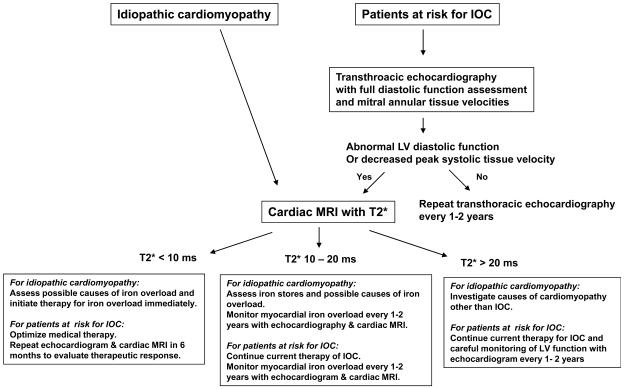
Figure 3. Our proposed clinical pathway to evaluate patients with idiopathic cardiomyopathy or those at risk for iron overload is shown
IOC=iron overload cardiomyopathy, LV=left ventricle.

References

    1. Liu P, Olivieri N. Iron overload cardiomyopathies: new insights into an old disease. Cardiovasc Drugs Ther. 1994;8:101–10. - PubMed
    1. Olivieri NF, Nathan DG, MacMillan JH, et al. Survival in medically treated patients with homozygous beta-thalassemia. N Engl J Med. 1994;331:574–8. - PubMed
    1. de Witte T. The role of iron in patients after bone marrow transplantation. Blood Rev. 2008;22(Suppl 2):S22–8. - PubMed
    1. Hahalis G, Alexopoulos D, Kremastinos DT, Zoumbos NC. Heart failure in beta-thalassemia syndromes: a decade of progress. Am J Med. 2005;118:957–67. - PubMed
    1. Pietrangelo A. Hereditary hemochromatosis--a new look at an old disease. N Engl J Med. 2004;350:2383–97. - PubMed

Publication types