


Structural and functional reorganization of the corpus callosum between the age of 6 and 8 years
- PMID: 20847151
- PMCID: PMC3077426
- DOI: 10.1093/cercor/bhq165
Structural and functional reorganization of the corpus callosum between the age of 6 and 8 years
Abstract
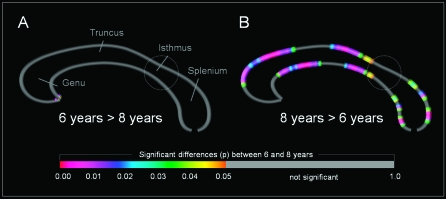
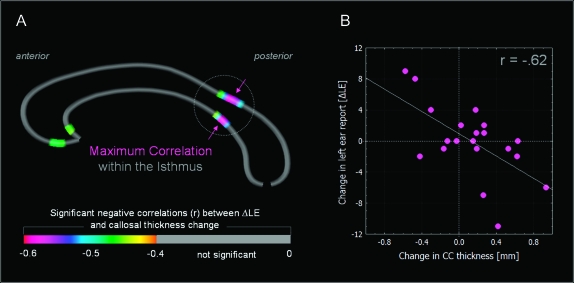
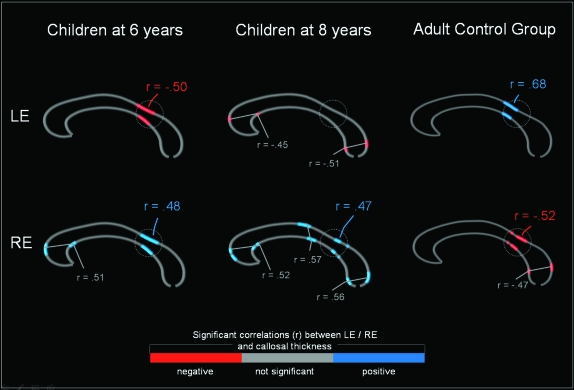
The establishment of an efficient exchange of information between the cerebral hemispheres is of crucial importance in the developing functionally lateralized brain. The corpus callosum, the major connection between the cerebral hemispheres, grows constantly throughout childhood and adolescence. However, behavioral studies suggest the existence of a critical time period for callosal functional development starting around the age of 6 years. In the present longitudinal study, examining a cohort of 20 children at the age of 6 and 8 years, we assessed the relationship between structural and functional callosal development during this time period. The structural development was quantified by calculating the increase in callosal thickness using a shape-based computational analysis of the mid-sagittal corpus callosum as obtained with magnetic resonance imaging. The functional development was assessed with a speech discrimination task based on the dichotic presentation of consonant-vowel syllables. The statistical analysis revealed that children whose callosal isthmus increased in thickness over the course of 2 years showed a decrease in interhemispheric information transfer. However, children exhibiting a decrease in isthmus thickness revealed an increase in information transfer. These results might indicate a refinement process of the callosal connections to optimize the neuronal communication between the developing cerebral hemispheres.
Figures
References
-
- Bamiou DE, Sisodiya S, Musiek FE, Luxon LM. The role of the interhemispheric pathway in hearing. Brain Res Rev. 2007;56:170–182. - PubMed
-
- Banich MT, Brown WS. A life-span perspective on interaction between the cerebral hemispheres. Dev Neuropsychol. 2000;18:1–10. - PubMed
-
- Banich MT, Passarotti AM, Janes D. Interhemispheric interaction during childhood: I. Neurologically intact children. Dev Neuropsychol. 2000;18:33–51. - PubMed
-
- Baynes K, Eliassen JC, Lutsep HL, Gazzaniga MS. Modular organization of cognitive systems masked by interhemispheric integration. Science. 1998;280:902–905. - PubMed
-
- Benavidez DA, Fletcher JM, Hannay HJ, Bland ST, Caudle SE, Mendelsohn DB, Yeakley J, Brunder DG, Harward H, Song J, et al. Corpus callosum damage and interhemispheric transfer of information following closed head injury in children 1196. Cortex. 1999;35:315–336. - PubMed
