Identification of FOXP1 deletions in three unrelated patients with mental retardation and significant speech and language deficits
- PMID: 20848658
- PMCID: PMC3049153
- DOI: 10.1002/humu.21362
Identification of FOXP1 deletions in three unrelated patients with mental retardation and significant speech and language deficits
Abstract
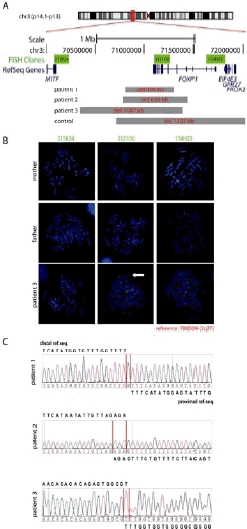
Mental retardation affects 2-3% of the population and shows a high heritability.Neurodevelopmental disorders that include pronounced impairment in language and speech skills occur less frequently. For most cases, the molecular basis of mental retardation with or without speech and language disorder is unknown due to the heterogeneity of underlying genetic factors.We have used molecular karyotyping on 1523 patients with mental retardation to detect copy number variations (CNVs) including deletions or duplications. These studies revealed three heterozygous overlapping deletions solely affecting the forkhead box P1 (FOXP1) gene. All three patients had moderate mental retardation and significant language and speech deficits. Since our results are consistent with a de novo occurrence of these deletions, we considered them as causal although we detected a single large deletion including FOXP1 and additional genes in 4104 ancestrally matched controls. These findings are of interest with regard to the structural and functional relationship between FOXP1 and FOXP2. Mutations in FOXP2 have been previously related to monogenic cases of developmental verbal dyspraxia. Both FOXP1 and FOXP2 are expressed in songbird and human brain regions that are important for the developmental processes that culminate in speech and language.
©2010 Wiley-Liss, Inc.
Figures
References
-
- Berkel S, Marshall CR, Weiss B, Howe J, Roeth R, Moog U, Endris V, Roberts W, Szatmari P, Pinto D. Mutations in the SHANK2 synaptic scaffolding gene in autism spectrum disorder and mental retardation. Nat Genet. 2010;42:489–491. - PubMed
-
- Carlsson P, Mahlapuu M. Forkhead transcription factors: key players in development and metabolism. Dev Biol. 2002;250:1–23. - PubMed
-
- Dasen JS, De Camilli A, Wang B, Tucker PW, Jessell TM. Hox repertoires for motor neuron diversity and connectivity gated by a single accessory factor, FoxP1. Cell. 2008;134:304–316. - PubMed
-
- Feuk L, Carson AR, Scherer SW. Structural variation in the human genome. Nat Rev Genet. 2006a;7:85–97. - PubMed
Publication types
MeSH terms
Substances
Grants and funding
LinkOut - more resources
Full Text Sources
Medical
Molecular Biology Databases