


A prospective examination of the role of childhood sexual abuse and physiological asymmetry in the development of psychopathology
- PMID: 20850183
- PMCID: PMC2962453
- DOI: 10.1016/j.chiabu.2010.02.010
A prospective examination of the role of childhood sexual abuse and physiological asymmetry in the development of psychopathology
Abstract
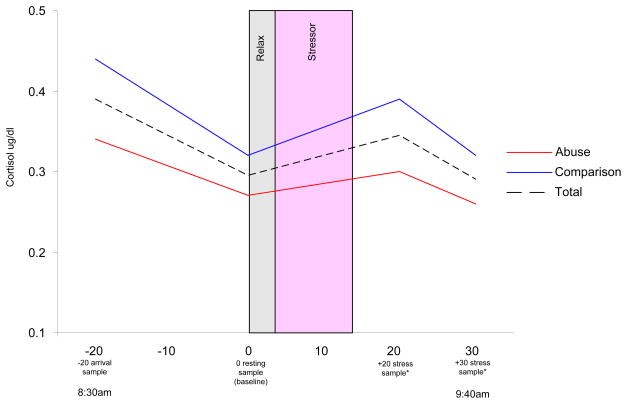
Objective: Recent literature has emphasized the simultaneous assessment of multiple physiological stress response systems in an effort to identify biobehavioral risk factors of psychopathology in maltreated populations. The current study assessed whether an asymmetrical stress response, marked by activation in one system and a blunted response in another system, predicted higher levels of psychopathology over time.
Methods: Data were collected from an ongoing, prospective study of females with a substantiated history of childhood sexual abuse (n=52) and a non-abused comparison group (n=77). Childhood sexual abuse was determined at the initial study visit. Vagal tone and cortisol were measured 7 years later to assess physiological response to a laboratory stressor across these systems. Depressive symptoms and antisocial behaviors were assessed 6 years after the completion of the laboratory stressor.
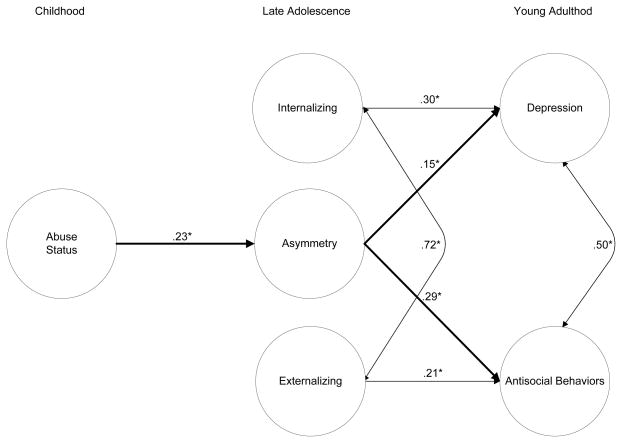
Results: Structural equation modeling indicated that a prior history of childhood sexual abuse predicted an asymmetrical physiological response to stress in late adolescence. In turn, this asymmetrical response predicted both higher levels of depression and antisocial behaviors in young adulthood.
Conclusions: Childhood sexual abuse may sensitize females to respond to moderate daily stressors in a manner that places them at higher risk for experiencing depressive symptoms and antisocial behaviors over time.
Practice implications: The management of mild to moderate stress in the everyday lives of maltreated females may be a particularly useful point of intervention in order to protect against later psychopathology.
Copyright © 2010 Elsevier Ltd. All rights reserved.
Figures
References
-
- Achenbach T. Manual for the youth self-report and 1991 profile. Burlington, VT: University of Vermont; 1991.
-
- American Psychiatric Association. Diagnostic and statistical manual of mental disorders. 4. Washington, DC: American Psychiatric Press; 1994.
-
- Bauer AM, Quas JA, Boyce WT. Associations between physiological reactivity and children’s behavior: Advantages of a multisystem approach. Journal of Developmental & Behavioral Pediatrics. 2002;23(2):102–113. - PubMed
-
- Beck AT, Steer RA, Ball R, Ranieri WF. Comparison of Beck Depression Inventories-IA and -II in Psychiatric Outpatients. Journal of Personality Assessment. 1996;67(3):588. - PubMed
-
- Beck AT, Steer RA, Brown GK. Manual for the Beck Depression Inventory-II. San Antonio, TX: Psychological Corporation; 1996.
Publication types
MeSH terms
Substances
Grants and funding
LinkOut - more resources
Full Text Sources
Medical
