


The effects of acupuncture on the brain networks for emotion and cognition: an observation of gender differences
- PMID: 20851113
- PMCID: PMC3784241
- DOI: 10.1016/j.brainres.2010.09.040
The effects of acupuncture on the brain networks for emotion and cognition: an observation of gender differences
Abstract
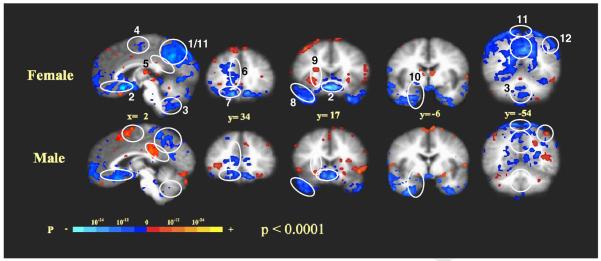
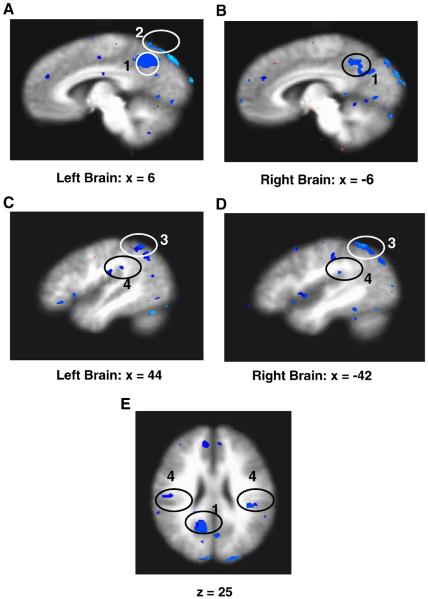
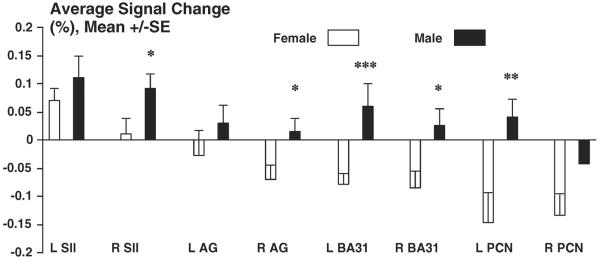
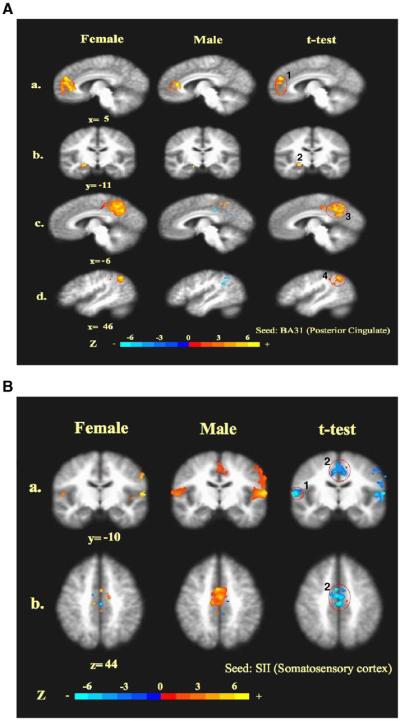
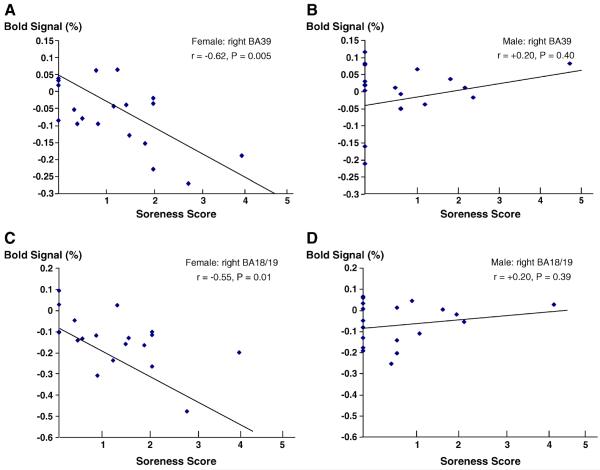
Acupuncture modulates brain activity at the limbic-paralimbic-neocortical network (LPNN) and the default mode network (DMN). Since these brain networks show gender differences when mediating emotional and cognitive tasks, we thus hypothesize that women and men may also respond differently to acupuncture procedure at these brain regions. In order to test this hypothesis, we retrieved the data of 38 subjects, 19 females and 19 males, who had brain fMRI during acupuncture from previous studies and reanalyzed them based on sex status. Deactivation at the LPNN/DMN during needle manipulation of acupuncture was more extensive in females than in males, particularly in the posterior cingulate (BA31), precuneus (BA7m) and angular gyrus (BA39). The functional correlations between the right BA31 and pregenual cingulate (BA32), hippocampus or contralateral BA31 were significantly stronger in females than in males. The angular gyrus (BA39) was functionally correlated with BA31 in females; in contrast, it was anticorrelated with BA31 in males. Soreness, a major component of the psychophysical responses to needle manipulation, deqi, was correlated in intensity with deactivation of the angular gyrus in females; no such relationships were observed in males. In contrast to lesser deactivation at the LPNN/DMN networks, needle manipulation during acupuncture induced greater activation at the secondary somatosensory cortex and stronger functional connectivity with the anterior-middle cingulate (BA32/24) in males than in females. Our study suggests that brains with sex dimorphism may process the acupuncture stimulation differently between women and men.
Copyright © 2010 Elsevier B.V. All rights reserved.
Figures
References
-
- Ben-Arye E, Karkabi S, Shapira C, Schiff E, Lavie O, Keshet Y. Complementary medicine in the primary care setting: results of a survey of gender and cultural patterns in Israel. Gend. Med. 2009;6:384–397. - PubMed
-
- Cox RW. AFNI: software for analysis and visualization of functional magnetic resonance neuroimages. Comput. Biomed. Res. 1996;29:162–173. - PubMed
-
- Dahan A, Kest B, Waxman AR, Sarton E. Sex-specific responses to opiates: animal and human studies. Anesth. Analg. 2008;107:83–95. - PubMed
-
- Goldstein JM, Jerram M, Poldrack R, Anagnoson R, Breiter HC, Makris N, Goodman JM, Tsuang MT, Seidman LJ. Sex differences in prefrontal cortical brain activity during fMRI of auditory verbal working memory. Neuropsychology. 2005;19:509–519. - PubMed
-
- Gur RC, Mozley LH, Mozley PD, Resnick SM, Karp JS, Alavi A, Arnold SE, Gur RE. Sex differences in regional cerebral glucose metabolism during a resting state. Science. 1995;267:528–531. - PubMed
Publication types
MeSH terms
Grants and funding
- NS 34189./NS/NINDS NIH HHS/United States
- 1-P01-002048-01/PHS HHS/United States
- K23 AG022476/AG/NIA NIH HHS/United States
- K01 AT003883/AT/NCCIH NIH HHS/United States
- P30 AG013846/AG/NIA NIH HHS/United States
- P41 RR014075/RR/NCRR NIH HHS/United States
- R21AT004497/AT/NCCIH NIH HHS/United States
- K23AG-022476/AG/NIA NIH HHS/United States
- R21 AT000978/AT/NCCIH NIH HHS/United States
- R21AT00978/AT/NCCIH NIH HHS/United States
- R21 AT004497/AT/NCCIH NIH HHS/United States
- P41RR14075/RR/NCRR NIH HHS/United States
- R01 NS034189/NS/NINDS NIH HHS/United States
LinkOut - more resources
Full Text Sources
Medical
