


Family factors are associated with psychological distress and smoking status in chronic obstructive pulmonary disease
- PMID: 20851269
- PMCID: PMC2943490
- DOI: 10.1016/j.genhosppsych.2010.06.007
Family factors are associated with psychological distress and smoking status in chronic obstructive pulmonary disease
Abstract
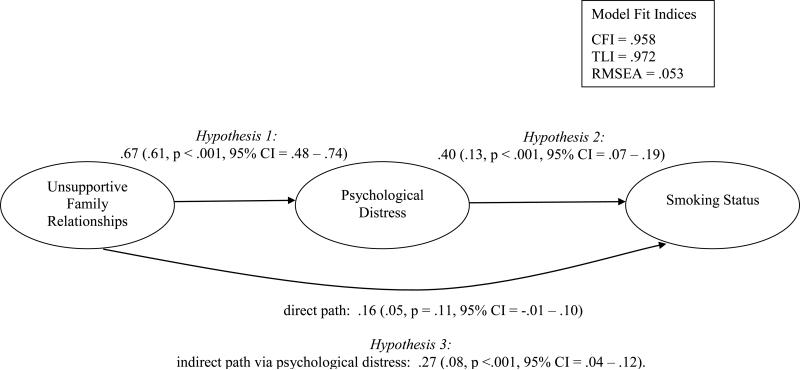
Objective: The objective of this study was to test three hypotheses in a sample of individuals with chronic obstructive pulmonary disease (COPD): (1) unsupportive family relationships are associated with psychological distress, (2) psychological distress is associated with smoking status and (3) unsupportive family relationships are indirectly associated with smoking status via psychological distress.
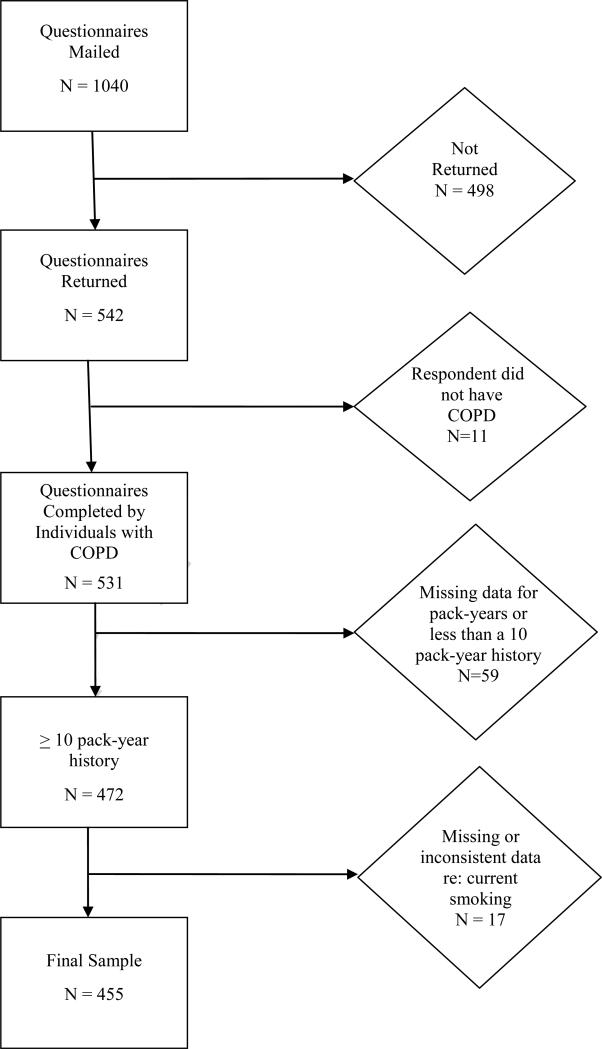
Method: Cross-sectional data were collected via self-report questionnaires completed by 455 individuals with COPD who had at least a 10-pack-year smoking history. The hypotheses were tested with structural equation modeling.
Results: All three hypotheses were supported. Unsupportive family relationships were associated with psychological distress (β=.67, P<.001), psychological distress was associated with smoking status (β=.40, P<.001), and unsupportive family relationships were indirectly associated with smoking status via psychological distress (β=.27, P<.001).
Conclusion: Results of this study suggest that family relationships are an important factor to include in future longitudinal research that attempts to elucidate social and psychological influences on smoking behavior.
Copyright © 2010 Elsevier Inc. All rights reserved.
Figures
References
-
- Clini E, Costi S, Lodi S, Rossi G. Non-pharmacological treatment for chronic obstructive pulmonary disease. Medical Science Monitor. 2003;9(12):RA300–5. - PubMed
-
- Rennard SI. Treatment of stable chronic obstructive pulmonary disease. Lancet. 2004;364(9436):791–802. - PubMed
-
- Nides MA, Rakos RF, Gonzales D, et al. Predictors of initial smoking cessation and relapse through the first 2 years of the Lung Health Study. J Consult Clin Psychol. 1995;63(1):60–9. - PubMed
-
- Gulliver SB, Hughes JR, Solomon LJ, Dey AN. An investigation of self-efficacy, partner support and daily stresses as predictors of relapse to smoking in self-quitters. Addiction. 1995;90(6):767–72. - PubMed
-
- Key JD, Marsh LD, Carter CL, Malcolm RJ, Sinha D. Family-focused smoking cessation:enhanced efficacy by the addition of partner support and group therapy. Subst Abus. 2004;25(1):37–41. - PubMed
Publication types
MeSH terms
Grants and funding
LinkOut - more resources
Full Text Sources
Medical
