


Cardioprotective PKG-independent NO signaling at reperfusion
- PMID: 20852051
- PMCID: PMC3006290
- DOI: 10.1152/ajpheart.00527.2010
Cardioprotective PKG-independent NO signaling at reperfusion
Abstract
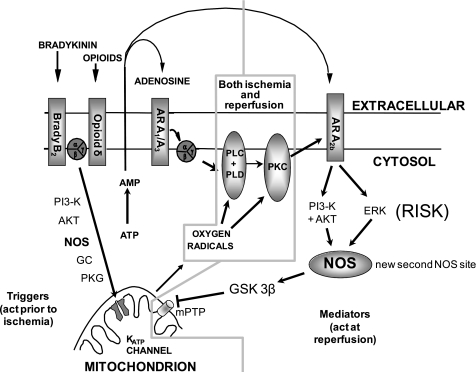
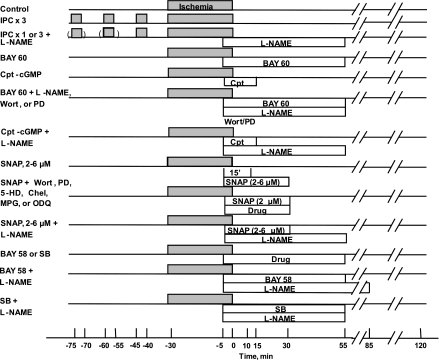
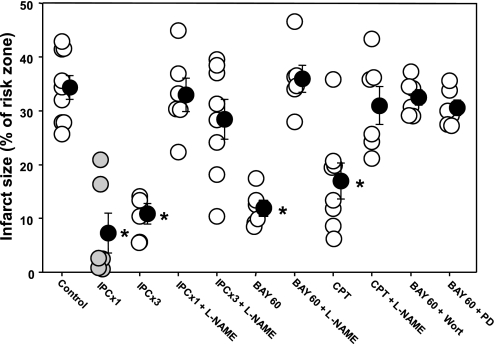
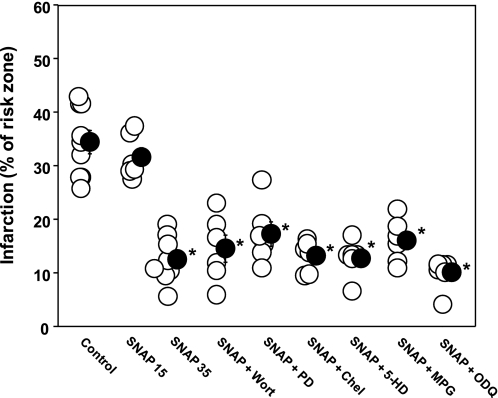
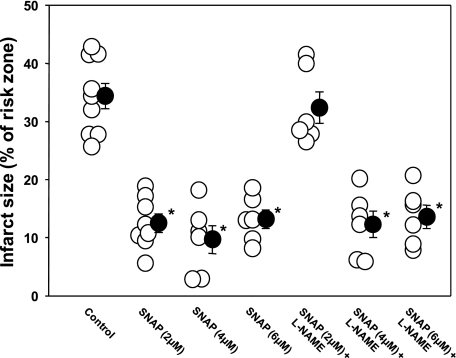
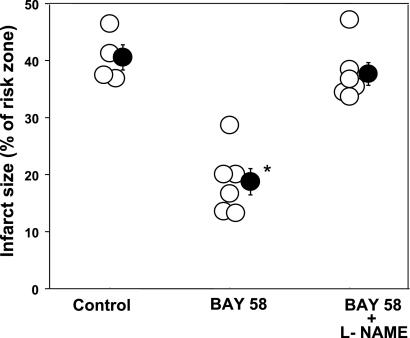
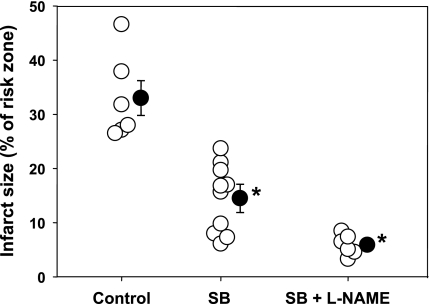
Cell models of ischemic preconditioning (IPC) indicate nitric oxide (NO) is involved in protection accruing during reoxygenation but disagree whether it acts through PKG. Using a more relevant intact heart model, we studied isolated rabbit hearts subjected to 30-min coronary artery occlusion/120-min reperfusion. We previously found protection from PKG activator 8-(4-chlorophenylthio)-guanosine 3',5'-cyclic monophosphate (CPT-cGMP) at reperfusion was blocked by A(2b) adenosine receptor (A(2b)AR), ERK, or phosphatidylinositol 3-kinase (PI3-kinase) blockers. In this investigation A(2b)AR agonist BAY 60-6583 or CPT-cGMP at reperfusion reduced infarction comparably to IPC. Their protection was abrogated by N(ω)-nitro-l-arginine methyl ester (l-NAME), suggesting a PKG-independent NO synthase in IPC's mediator pathway downstream of PKG and A(2b)AR. NO donor S-nitroso-N-acetyl-d,l-penicillamine (SNAP) at reperfusion also protected. This protection was not blocked by PI3-kinase inhibitor wortmannin or ERK antagonist PD-98059, suggesting NO acted downstream of these kinases. Protection from SNAP was not affected by mitochondrial ATP-sensitive K(+) channel closer 5-hydroxydecanoate, PKC antagonist chelerythrine, reactive oxygen species scavenger N-2-mercaptopropionylglycine, or soluble guanylyl cyclase antagonist 1H-[1,2,4]oxadiazolo[4,3-a]quinoxalin-1-one (ODQ). Absence of ODQ effect indicated NO was acting independently of PKG. BAY 58-2667, a soluble guanylyl cyclase activator, was protective, and l-NAME blocked its infarct-sparing effect, indicating a second signaling event dependent on NO generation but independent of PKG. SB216763, a blocker of glycogen synthase kinase-3β (GSK-3β), decreased infarct size, and its infarct-sparing effect was not affected by l-NAME, suggesting GSK-3β acted downstream or independently of NO. Hence, NO signaling occurs in IPC's mediator pathway downstream of Akt and ERK, and its protection is independent of PKG.
Figures
References
-
- Barouch LA, Harrison RW, Skaf MW, Rosas GO, Cappola TP, Kobeissi ZA, Hobai IA, Lemmon CA, Burnett AL, O'Rourke B, Rodriguez ER, Huang PL, Lima JAC, Berkowitz DE, Hare JM. Nitric oxide regulates the heart by spatial confinement of nitric oxide synthase isoforms. Nature 416: 337–340, 2002 - PubMed
-
- Bell RM, Yellon DM. Atorvastatin, administered at the onset of reperfusion, and independent of lipid lowering, protects the myocardium by up-regulating a pro-survival pathway. J Am Coll Cardiol 41: 508–515, 2003 - PubMed
-
- Bell RM, Yellon DM. The contribution of endothelial nitric oxide synthase to early ischaemic preconditioning: the lowering of the preconditioning threshold. An investigation in eNOS knockout mice. Cardiovasc Res 52: 274–280, 2001 - PubMed
-
- Burley DS, Baxter GF. B-type natriuretic peptide at early reperfusion limits infarct size in the rat isolated heart. Basic Res Cardiol 102: 529–541, 2007 - PubMed
-
- Burwell LS, Brookes PS. Mitochondria as a target for the cardioprotective effects of nitric oxide in ischemia-reperfusion injury. Antioxid Redox Signal 10: 579–599, 2008 - PubMed
Publication types
MeSH terms
Substances
Grants and funding
LinkOut - more resources
Full Text Sources
Other Literature Sources
Medical
Research Materials
Miscellaneous
