


Absence of branches from xylan in Arabidopsis gux mutants reveals potential for simplification of lignocellulosic biomass
- PMID: 20852069
- PMCID: PMC2951434
- DOI: 10.1073/pnas.1005456107
Absence of branches from xylan in Arabidopsis gux mutants reveals potential for simplification of lignocellulosic biomass
Abstract
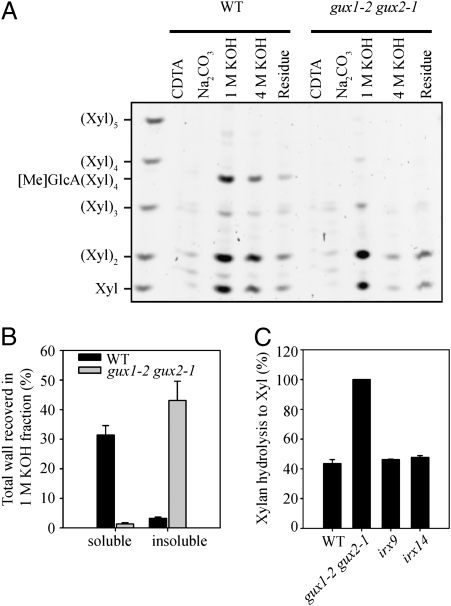
As one of the most abundant polysaccharides on Earth, xylan will provide more than a third of the sugars for lignocellulosic biofuel production when using grass or hardwood feedstocks. Xylan is characterized by a linear β(1,4)-linked backbone of xylosyl residues substituted by glucuronic acid, 4-O-methylglucuronic acid or arabinose, depending on plant species and cell types. The biological role of these decorations is unclear, but they have a major influence on the properties of the polysaccharide. Despite the recent isolation of several mutants with reduced backbone, the mechanisms of xylan synthesis and substitution are unclear. We identified two Golgi-localized putative glycosyltransferases, GlucUronic acid substitution of Xylan (GUX)-1 and GUX2 that are required for the addition of both glucuronic acid and 4-O-methylglucuronic acid branches to xylan in Arabidopsis stem cell walls. The gux1 gux2 double mutants show loss of xylan glucuronyltransferase activity and lack almost all detectable xylan substitution. Unexpectedly, they show no change in xylan backbone quantity, indicating that backbone synthesis and substitution can be uncoupled. Although the stems are weakened, the xylem vessels are not collapsed, and the plants grow to normal size. The xylan in these plants shows improved extractability from the cell wall, is composed of a single monosaccharide, and requires fewer enzymes for complete hydrolysis. These findings have implications for our understanding of the synthesis and function of xylan in plants. The results also demonstrate the potential for manipulating and simplifying the structure of xylan to improve the properties of lignocellulose for bioenergy and other uses.
Conflict of interest statement
Conflict of interest statement: The authors declare that a related patent application has been filed.
Figures


References
-
- Ebringerova A, Heinze T. Xylan and xylan derivatives—biopolymers with valuable properties, 1—naturally occurring xylans structures, procedures and properties. Macromol Rapid Commun. 2000;21:542–556.
-
- Watanabe T, Koshijima T. Evidence for an ester linkage between lignin and glucuronic-acid in lignin carbohydrate complexes by ddq-oxidation. Agric Biol Chem. 1988;52:2953–2955.
-
- Fry SC. Cross-linking of matrix polymers in the growing cell-walls of angiosperms. Annu Rev Plant Physiol Plant Mol Biol. 1986;37:165–186.
-
- US Department of Energy Breaking the biological barriers to cellulosic ethanol: A joint research agenda (US Department of Energy, Washington, DC) 2006
-
- Marquart L. Whole Grains and Health. 1st Ed. Ames: Blackwell; 2007. p. xvi.
Publication types
MeSH terms
Substances
Grants and funding
- BB/C505632/1/BB_/Biotechnology and Biological Sciences Research Council/United Kingdom
- BB/C511064/1/BB_/Biotechnology and Biological Sciences Research Council/United Kingdom
- BB/C507561/1/BB_/Biotechnology and Biological Sciences Research Council/United Kingdom
- BBS/B/10684/BB_/Biotechnology and Biological Sciences Research Council/United Kingdom
- BB/D010446/1/BB_/Biotechnology and Biological Sciences Research Council/United Kingdom
LinkOut - more resources
Full Text Sources
Molecular Biology Databases
Research Materials
