


Mortality in COPD: causes, risk factors, and prevention
- PMID: 20854053
- PMCID: PMC7273182
- DOI: 10.3109/15412555.2010.510160
Mortality in COPD: causes, risk factors, and prevention
Abstract
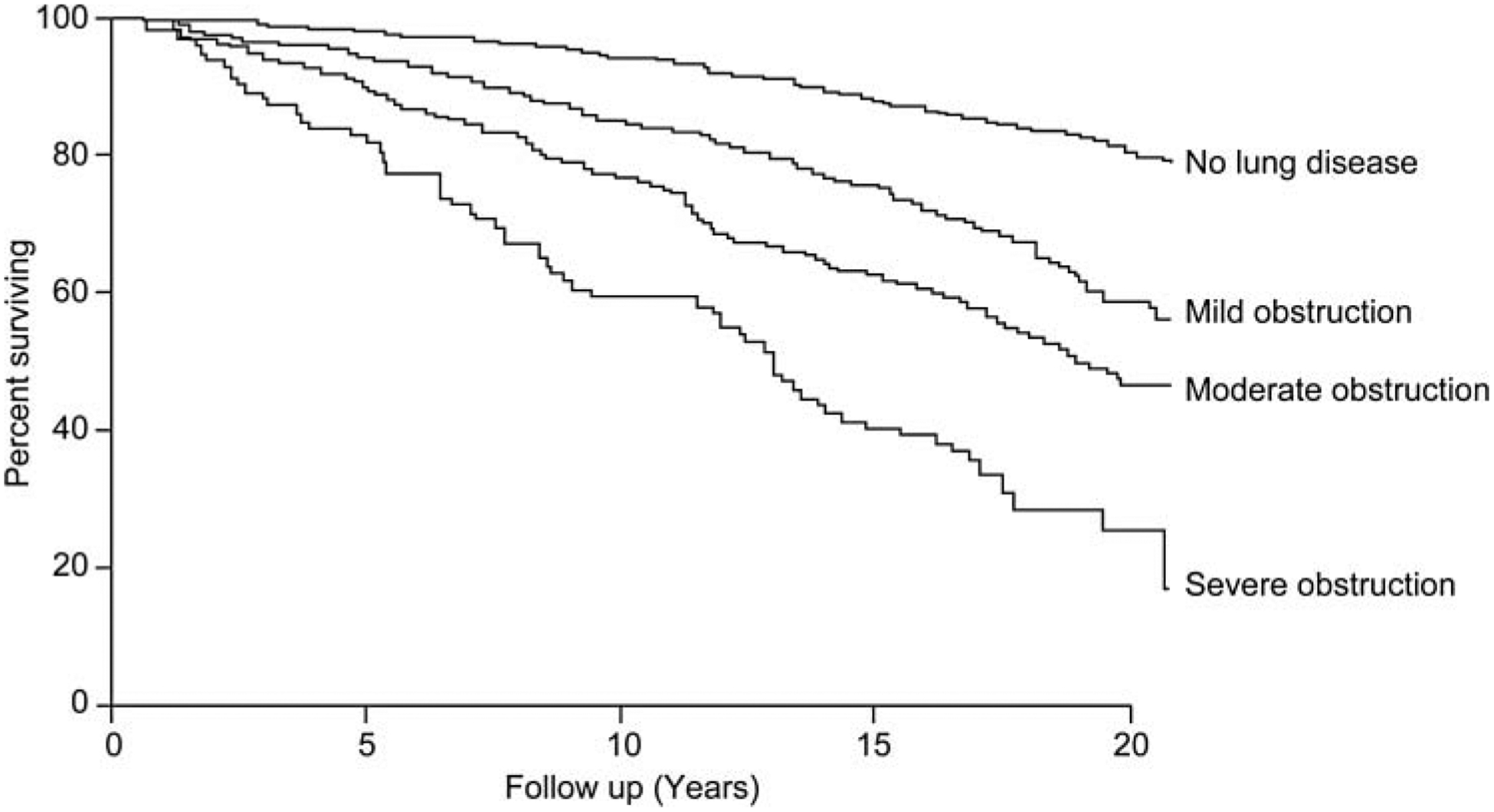
Chronic obstructive pulmonary disease (COPD) is a leading and increasing cause of death, the extent of which is underestimated as a consequence of underdiagnosis and underreporting on death certificates. Data from large trials, such as the Lung Health Study, Towards a Revolution in COPD Health (TORCH), Understanding Potential Long-term Impacts on Function with Tiotropium (UPLIFT), European Respiratory Society Study on Chronic Obstructive Pulmonary Disease (EUROSCOP), and Inhaled Steroids in Obstructive Lung Disease (ISOLDE), have shown that the causes of death in patients with mild COPD are predominantly cancer and cardiovascular disease, but as COPD severity increases, deaths due to non-malignant respiratory disease are increasingly common. In practice, mortality of patients with COPD can be predicted by a variety of measures including: forced expiratory volume in one second (FEV(1)), the ratio of inspiratory and total lung capacities, exercise capacity, dyspnea scores, and composite indices such as the body-mass index (B), degree of airflow obstruction (O), degree of functional dyspnea (D), and exercise capacity (E) (BODE) index. Smoking cessation improves survival in COPD patients, and in select patients with advanced disease, oxygen therapy, lung volume reduction surgery, or lung transplantation may also improve survival.
Conflict of interest statement
Declaration of interests
Dr. Cristine Berry has no conflicts of interest to declare. Dr Robert Wise has served as a paid consultant for AstraZeneca, Boehringer-Ingelheim Pharmaceuticals, Inc., Emphasys Medical (now part of Pulmonx Inc.), GlaxoSmithKline, Mpex Pharmaceuticals, Novartis Pharmaceuticals Corporation, Pfizer, Inc., Schering-Plough (now part of Merck), and Spiration, Inc. He has received research funding from Boehringer-Ingelheim Pharmaceuticals, Inc. and GlaxoSmithKline. The authors are responsible for the content and writing of this paper.
Figures
References
-
- National Institutes of Health. National Heart, Lung, and Blood Institute (NHLBI). Morbidity and mortality: 2009 chartbook on cardiovascular, lung, and blood diseases. 2009 October 2009.
-
- Murray CJ, Lopez AD. Alternative projections of mortality and disability by cause 1990–2020: Global Burden of Disease Study. Lancet 1997. May 24; 349(9064):1498–504. - PubMed
-
- Jemal A, Ward E, Hao Y, Thun M. Trends in the leading causes of death in the United States, 1970–2002. JAMA 2005. September 14; 294(10):1255–9. - PubMed
-
- Sin DD, Anthonisen NR, Soriano JB, Agusti AG. Mortality in COPD: Role of co-morbidities. Eur Respir J 2006. December;28(6):1245–57. - PubMed
-
- Mannino DM, Homa DM, Akinbami LJ, Ford ES, Redd SC. Chronic obstructive pulmonary disease surveillance—United States, 1971–2000. MMWR Surveill Summ 2002. August 2;51(6):1–16. - PubMed
Publication types
MeSH terms
Grants and funding
LinkOut - more resources
Full Text Sources
Medical
