


Mature chief cells are cryptic progenitors for metaplasia in the stomach
- PMID: 20854822
- PMCID: PMC2997152
- DOI: 10.1053/j.gastro.2010.09.005
Mature chief cells are cryptic progenitors for metaplasia in the stomach
Abstract
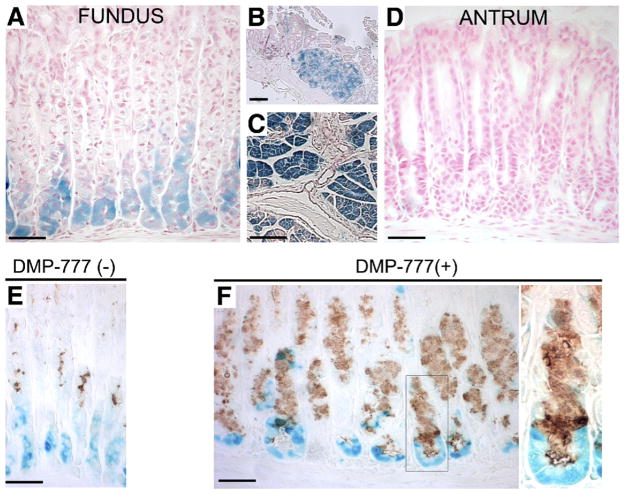
Background & aims: Gastric cancer evolves in the setting of a pathologic mucosal milieu characterized by both loss of acid-secreting parietal cells and mucous cell metaplasias. Indeed, mucous cell metaplasia is considered the critical preneoplastic lesion for gastric cancer. Previous investigations have shown that infection of mice with Helicobacter felis or induction of acute parietal cell loss with the drug DMP-777 leads to the emergence of a type of metaplasia designated spasmolytic polypeptide-expressing metaplasia (SPEM). We have hypothesized that SPEM arises from proliferating cells in gland bases, either from a cryptic progenitor cell or by transdifferentiation of mature chief cells.
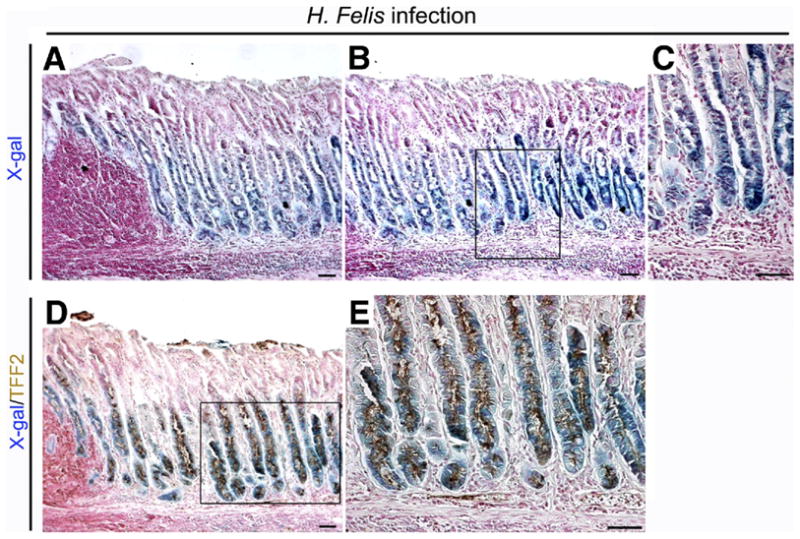
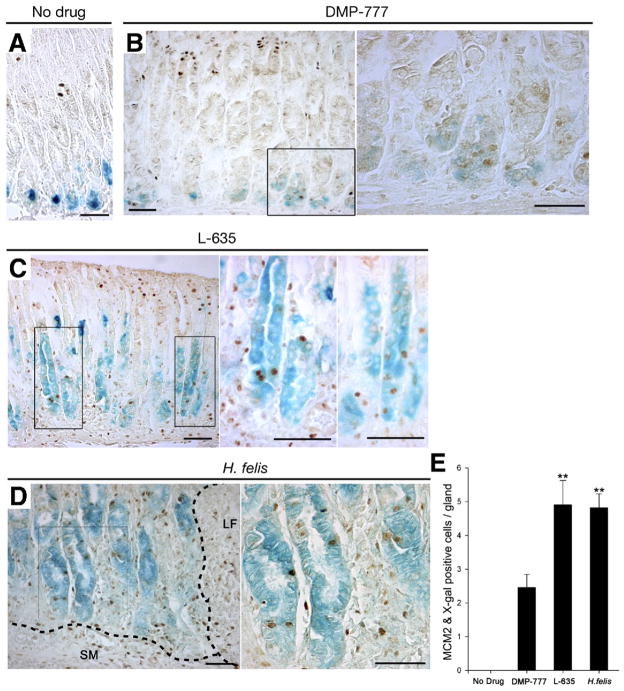
Methods: Taking advantage of the chief cell-restricted expression of Mist1-Cre-ER(T2), we used lineage mapping to examine whether SPEM lineages were derived from chief cells in 3 independent models of induction by DMP-777 treatment, L-635 treatment, or H felis infection.
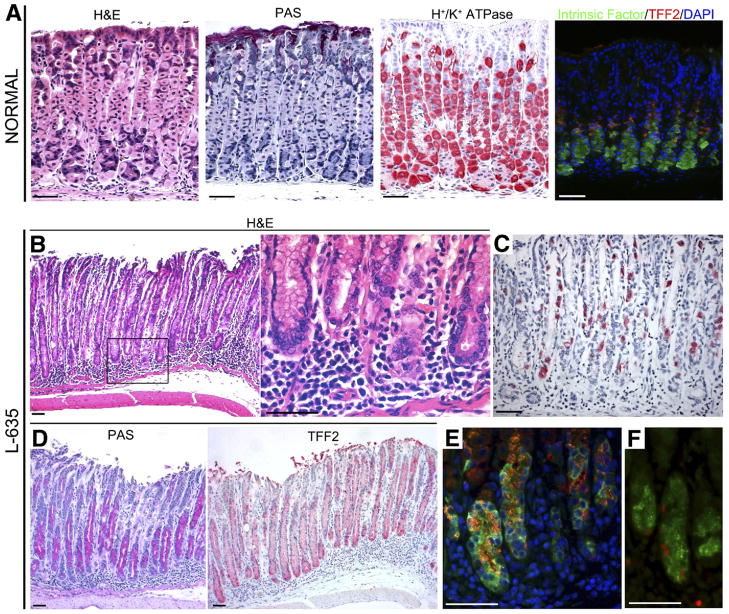
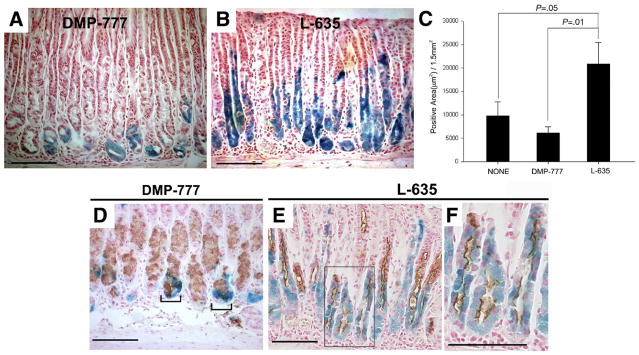
Results: Treatment of mice with L-635 for 3 days led to rapid parietal cell loss, induction of a prominent inflammatory infiltrate, and emergence of SPEM. In all 3 models, SPEM developed, at least in part, from transdifferentiation of chief cells. We further found that acute parietal cell loss in the setting of inflammation (L-635 treatment) led to more rapid induction and expansion of SPEM derived from transdifferentiation of chief cells.
Conclusions: These studies provide direct evidence by lineage tracing that SPEM evolves from differentiated chief cells. Thus, mature gastric chief cells have the ability to act as cryptic progenitors and reacquire proliferative capacity within the context of mucosal injury and inflammation.
Copyright © 2010 AGA Institute. Published by Elsevier Inc. All rights reserved.
Conflict of interest statement
Conflicts of interest
The authors disclose no conflicts.
Figures
References
-
- Karam SM, Leblond CP. Dynamics of epithelial cells in the corpus of the mouse stomach. I. Identification of proliferative cell types and pinpointing of the stem cell. Anat Rec. 1993;236:259–279. - PubMed
-
- Karam SM, Leblond CP. Dynamics of epithelial cells in the corpus of the mouse stomach. III. Inward migration of neck cells followed by progressive transformation into zymogenic cells. Anat Rec. 1993;236:297–313. - PubMed
-
- Correa P. A human model of gastric carcinogenesis. Cancer Res. 1988;48:3554–3560. - PubMed
-
- Schmidt PH, Lee JR, Joshi V, et al. Identification of a metaplastic cell lineage associated with human gastric adenocarcinoma. Lab Invest. 1999;79:639–646. - PubMed
Publication types
MeSH terms
Substances
Grants and funding
- R01 DK048370/DK/NIDDK NIH HHS/United States
- R01 DK58587/DK/NIDDK NIH HHS/United States
- R01 CA077955/CA/NCI NIH HHS/United States
- R01 DK071590/DK/NIDDK NIH HHS/United States
- P30 DK058404/DK/NIDDK NIH HHS/United States
- R01 DK079798/DK/NIDDK NIH HHS/United States
- R01 DK55489/DK/NIDDK NIH HHS/United States
- R01 CA124586/CA/NCI NIH HHS/United States
- R01 DK058587/DK/NIDDK NIH HHS/United States
- R01 CA77955/CA/NCI NIH HHS/United States
- R01 DK043405/DK/NIDDK NIH HHS/United States
- P01 CA116087/CA/NCI NIH HHS/United States
- R01 DK055489/DK/NIDDK NIH HHS/United States
LinkOut - more resources
Full Text Sources
Medical
Molecular Biology Databases
