


Intellectual impairment in school-age children exposed to manganese from drinking water
- PMID: 20855239
- PMCID: PMC3018493
- DOI: 10.1289/ehp.1002321
Intellectual impairment in school-age children exposed to manganese from drinking water
Abstract
Background: Manganese is an essential nutrient, but in excess it can be a potent neurotoxicant. Despite the common occurrence of manganese in groundwater, the risks associated with this source of exposure are largely unknown.
Objectives: Our first aim was to assess the relations between exposure to manganese from drinking water and children's intelligence quotient (IQ). Second, we examined the relations between manganese exposures from water consumption and from the diet with children's hair manganese concentration.
Methods: This cross-sectional study included 362 children 6-13 years of age living in communities supplied by groundwater. Manganese concentration was measured in home tap water (MnW) and children's hair (MnH). We estimated manganese intake from water ingestion and the diet using a food frequency questionnaire and assessed IQ with the Wechsler Abbreviated Scale of Intelligence.
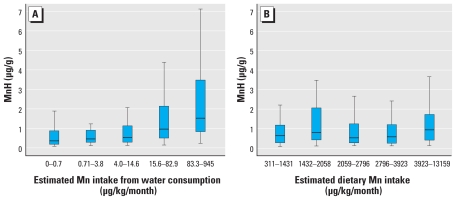
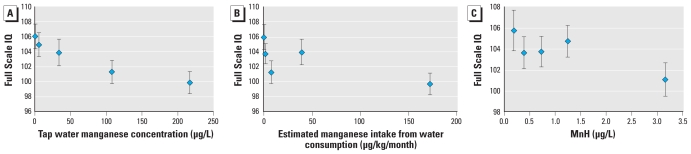
Results: The median MnW in children's home tap water was 34 µg/L (range, 1-2,700 µg/L). MnH increased with manganese intake from water consumption, but not with dietary manganese intake. Higher MnW and MnH were significantly associated with lower IQ scores. A 10-fold increase in MnW was associated with a decrease of 2.4 IQ points (95% confidence interval: -3.9 to -0.9; p < 0.01), adjusting for maternal intelligence, family income, and other potential confounders. There was a 6.2-point difference in IQ between children in the lowest and highest MnW quintiles. MnW was more strongly associated with Performance IQ than Verbal IQ.
Conclusions: The findings of this cross-sectional study suggest that exposure to manganese at levels common in groundwater is associated with intellectual impairment in children.
Figures
Comment in
-
Manganese in drinking water and intellectual impairment in school-age children.Environ Health Perspect. 2011 Jun;119(6):A240-1; author reply A241. doi: 10.1289/ehp.1103485. Environ Health Perspect. 2011. PMID: 21628122 Free PMC article. No abstract available.
References
-
- Agusa T, Kunito T, Fujihara J, Kubota R, Minh TB, Kim Trang PT, et al. Contamination by arsenic and other trace elements in tube-well water and its risk assessment to humans in Hanoi, Vietnam. Environ Pollut. 2006;139:95–106. - PubMed
-
- Aschner M. Manganese in the shower: mere speculation over an invalidated public health danger. Med Hypotheses. 2006;66:200–201. - PubMed
-
- Beck AT, Steer RA, Brown GK. Manual for Beck Depression Inventory. 2nd ed. San Antonio, TX: Psychological Corporation; 1996. (BDI-II)
-
- Bellinger DC. Lead neurotoxicity in children: decomposing the variability in dose-effect relationships. Am J Ind Med. 2007;50:720–728. - PubMed
Publication types
MeSH terms
Substances
Grants and funding
LinkOut - more resources
Full Text Sources
Other Literature Sources
Miscellaneous