


Hominin diversity in the Middle Pliocene of eastern Africa: the maxilla of KNM-WT 40000
- PMID: 20855311
- PMCID: PMC2981955
- DOI: 10.1098/rstb.2010.0042
Hominin diversity in the Middle Pliocene of eastern Africa: the maxilla of KNM-WT 40000
Abstract
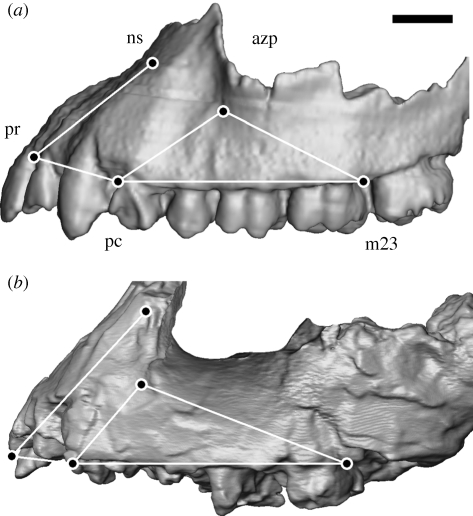
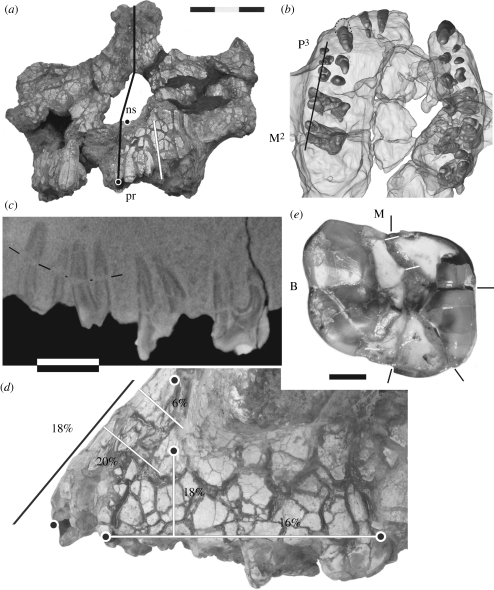
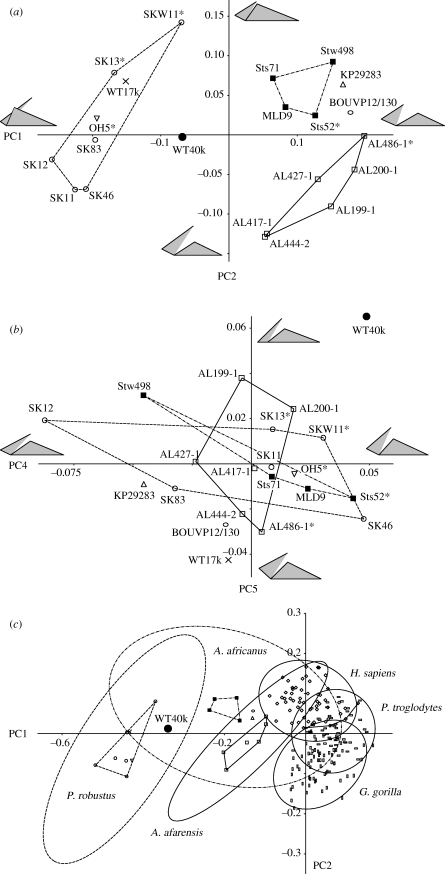
The 3.5-Myr-old hominin cranium KNM-WT 40000 from Lomekwi, west of Lake Turkana, has been assigned to a new hominin genus and species, Kenyanthropus platyops, on the basis of a unique combination of derived facial and primitive neurocranial features. Central to the diagnosis of K. platyops is the morphology of the maxilla, characterized by a flat and relatively orthognathic subnasal region, anteriorly placed zygomatic processes and small molars. To study this morphology in more detail, we compare the maxillae of African Plio-Pleistocene hominin fossils and samples of modern humans, chimpanzees and gorillas, using conventional and geometric morphometric methods. Computed tomography scans and detailed preparation of the KNM-WT 40000 maxilla enable comprehensive assessment of post-mortem changes, so that landmark data characterizing the morphology can be corrected for distortion. Based on a substantially larger comparative sample than previously available, the results of statistical analyses show that KNM-WT 40000 is indeed significantly different from and falls outside the known range of variation of species of Australopithecus and Paranthropus, contemporary Australopithecus afarensis in particular. These results support the attribution of KNM-WT 40000 to a separate species and the notion that hominin taxonomic diversity in Africa extends back well into the Middle Pliocene.
Figures
References
-
- Asfaw B., White T., Lovejoy O., Latimer B., Simpson S., Suwa G.1999Australopithecus garhi: a new species of early hominid from Ethiopia. Science 284, 629–635 (doi:10.1126/science.284.5414.629) - DOI - PubMed
-
- Boaz N. T.1988Status of Australopithecus afarensis. Yrbk. Phys. Anthropol. 31, 85–113 (doi:10.1002/ajpa.1330310506) - DOI
-
- Brown B., Brown F., Walker A.2001A. New hominids from the Lake Turkana Basin, Kenya. J. Hum. Evol. 41, 29–44 (doi:10.1006/jhev.2001.0476) - DOI - PubMed
-
- Brunet M., Beauvillain A., Coppens Y., Heintz E., Moutaye A. H. E., Pilbeam D.1995The first australopithecine 2 500 kilometres west of the Rift Valley (Chad). Nature 378, 273–274 (doi:10.1038/378273a0) - DOI - PubMed
-
- Brunet M., Beauvillain A., Coppens Y., Heintz E., Moutaye A. H. E., Pilbeam D.1996Australopithecus bahrelghazali, une nouvelle espèce d'hominidé ancien de la région de Koro Toro (Tchad). C. R. Acad. Sci. Paris 322, 907–913
Publication types
MeSH terms
LinkOut - more resources
Full Text Sources
