


Stable isotopes in fossil hominin tooth enamel suggest a fundamental dietary shift in the Pliocene
- PMID: 20855312
- PMCID: PMC2981957
- DOI: 10.1098/rstb.2010.0059
Stable isotopes in fossil hominin tooth enamel suggest a fundamental dietary shift in the Pliocene
Abstract
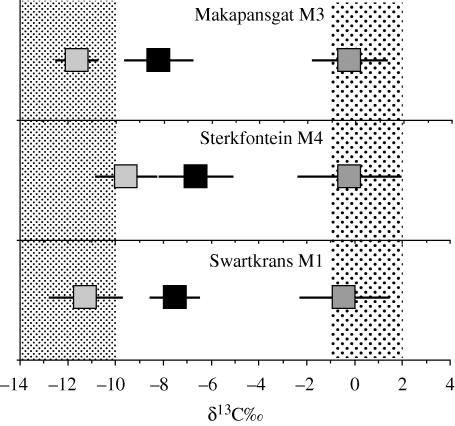
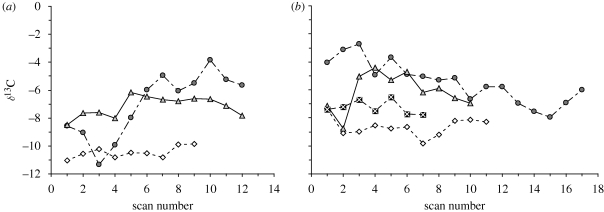
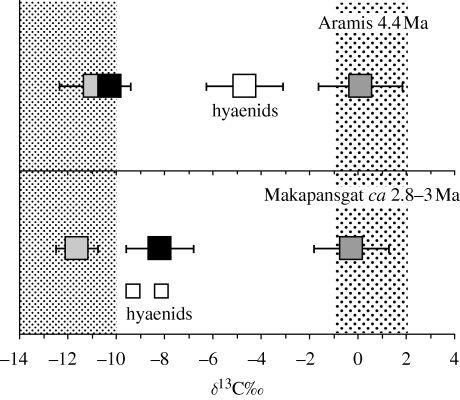
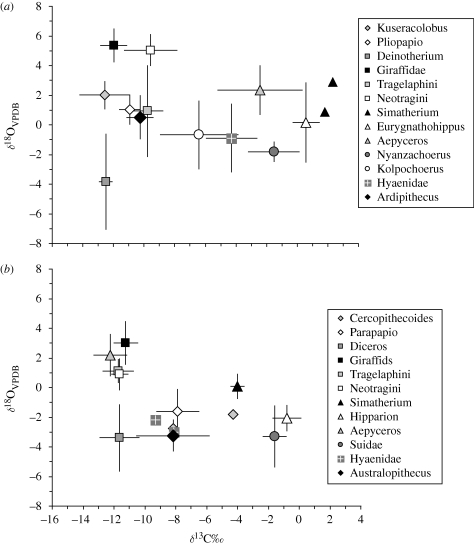
Accumulating isotopic evidence from fossil hominin tooth enamel has provided unexpected insights into early hominin dietary ecology. Among the South African australopiths, these data demonstrate significant contributions to the diet of carbon originally fixed by C(4) photosynthesis, consisting of C(4) tropical/savannah grasses and certain sedges, and/or animals eating C(4) foods. Moreover, high-resolution analysis of tooth enamel reveals strong intra-tooth variability in many cases, suggesting seasonal-scale dietary shifts. This pattern is quite unlike that seen in any great apes, even 'savannah' chimpanzees. The overall proportions of C(4) input persisted for well over a million years, even while environments shifted from relatively closed (ca 3 Ma) to open conditions after ca 1.8 Ma. Data from East Africa suggest a more extreme scenario, where results for Paranthropus boisei indicate a diet dominated (approx. 80%) by C(4) plants, in spite of indications from their powerful 'nutcracker' morphology for diets of hard objects. We argue that such evidence for engagement with C(4) food resources may mark a fundamental transition in the evolution of hominin lineages, and that the pattern had antecedents prior to the emergence of Australopithecus africanus. Since new isotopic evidence from Aramis suggests that it was not present in Ardipithecus ramidus at 4.4 Ma, we suggest that the origins lie in the period between 3 and 4 Myr ago.
Figures
References
-
- Balasse M.2002Reconstructing dietary and environmental history from enamel isotopic analysis: time resolution of intra-tooth sequential sampling. Int. J. Osteoarch. 12, 155–165 (doi:10.1002/oa.601) - DOI
-
- Bocherens H., Koch P. L., Mariotti A., Geraads D., Jaeger J.1996Isotopic biogeochemistry (13C, 18O) of mammalian enamel from African Pleistocene hominid sites. PALAIOS 11, 306–318 (doi:10.2307/3515241) - DOI
-
- Carter M. L.2001Sensitivity of stable isotopes (13C, 15N, and 18O) in bone to dietary specialization and niche separation among sympatric primates in Kibale National Park, Uganda. PhD dissertation, University of Chicago
-
- Cerling T. E., Harris J. M., MacFadden B. J., Leakey M. G., Quade J., Eisenman V., Ehleringer J. R.1997Global vegetation change through the Miocene/Pliocene boundary. Nature 389, 153–158 (doi:10.1038/38229) - DOI
-
- Cerling T. E., Hart J. A., Hart T. B.2004Stable isotope ecology in the Ituri Forest. Oecologia 138, 5–12 (doi:10.1007/s00442-003-1375-4) - DOI - PubMed
Publication types
MeSH terms
Substances
LinkOut - more resources
Full Text Sources
Miscellaneous
