


Performance of A1C for the classification and prediction of diabetes
- PMID: 20855549
- PMCID: PMC3005486
- DOI: 10.2337/dc10-1235
Performance of A1C for the classification and prediction of diabetes
Abstract
Objective: Although A1C is now recommended to diagnose diabetes, its test performance for diagnosis and prognosis is uncertain. Our objective was to assess the test performance of A1C against single and repeat glucose measurements for diagnosis of prevalent diabetes and for prediction of incident diabetes.
Research design and methods: We conducted population-based analyses of 12,485 participants in the Atherosclerosis Risk in Communities (ARIC) study and a subpopulation of 691 participants in the Third National Health and Nutrition Examination Survey (NHANES III) with repeat test results.
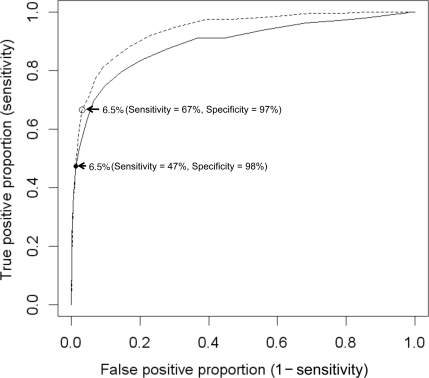
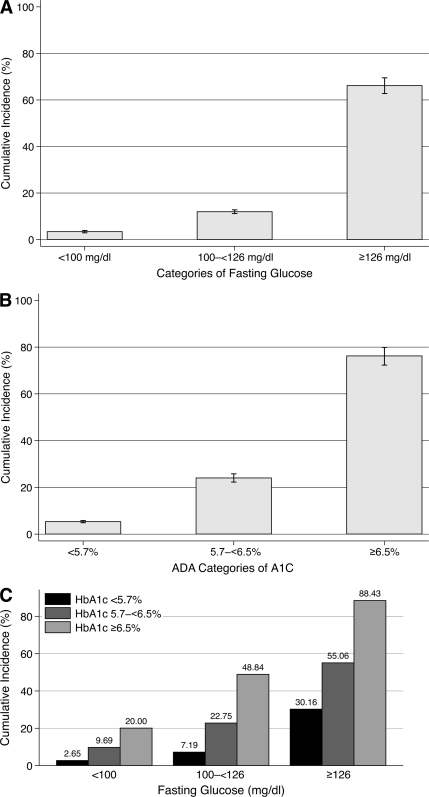
Results: Against a single fasting glucose ≥126 mg/dl, the sensitivity and specificity of A1C ≥6.5% for detection of prevalent diabetes were 47 and 98%, respectively (area under the curve 0.892). Against repeated fasting glucose (3 years apart) ≥126 mg/dl, sensitivity improved to 67% and specificity remained high (97%) (AUC 0.936). Similar results were obtained in NHANES III against repeated fasting glucose 2 weeks apart. The accuracy of A1C was consistent across age, BMI, and race groups. For individuals with fasting glucose ≥126 mg/dl and A1C ≥6.5% at baseline, the 10-year risk of diagnosed diabetes was 88% compared with 55% among those individuals with fasting glucose ≥126 mg/dl and A1C 5.7-<6.5%.
Conclusions: A1C performs well as a diagnostic tool when diabetes definitions that most closely resemble those used in clinical practice are used as the "gold standard." The high risk of diabetes among individuals with both elevated fasting glucose and A1C suggests a dual role for fasting glucose and A1C for prediction of diabetes.
Figures
References
-
- Buell C, Kermah D, Davidson MB: Utility of A1C for diabetes screening in the 1999 2004 NHANES population. Diabetes Care 2007;30:2233–2235 - PubMed
-
- Davidson MB, Schriger DL, Peters AL, Lorber B: Relationship between fasting plasma glucose and glycosylated hemoglobin: potential for false-positive diagnoses of type 2 diabetes using new diagnostic criteria. JAMA 1999;281:1203–1210 - PubMed
-
- Rohlfing CL, Little RR, Wiedmeyer HM, England JD, Madsen R, Harris MI, Flegal KM, Eberhardt MS, Goldstein DE: Use of GHb (HbA1c) in screening for undiagnosed diabetes in the U.S. population. Diabetes Care 2000;23:187–191 - PubMed
Publication types
MeSH terms
Substances
Grants and funding
- N01 HC055016/HL/NHLBI NIH HHS/United States
- K01-DK-076595/DK/NIDDK NIH HHS/United States
- N01 HC055019/HL/NHLBI NIH HHS/United States
- N01-HC-55016/HC/NHLBI NIH HHS/United States
- P30 DK079637/DK/NIDDK NIH HHS/United States
- N01 HC055015/HL/NHLBI NIH HHS/United States
- N01-HC-55021/HC/NHLBI NIH HHS/United States
- R21-DK-080294/DK/NIDDK NIH HHS/United States
- N01-HC-55019/HC/NHLBI NIH HHS/United States
- N01-HC-55015/HC/NHLBI NIH HHS/United States
- P60 DK079637/DK/NIDDK NIH HHS/United States
- N01 HC055018/HL/NHLBI NIH HHS/United States
- N01 HC055022/HL/NHLBI NIH HHS/United States
- R21 DK080294/DK/NIDDK NIH HHS/United States
- N01-HC-55018/HC/NHLBI NIH HHS/United States
- K24 DK062222/DK/NIDDK NIH HHS/United States
- N01-HC-55022/HC/NHLBI NIH HHS/United States
- P60-DK-079637/DK/NIDDK NIH HHS/United States
- N01 HC055021/HL/NHLBI NIH HHS/United States
- N01 HC055020/HL/NHLBI NIH HHS/United States
- K01 DK076595/DK/NIDDK NIH HHS/United States
- N01-HC-55020/HC/NHLBI NIH HHS/United States
- K24-DK-62222/DK/NIDDK NIH HHS/United States
