


From access to engagement: measuring retention in outpatient HIV clinical care
- PMID: 20858055
- PMCID: PMC2965698
- DOI: 10.1089/apc.2010.0086
From access to engagement: measuring retention in outpatient HIV clinical care
Abstract
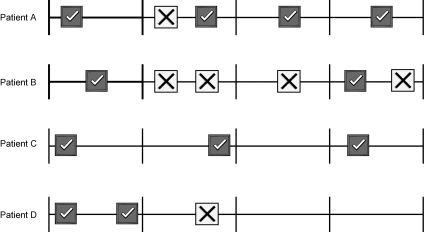
Engagement in HIV care is increasingly recognized as a crucial step in maximizing individual patient outcomes. The recently updated HIV Medicine Association primary HIV care guidelines include a new recommendation highlighting the importance of extending adherence beyond antiretroviral medications to include adherence to clinical care. Beyond individual health, emphasis on a "test and treat" approach to HIV prevention highlights the public health importance of engagement in clinical care as an essential intermediary between the putative benefits of universal HIV testing ("test") followed by ubiquitous antiretroviral treatment ("treat"). One challenge to administrators, researchers and clinicians who want to systematically evaluate HIV clinical engagement is deciding on how to measure retention in care. Measuring retention is complex as this process includes multiple clinic visits (repeated measures) occurring longitudinally over time. This article provides a synthesis of five commonly used measures of retention in HIV care, highlighting their methodological and conceptual strengths and limitations, and suggesting situations where certain measures may be preferred over others. The five measures are missed visits, appointment adherence, visit constancy, gaps in care, and the Human Resources and Services Administration HIV/AIDS Bureau (HRSA HAB) performance measure for retention in HIV care. As has been noted for antiretroviral medication adherence, there is no gold standard to measure retention in care, and consideration of the advantages and limitations of each measure, particularly in the context of the desired application, should guide selection of a retention measure.
Figures
References
-
- Unequal Treatment: Confronting Racial and Ethnic Disparities in Healthcare. Washington, D.C.: National Academies Press; 2003. Institute of Medicine of the National Academies. - PubMed
-
- Lurie N. Dubowitz T. Health disparities and access to health. JAMA. 2007;297:1118–1121. - PubMed
-
- Bozzette SA. Berry SH. Duan N, et al. The care of HIV-infected adults in the United States. HIV Cost and Services Utilization Study Consortium. N Engl J Med. 1998;339:1897–1904. - PubMed
-
- Fleming P. Byers R. Sweeney P. Daniels D. Karon J. Jansen R. HIV Prevalence in the United States, 2000 [Abstract 11]; Program and Abstracts of the 9th Conference on Retroviruses and Opportunistic Infections; Seattle, WA. Feb 24–28;2002 ;
-
- Berg MB. Safren SA. Mimiaga MJ. Grasso C. Boswell S. Mayer KH. Nonadherence to medical appointments is associated with increased plasma HIV RNA and decreased CD4 cell counts in a community-based HIV primary care clinic. AIDS Care. 2005;17:902–907. - PubMed
Publication types
MeSH terms
Substances
Grants and funding
LinkOut - more resources
Full Text Sources
Medical
Research Materials
