. 2010 Sep 21:10:502.
doi: 10.1186/1471-2407-10-502.

Dysregulated miR-183 inhibits migration in breast cancer cells

Affiliations

Dysregulated miR-183 inhibits migration in breast cancer cells

Aoife J Lowery et al. BMC Cancer. .

Abstract

Background: The involvement of miRNAs in the regulation of fundamental cellular functions has placed them at the fore of ongoing investigations into the processes underlying carcinogenesis. MiRNA expression patterns have been shown to be dysregulated in numerous human malignancies, including breast cancer, suggesting their probable involvement as novel classes of oncogenes or tumour suppressor genes. The identification of differentially expressed miRNAs and elucidation of their functional roles may provide insight into the complex and diverse molecular mechanisms of tumorigenesis. MiR-183 is located on chromosome 7q32 and is part of a miRNA family which are dysregulated in numerous cancers. The aims of this study were to further examine the expression and functional role of miR-183 in breast cancer.

Methods: MiR-183 expression was quantitated in primary breast tumours, tumour associated normal tissue and breast cancer cell lines using RQ-PCR. Gain of function analysis was performed in breast cancer cells using pre-miR-183 and the effect of miR-183 overexpression on cell viability, proliferation, apoptosis and migration was examined. Customized Taqman Low Density Arrays (TLDA) were used to identify dysregulated genes in breast cancer cells transfected with pre-miR-183.

Results: We demonstrate that miR-183 is dysregulated in breast cancer and expression correlates with estrogen receptor and HER2/neu receptor expression. Induced overexpression of miR-183 inhibited migration of breast cancer cells. This finding was substantiated by RQ-PCR of mRNA from cells overexpressing miR-183 which showed dysregulation of several migration and invasion related genes. Specifically, the VIL2-coding protein Ezrin was confirmed as a target of miR-183 and downregulation of this protein was confirmed with immunocytochemistry.

Conclusions: These findings indicate that miR-183 targets VIL2 and may play a central role in the regulation of migration and metastasis in breast cancer. Consequently, this miRNA may present an attractive target for therapeutic intervention.


Figures
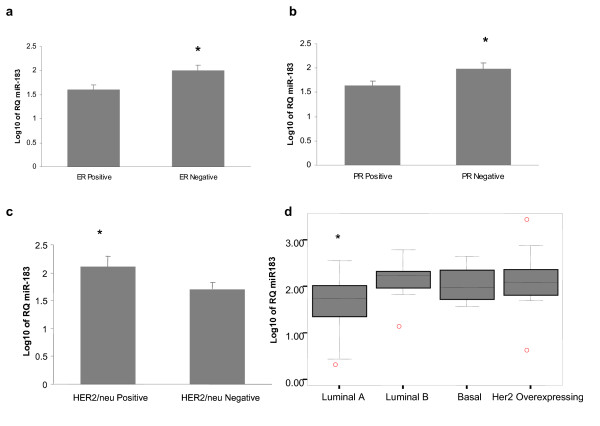
Figure 1
Figure 1
MiR-183 Expression in Primary Breast Tumors. Figure 1a: miR-183 expression is significantly higher in ER-negative tumors *p = 0.01, independent t-test. Figure 1b: miR-183 expression is signifcantly higher in PR-negative tumors *p = 0.03, independent t-test. Figure 1c: miR-183 expression is significantly higher in HER2/neu positive tumors *p = 0.029, independent t-test. Figure 1d: miR-183 expression is significantly lower in Luminal A tumors compared to all other subtypes p = 0.02, ANOVA.
Figure 2
Figure 2
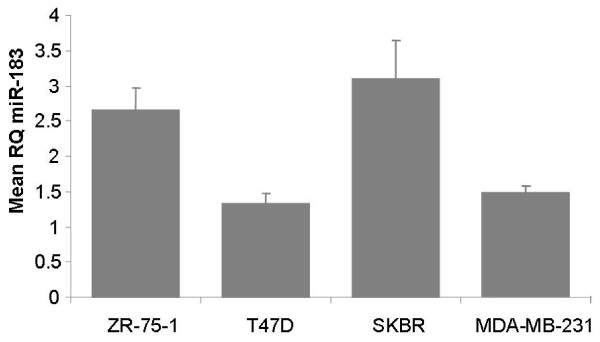
miR-183 expression in breast cancer cell lines. The lowest expression of miR-183 is in T47D cells which are ER positive and HER2/neu receptor negative
Figure 3
Figure 3
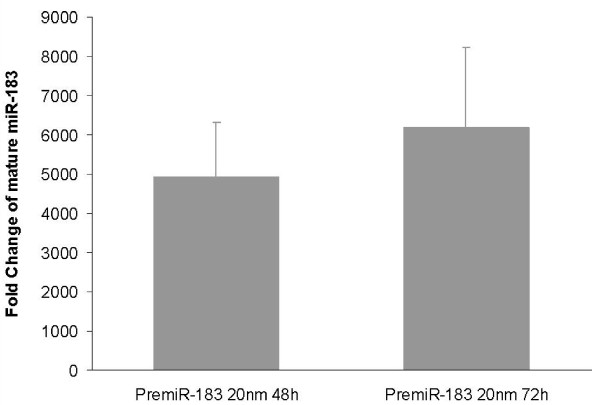
premiR-183 transfection efficacy. Mature miR-183 levels were quantitated in T47D cells following transfection with PremiR-183 precursor molecules. The fold change represents the level of mature miRNA in PremiR-183 transfected cells relative to cells transfected with PremiR-negative control. Fold change was quantitated using the comparative CT method with miR-16 and let-7a as endogenous controls and miRNA levels from cells transfected with premiR-negative control as a calibrator.
Figure 4
Figure 4
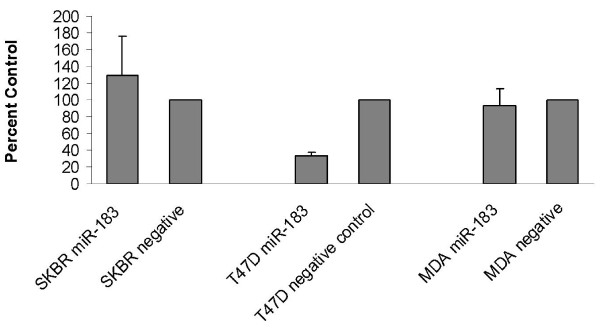
Overexpression of miR-183 inhibits migration in T47D cells. Quantification of migration through 8- m pore inserts by miR-183 transfected cells as a percentage of that achieved by control cells. The migratory cell number was significantly less in cells transfected with pre-miR-183 compared to cells transfected with pre-miR-negative control (*p = 0.001). In the more aggressive SKBR-3 and MDA-MB-231 cells the migratory cell number was higher overall but there was no difference in migratory number between cells transfected with pre-miR-183 and negative controls. Experiments were performed in triplicate.
Figure 5
Figure 5
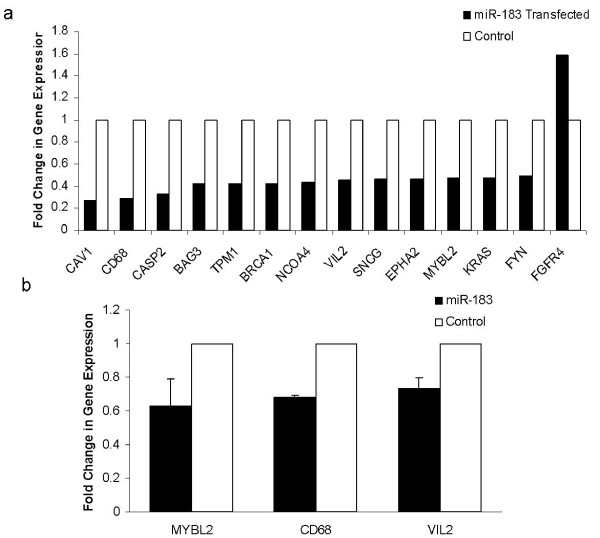
Dysregulation of mRNAs following induced overexpression of miR-183. Figure 5a: 14 genes were differentially expressed in T47D cells transfected with pre-miR-183 compared to negative control. Gene expression was analysed using TLDA. Figure 5b: RQ-PCR using conventional taqman assays verified downregulation of a selection of breast cancer associated genes following transfection of T47D cells with pre-miR-183.
Figure 6
Figure 6
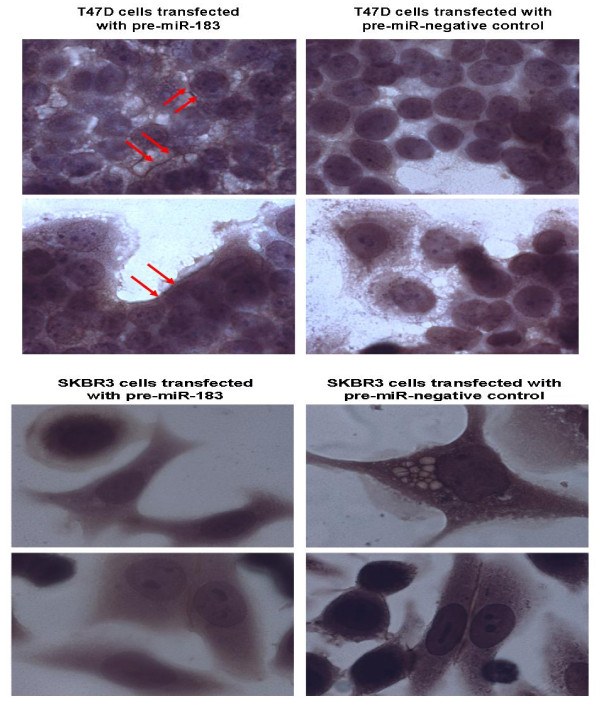
VIL2 expression in breast cancer cells overexpressing miR-183. Figure 6a: stronger membranous staining of VIL2 in cells transfected with premiR-183 is denoted by the red arrows. Figure 6b: VIL2 staining is weaker in cells transfected with premiR-183.

References

    1. Sorlie T. Molecular portraits of breast cancer: tumour subtypes as distinct disease entities. Eur J Cancer. 2004;40:2667–2675. doi: 10.1016/j.ejca.2004.08.021. - DOI - PubMed
    1. Jemal A, Siegel R, Ward E, Hao Y, Xu J, Murray T, Thun MJ. Cancer statistics, 2008. CA Cancer J Clin. 2008;58:71–96. doi: 10.3322/CA.2007.0010. - DOI - PubMed
    1. Sorlie T, Wang Y, Xiao C, Johnsen H, Naume B, Samaha RR, Borresen-Dale AL. Distinct molecular mechanisms underlying clinically relevant subtypes of breast cancer: gene expression analyses across three different platforms. BMC Genomics. 2006;7:127. doi: 10.1186/1471-2164-7-127. - DOI - PMC - PubMed
    1. van de Vijver MJ, He YD, van't Veer LJ, Dai H, Hart AA, Voskuil DW, Schreiber GJ, Peterse JL, Roberts C, Marton MJ. et al. A gene-expression signature as a predictor of survival in breast cancer. N Engl J Med. 2002;347:1999–2009. doi: 10.1056/NEJMoa021967. - DOI - PubMed
    1. van't Veer LJ, Dai H, van de Vijver MJ, He YD, Hart AA, Bernards R, Friend SH. Expression profiling predicts outcome in breast cancer. Breast Cancer Res. 2003;5:57–58. doi: 10.1186/bcr562. - DOI - PMC - PubMed

Publication types