. 2010 Dec;335(3):614-21.
doi: 10.1124/jpet.110.174144. Epub 2010 Sep 21.

A novel family of negative and positive allosteric modulators of NMDA receptors

Affiliations

A novel family of negative and positive allosteric modulators of NMDA receptors

Blaise Mathias Costa et al. J Pharmacol Exp Ther. 2010 Dec.

Abstract

The N-methyl-D-aspartate (NMDA) receptor family regulates various central nervous system functions, such as synaptic plasticity. However, hypo- or hyperactivation of NMDA receptors is critically involved in many neurological and psychiatric conditions, such as pain, stroke, epilepsy, neurodegeneration, schizophrenia, and depression. Consequently, subtype-selective positive and negative modulators of NMDA receptor function have many potential therapeutic applications not addressed by currently available compounds. We have identified allosteric modulators with several novel patterns of NMDA receptor subtype selectivity that have a novel mechanism of action. In a series of carboxylated naphthalene and phenanthrene derivatives, compounds were identified that selectively potentiate responses at GluN1/GluN2A [e.g., 9-iodophenanthrene-3-carboxylic acid (UBP512)]; GluN1/GluN2A and GluN1/GluN2B [9-cyclopropylphenanthrene-3-carboxylic acid (UBP710)]; GluN1/GluN2D [3,5-dihydroxynaphthalene-2-carboxylic acid (UBP551)]; or GluN1/GluN2C and GluN1/GluN2D receptors [6-, 7-, 8-, and 9-nitro isomers of naphth[1,2-c][1,2,5]oxadiazole-5-sulfonic acid (NSC339614)] and have no effect or inhibit responses at the other NMDA receptors. Selective inhibition was also observed; UBP512 inhibits only GluN1/GluN2C and GluN1/GluN2D receptors, whereas 6-bromo-2-oxo-2H-chromene-3-carboxylic acid (UBP608) inhibits GluN1/GluN2A receptors with a 23-fold selectivity compared with GluN1/GluN2D receptors. The actions of these compounds were not competitive with the agonists L-glutamate or glycine and were not voltage-dependent. Whereas the N-terminal regulatory domain was not necessary for activity of either potentiators or inhibitors, segment 2 of the agonist ligand-binding domain was important for potentiating activity, whereas subtype-specific inhibitory activity was dependent upon segment 1. In terms of chemical structure, activity profile, and mechanism of action, these modulators represent a new class of pharmacological agents for the study of NMDA receptor subtype function and provide novel lead compounds for a variety of neurological disorders.


Figures
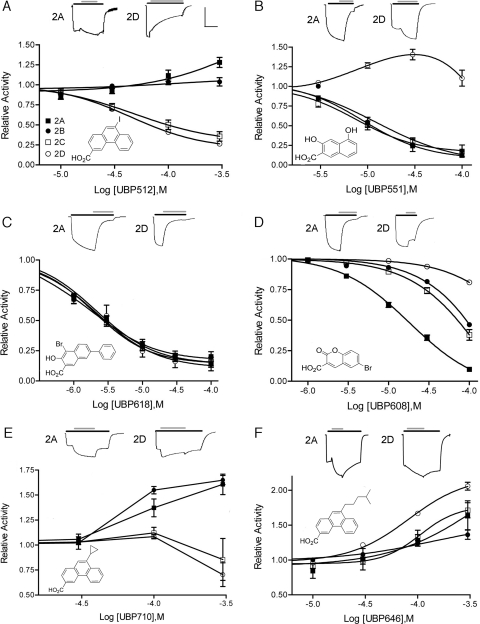
Fig. 1.
Fig. 1.
A series of two- and three-ring aromatic structures display varied activities on the responses of NMDA receptor subtypes. Representative voltage-clamped (−60 mV) current responses are shown for GluN1/GluN2A (2A) and GluN1/GluN2D (2D) receptors evoked by 10 μM l-glutamate and 10 μM glycine (black bar) plus the addition of a 100 μM concentration of the indicated compound (gray bar). Scale bars: x-axis = 17 s; y-axis = 300 nA (mean values; see Supplemental Table 1 for individual values). In the bottom of each panel is a dose-response curve of compound potentiation (values >1) or inhibition (values <1) of agonist responses by GluN1/GluN2A (■), GluN1/GluN2B (●), GluN1/GluN2C (□), and GluN1/GluN2D (○) receptors. Values represent means ± S.E.M. with n = 4 or more.
Fig. 2.
Fig. 2.
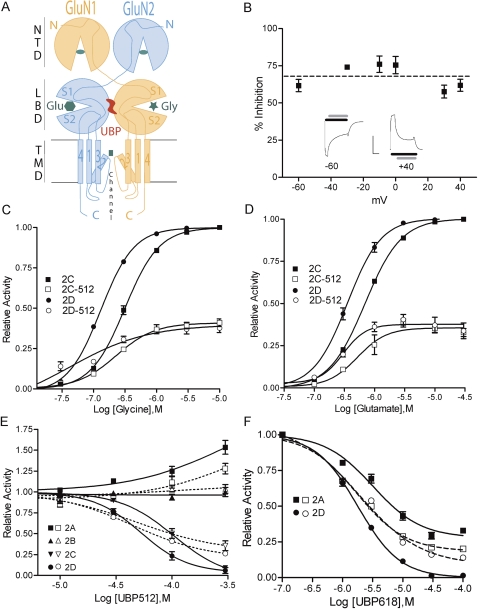
Compound inhibition of NMDA receptor responses is not voltage-dependent and does not compete with l-glutamate or glycine binding to NMDA receptors. A, a schematic illustrating a GluN1/GluN2 dimer and the domain structure and binding sites for l-glutamate (hexagon), glycine (star), NTD ligands (oval), and channel blockers (square). B, UBP512 (100 μM) inhibition of GluN1/GluN2D receptor responses at different membrane potentials. Insets: current traces showing agonist (black bar) and UBP512 application (gray bar), scale bars (x-axis = seconds, y-axis = microamperes): −60 mV (180 s, 1.1 μA); +40 mV (72 s, 2.0 μA). C and D, GluN1/GluN2C (2C) or GluN1/GluN2D (2D) receptors were activated by increasing concentrations of glycine (C) or l-glutamate (D), and 10 μM concentrations of the other agonist in the absence (filled symbols) or presence (open symbols) of 100 μM UBP512. E and F, UBP512 (E) and UBP618 (F) modulation of NMDA receptor responses evoked by low (10 μM l-glutamate and 10 μM glycine; open symbols) or high agonist concentrations (300 μM l-glutamate/300 μM glycine; closed symbols). UBP512 more effectively inhibited GluN1/GluN2C (inverted triangles) and GluN1/GluN2D (circles) receptor responses and more effectively potentiated GluN1/GluN2A (squares) receptor responses evoked by high agonist concentrations than by low concentrations. F, UPB618 displays greater maximal inhibition of GluN1/GluN2D receptor responses and decreased maximal inhibition of GluN1/GluN2A receptor responses in the presence of high agonist concentrations.
Fig. 3.
Fig. 3.
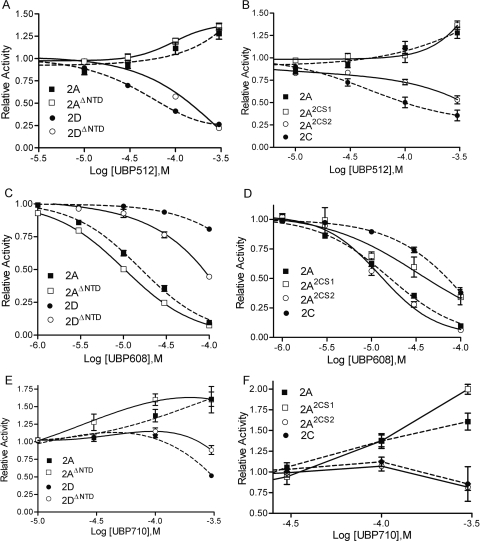
A, C, and E, compound activity was tested on responses evoked by 10 μM l-glutamate/10 μM glycine of wild-type GluN1/GluN2A (2A) and GluN1/GluN2D (2D) receptors (dashed lines) or receptors without NTDs of both GluN1 and GluN2 subunits (solid lines)—GluN1/GluN2A (2AΔNTD) and GluN1/GluN2D (2DΔNTD). B, D, and E, compounds were tested on responses by wild-type GluN1/GluN2A (2A) and GluN1/GluN2C (2C) receptors (dashed lines) and by chimeric receptors (solid lines) where the GluN2A subunit has the GluN2C S1 (2A2CS1) or the GluN2C S2 (2A2CS2) domain.

References

    1. Ahmed AH, Oswald RE. (2010) Piracetam defines a new binding site for allosteric modulators of alpha-amino-3-hydroxy-5-methyl-4-isoxazole-propionic acid (AMPA) receptors. J Med Chem 53:2197–2203 - PMC - PubMed
    1. Balannik V, Menniti FS, Paternain AV, Lerma J, Stern-Bach Y. (2005) Molecular mechanism of AMPA receptor noncompetitive antagonism. Neuron 48:279–288 - PubMed
    1. Baron A, Montagne A, Cassé F, Launay S, Maubert E, Ali C, Vivien D. (2010) NR2D-containing NMDA receptors mediate tissue plasminogen activator-promoted neuronal excitotoxicity. Cell Death Differ 17:860–871 - PubMed
    1. Brickley SG, Misra C, Mok MH, Mishina M, Cull-Candy SG. (2003) NR2B and NR2D subunits coassemble in cerebellar Golgi cells to form a distinct NMDA receptor subtype restricted to extrasynaptic sites. J Neurosci 23:4958–4966 - PMC - PubMed
    1. Buller AL, Larson HC, Schneider BE, Beaton JA, Morrisett RA, Monaghan DT. (1994) The molecular basis of NMDA receptor subtypes: native receptor diversity is predicted by subunit composition. J Neurosci 14:5471–5484 - PMC - PubMed

Publication types

MeSH terms

LinkOut - more resources