


Melanoma sentinel node biopsy and prediction models for relapse and overall survival
- PMID: 20859289
- PMCID: PMC2967048
- DOI: 10.1038/sj.bjc.6605849
Melanoma sentinel node biopsy and prediction models for relapse and overall survival
Abstract
Background: To optimise predictive models for sentinal node biopsy (SNB) positivity, relapse and survival, using clinico-pathological characteristics and osteopontin gene expression in primary melanomas.
Methods: A comparison of the clinico-pathological characteristics of SNB positive and negative cases was carried out in 561 melanoma patients. In 199 patients, gene expression in formalin-fixed primary tumours was studied using Illumina's DASL assay. A cross validation approach was used to test prognostic predictive models and receiver operating characteristic curves were produced.
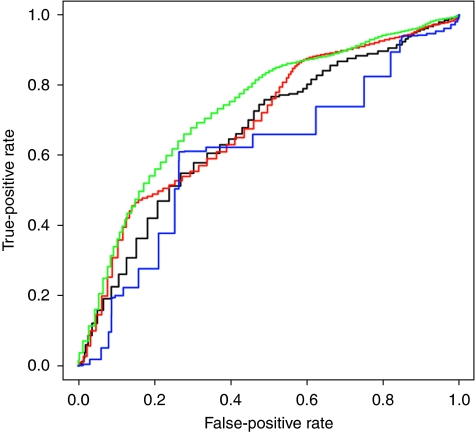
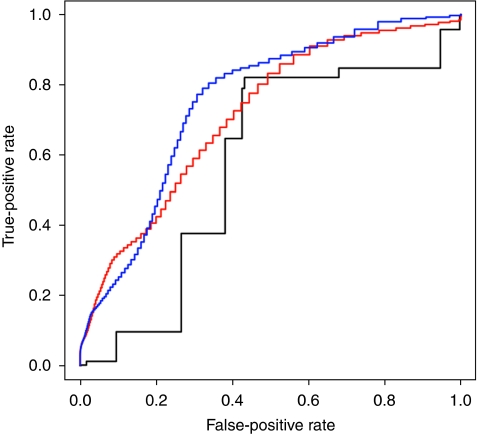
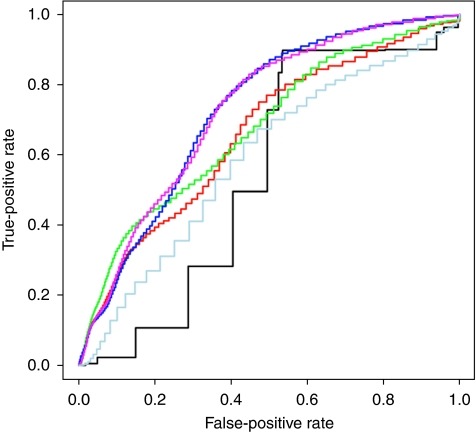
Results: Independent predictors of SNB positivity were Breslow thickness, mitotic count and tumour site. Osteopontin expression best predicted SNB positivity (P=2.4 × 10⁻⁷), remaining significant in multivariable analysis. Osteopontin expression, combined with thickness, mitotic count and site, gave the best area under the curve (AUC) to predict SNB positivity (72.6%). Independent predictors of relapse-free survival were SNB status, thickness, site, ulceration and vessel invasion, whereas only SNB status and thickness predicted overall survival. Using clinico-pathological features (thickness, mitotic count, ulceration, vessel invasion, site, age and sex) gave a better AUC to predict relapse (71.0%) and survival (70.0%) than SNB status alone (57.0, 55.0%). In patients with gene expression data, the SNB status combined with the clinico-pathological features produced the best prediction of relapse (72.7%) and survival (69.0%), which was not increased further with osteopontin expression (72.7, 68.0%).
Conclusion: Use of these models should be tested in other data sets in order to improve predictive and prognostic data for patients.
Conflict of interest statement
The authors declare no conflict of interest.
Figures
References
-
- Balch CM, Sober AJ, Soong SJ, Gershenwald JE (2003) The new melanoma staging system. Semin Cutan Med Surg 22: 42–54 - PubMed
-
- Balch CM, Soong SJ, Gershenwald JE, Thompson JF, Reintgen DS, Cascinelli N, Urist M, McMasters KM, Ross MI, Kirkwood JM, Atkins MB, Thompson JA, Coit DG, Byrd D, Desmond R, Zhang Y, Liu PY, Lyman GH, Morabito A (2001) Prognostic factors analysis of 17 600 melanoma patients: validation of the American Joint Committee on Cancer melanoma staging system. J Clin Oncol 19: 3622–3634 - PubMed
-
- Clark Jr WH, Elder DE, Guerry Dt, Braitman LE, Trock BJ, Schultz D, Synnestvedt M, Halpern AC (1989) Model predicting survival in stage I melanoma based on tumor progression. J Natl Cancer Inst 81: 1893–1904 - PubMed
-
- Cochran AJ, Elashoff D, Morton DL, Elashoff R (2000) Individualized prognosis for melanoma patients. Hum Pathol 31: 327–331 - PubMed
-
- Conway C, Mitra A, Jewell R, Randerson-Moor J, Lobo S, Nsengimana J, Edward S, Sanders DS, Cook M, Powell B, Boon A, Elliott F, de Kort F, Knowles MA, Bishop DT, Newton-Bishop J (2009) Gene expression profiling of paraffin-embedded primary melanoma using the DASL assay identifies increased osteopontin expression as predictive of reduced relapse-free survival. Clin Cancer Res 15: 6939–6946 - PMC - PubMed
Publication types
MeSH terms
Substances
Grants and funding
LinkOut - more resources
Full Text Sources
Other Literature Sources
Medical
Research Materials
