Management of recently traumatized maxillary central incisors by partial pulpotomy using MTA: Case reports with two-year follow-up
- PMID: 20859487
- PMCID: PMC2936090
- DOI: 10.4103/0972-0707.66724
Management of recently traumatized maxillary central incisors by partial pulpotomy using MTA: Case reports with two-year follow-up
Abstract
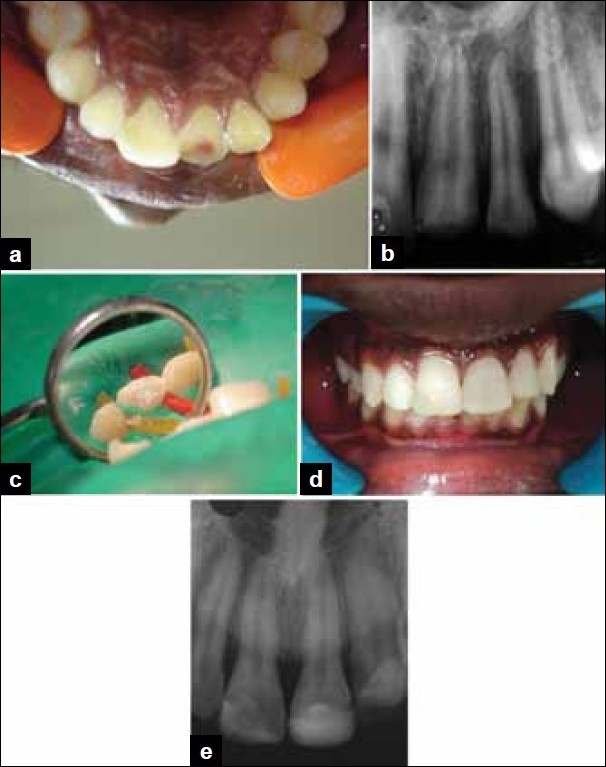
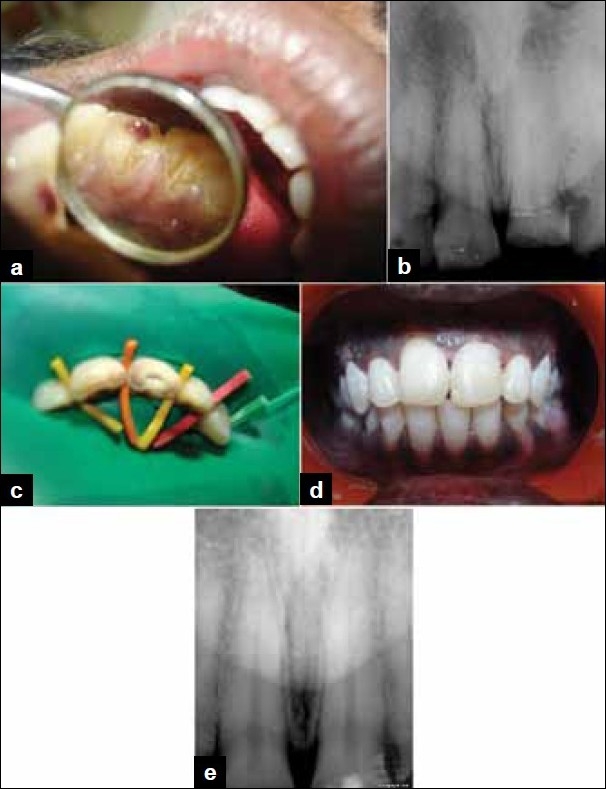
In traumatized, young, permanent teeth, pulpotomy is classically undertaken to promote apexogenesis. The objective is to promote root development and apical closure. Once root end development and apical closure is achieved, the root canal treatment is completed. However, it has been suggested that mere pulp exposure does not cause pulpitis in the absence of bacteria. Recent studies have proposed that as long as a good seal is ensured, root canal treatment may not be necessary following pulpotomy. In this article we report two cases of traumatized, fully matured, maxillary permanent central incisors, which have been treated with mineral trioxide aggregate following partial pulpotomy, with a two-year follow-up.
Keywords: Partial pulpotomy; mineral trioxide aggregate; vital pulp therapy.
Conflict of interest statement
Figures
References
-
- Mejàre I, Cvek M. Partial pulpotomy in young permanent teeth with deep carious lesions. Endod Dent Traumatol. 1993;9:238–42. - PubMed
-
- Cohen S, Bums RC, editors. Pathways of the pulp. 9th ed. St. Louis: Mosby; 2005. The role of endodontics after dental traumatic injuries; pp. 616–8.
-
- Kakehashi S, Stanley HR, Fitzgerald RJ. The effects of surgical exposures of dental pulps in germfree and conventional laboratory rats. J South Calif Dent Assoc. 1966;34:449–51. - PubMed
-
- Barrieshi-Nusair KM, Qudeimat MA. A prospective clinical study of mineral trioxide aggregate for partial pulpotomy in cariously exposed permanent teeth. J Endod. 2006;32:731–5. - PubMed
-
- Accorinte Mde L, Holland R, Reis A, Bortoluzzi MC, Murata SS, Dezan E, Jr, et al. Evaluation of mineral trioxide aggregate and calcium hydroxide cement as pulp-capping agents in human teeth. J Endod. 2008;34:1–6. - PubMed