


Mechanisms of functional improvement in a 2-year trial of cognitive enhancement therapy for early schizophrenia
- PMID: 20860867
- PMCID: PMC3708034
- DOI: 10.1017/S0033291710001765
Mechanisms of functional improvement in a 2-year trial of cognitive enhancement therapy for early schizophrenia
Abstract
Background: Cognitive rehabilitation has emerged as an effective treatment for addressing cognitive impairments and functional disability in schizophrenia; however, the degree to which changes in various social and non-social cognitive processes translate into improved functioning during treatment remains unclear. This research sought to identify the neurocognitive and social-cognitive mechanisms of functional improvement during a 2-year trial of cognitive enhancement therapy (CET) for early-course schizophrenia.
Method: Patients in the early course of schizophrenia were randomly assigned to CET (n=31) or an enriched supportive therapy control (n=27) and treated for up to 2 years. A comprehensive neurocognitive assessment battery and the Mayer-Salovey-Caruso Emotional Intelligence Test (MSCEIT) were completed annually, along with measures of functioning. Mediator analyses using mixed-effects growth models were conducted to examine the effects of neurocognitive and social-cognitive improvement on functional change.
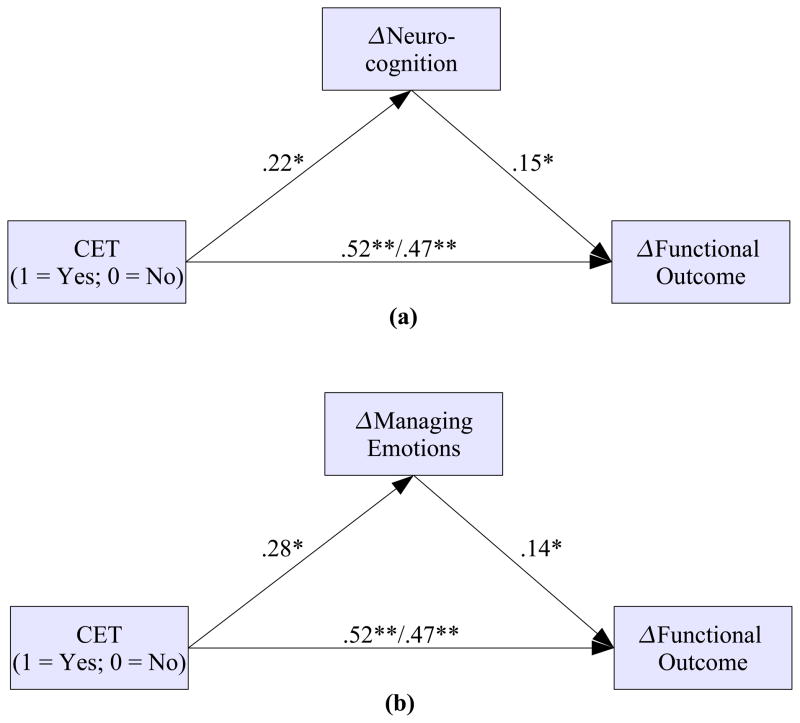
Results: Improvements over 2 years in neurocognition and the emotion management branch of the MSCEIT were found to be significantly related to improved functional outcome in early-course schizophrenia patients. Neurocognitive improvement, primarily in executive functioning, and social-cognitive change in emotion management also mediated the robust effects of CET on functioning.
Conclusions: Improvements in neurocognition and social cognition that result from cognitive rehabilitation are both significant mediators of functional improvement in early-course schizophrenia. Cognitive rehabilitation programs for schizophrenia may need to target deficits in both social and non-social cognition to achieve an optimal functional response.
Conflict of interest statement
Declaration of Interest
The authors report no competing financial or other conflicts of interest with this research.
Figures
References
-
- Baron RM, Kenny DA. The moderator-mediator variable distinction in social psychological research: Conceptual, strategic, and statistical considerations. Journal of Personality and Social Psychology. 1986;51(6):1173–1182. - PubMed
-
- Brekke JS, Hoe M, Green MF. Neurocognitive change, functional change and service intensity during community-based psychosocial rehabilitation for schizophrenia. Psychological Medicine (in press) - PubMed
-
- Buchanan RW, Heinrichs DW. The Neurological Evaluation Scale (NES): a structured instrument for the assessment of neurological signs in schizophrenia. Psychiatry Research. 1989;27(3):335–350. - PubMed
