Review
. 2010 Dec 6;7 Suppl 6(Suppl 6):S717-29.
doi: 10.1098/rsif.2010.0345.focus. Epub 2010 Sep 22.

Engineering extracellular matrix through nanotechnology

Affiliations
Review

Engineering extracellular matrix through nanotechnology

Cassandra M Kelleher et al. J R Soc Interface. .

Abstract

The goal of tissue engineering is the creation of a living device that can restore, maintain or improve tissue function. Behind this goal is a new idea that has emerged from twentieth century medicine, science and engineering. It is preceded by centuries of human repair and replacement with non-living materials adapted to restore function and cosmetic appearance to patients whose tissues have been destroyed by disease, trauma or congenital abnormality. The nineteenth century advanced replacement and repair strategies based on moving living structures from a site of normal tissue into a site of defects created by the same processes. Donor skin into burn wounds, tendon transfers, intestinal replacements into the urinary tract, toes to replace fingers are all examples. The most radical application is that of vital organ transplantation in which a vital part such as heart, lung or liver is removed from one donor, preserved for transfer and implanted into a patient dying of end-stage organ failure. Tissue engineering and regenerative medicine have advanced a general strategy combining the cellular elements of living tissue with sophisticated biomaterials to produce living structures of sufficient size and function to improve patients' lives. Multiple strategies have evolved and the application of nanotechnology can only improve the field. In our era, by necessity, any medical advance must be successfully commercialized to allow widespread application to help the greatest number of patients. It follows that business models and regulatory agencies must adapt and change to enable these new technologies to emerge. This brief review will discuss the science of nanotechnology and how it has been applied to this evolving field. We will then briefly summarize the history of commercialization of tissue engineering and suggest that nanotechnology may be of use in breeching the barriers to commercialization although its primary mission is to improve the technology by solving some remaining and vexing problems in its science and engineering aspects.


Figures

Figure 1.
Figure 1.
Hyaluronic acid (HA) micropatterns and co-cultures. (ac) Well-defined HA patterns were formed, as observed with a phase-contrast microscope. (d) Hepatocytes selectively adhered to the fibronectin-coated regions on the HA-patterned surface during the 6 h incubation period. (e) The HA surface, including the hepatocytes, was treated with collagen and seeded with fibroblasts. (f) The co-culture was visualized by fluorescence staining with anti-albumin antibody (black, hepatocytes) and DAPI (grey, fibroblasts) on day 3 of culture. (g,h) Fibroblasts and (i) PA6 cells selectively adhered to form different HA patterns. Hepatocytes observed in islands with diameters of (j) 100 µm, (k) 200 µm and (l) 400 µm and the surrounding fibroblasts after pre-labelling with fluorescent markers on day 3 of culture. Scale bars, (af, hl) 500 µm; (g) 1 mm. Reprinted with permission from Elsevier.
Figure 2.
Figure 2.
(a) The microfluidics device was tested by flowing trypan blue through the channels to verify patency. (b) Cross-sectional view of the bilayer-assembled device showing the layers containing microfluidics channels, C, and posts supporting the parenchymal chamber, P, connected by the intervening nanoporous polycarbonate membrane, M. (c) Scanning electron micrograph of the finished device. Adapted from Cortiella et al. (2006). Reprinted with permission from Springer.
Figure 3.
Figure 3.
Scanning electron microscope images of electrospun poly(ɛ-caprolactone) (PCL) fibres. (ai), (aii) Aligned fibres with different magnification; (bi,bii) non-aligned fibres. Laser confocal microscopy images of F-actin staining in human skeletal muscle cells seeded on aligned electrospun PCL/collagen nanofibre meshes (c) and randomly oriented electrospun meshes (d) (600× magnification). Adapted from Choi et al. (2008) (ai,aii, bi,bii) and Zhu et al. (2010) (c,d). Reprinted with permission from Wiley (ai,aii,bi,bii) and Elsevier. Scale bars, (ai,bi), 200 µm; (aii,bii), 10 µm; (c,d) 100 µm.
Figure 4.
Figure 4.
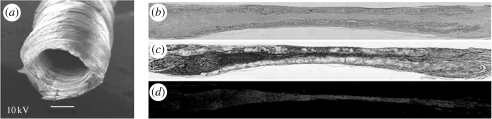
(a) Scanning electron microscope image of the electrospun PLGA/PCL nerve guide conduit. Scale bar, 500 µm. (bd) Longitudinal sections of nerve regenerated within the implanted guide channel. In the conduit, the regenerated nerve bridged the 10 mm gap, reconnecting the two sciatic nerve stumps. (a) Four months after surgery, haematoxylin–eosin staining shows the presence of regenerated tissue filling the conduit lumen; decreased lumen diameter is observable at middle length of the guidance channel. Regenerated tissue positive to Bielschowsky staining (b) and to anti-β-tubulin antibody (c) shows nervous projections oriented along the major axis of the prosthesis bridging the 10 mm gap between the severed sciatic nerve stumps (image sequence collected at 4× magnification). Adapted from Panseri et al. (2008). Reprinted with permission from BioMed Central.
Figure 5.
Figure 5.
Vascular endothelial growth factor and fibroblast growth factor-2 delivered via heparin-binding peptide amphiphile (HBPA) nanostructures significantly increase vascular density at the omental transplant site. CD31 staining of (a) HBPA-control (CNTRL) and (b) HBPA+ growth factor (GF) scaffolds retrieved from omenta on post-transplant day 14. CD31-positive cells are stained brown by DAB chromogen and cell nuclei are stained blue by haematoxylin. Arrows denote sections of PLLA filaments among the infiltrating cellular tissue. (c) Haematoxylin–eosin staining of an HBPA-GF scaffold retrieved on day 14. Erythrocytes in the lumens (see arrows) suggest that neovessels have functional characteristics. (d) Density of CD31-positive neovessels in HBPA scaffold specimens retrieved between days 11 and 14. Neovessel densities in HBPA-GF specimens were nearly eight times greater than those in HBPA-CNTRL specimens (error bars represent 95% CI). *p = 2.86 × 10⁻⁴ by Student's t-test. Reprinted with permission from Lippincott Williams & Wilkins. Scale bars, (a,b) 25 µm and (c) 30 µm.
Figure 6.
Figure 6.
Soft X-ray photographs at (a) four and (b) six weeks after the operation. A critical size bone defect (5 mm in length) was prepared in the rat tibia and the defect treated with different implants. G1, bmp2-CaP-collagen; G2, bmp2-collagen; G3, collagen; G4, vacant plasmid vector-CaP-collagen; G5, untreated. Reprinted with permission from Mary Ann Liebert, Inc.
Figure 7.
Figure 7.
In vitro tissue-engineered lung. (af) Scanning electron micrographs of in vitro tissue-engineered ovine somatic lung progenitor cells seeded onto polyglycolic acid scaffolds. Directly after seeding (a) and after one week (b), two weeks (c), six weeks (d) and eight weeks (e) of culture in vitro. By six weeks, cultures developed morphological features of lung tissue. By eight weeks, tissue-engineered lung (e,f) contained structures similar to alveoli (a) with septa (arrows), compared with septa (arrows) in native lung (f) (scale bars, 10 µm). By eight weeks, engineered lung tissue grown in vitro was macroscopically visible and could be handled easily (g) (scale bar, 5 mm). Reproduced with permission from Mary Ann Liebert, Inc.
Figure 8.
Figure 8.
(a) Photographs of cadaveric perfusion decellularization of whole rat hearts perfused with sodium dodecyl sulphate (SDS) over 12 h. The heart becomes more translucent as cellular material is washed out from the right ventricle, then the atria and finally the left ventricle. (b) Haematoxylin–eosin staining of thin sections of SDS-treated heart showing no intact cells or nuclei. Maintenance of large vasculature conduits (asterisks). Scale bar, 200 µm. (c) Formation of a working perfused bioartificial heart-like construct by recellularization of decellularized cardiac ECM. Recellularized whole rat heart at day 4 of perfusion culture in a working heart bioreactor. (d) Representative functional assessment tracing of decellularized whole heart construct paced in a working heart bioreactor. Tracings of electrocardiogram (ECG), aortic pressure (afterload) and left ventricular pressure (LVP) of the paced construct on day 8 after recellularization, and on day 8 after stimulation with physiological (B50–100 mM) doses of phenylephrine. Adapted from Ott et al. (2008). Reprinted with permission from Nature Medicine.

References

    1. Andrade C. F., Wong A. P., Waddell T. K., Keshavjee S., Liu M. 2007. Cell-based tissue engineering for lung regeneration. Am. J. Physiol. Lung Cell. Mol. Physiol. 292, L510–L518. (10.1152/ajplung.00175.2006) - DOI - PubMed
    1. Ayres C. E., Jha B. S., Sell S. A., Bowlin G. L., Simpson D. G. 2010. Nanotechnology in the design of soft tissue scaffolds: innovations in structure and function. Wiley Interdiscip. Rev. Nanomed. Nanobiotechnol. 2, 20–34. (10.1002/wnan.55) - DOI - PubMed
    1. Baker B. M., Mauck R. L. 2007. The effect of nanofiber alignment on the maturation of engineered meniscus constructs. Biomaterials 28, 1967–1977. (10.1016/j.biomaterials.2007.01.004) - DOI - PMC - PubMed
    1. Berry M., et al. 2001. Sustained effects of gene-activated matrices after CNS injury. Mol. Cell. Neurosci. 17, 706–716. (10.1006/mcne.2001.0975) - DOI - PubMed
    1. Bonadio J. 2000. Tissue engineering via local gene delivery: update and future prospects for enhancing the technology. Adv. Drug Deliv. Rev. 44, 185–194. (10.1016/S0169-409X(00)00094-6) - DOI - PubMed

LinkOut - more resources