


Incidence and risk factors for fatal pulmonary embolism after major trauma: a nested cohort study
- PMID: 20861095
- PMCID: PMC2955535
- DOI: 10.1093/bja/aeq254
Incidence and risk factors for fatal pulmonary embolism after major trauma: a nested cohort study
Abstract
Background: Venous thromboembolism is common after major trauma. Strategies to prevent fatal pulmonary embolism (PE) are widely utilized, but the incidence and risk factors for fatal PE are poorly understood.
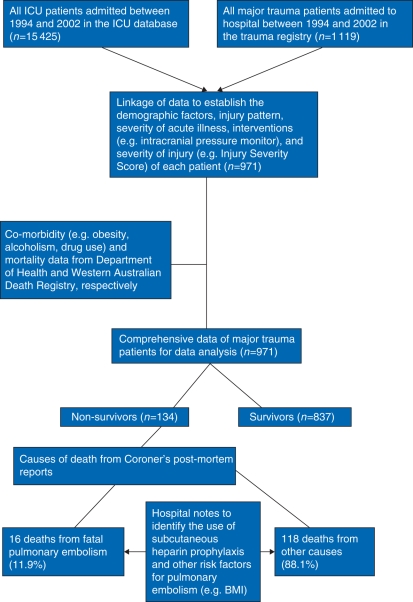
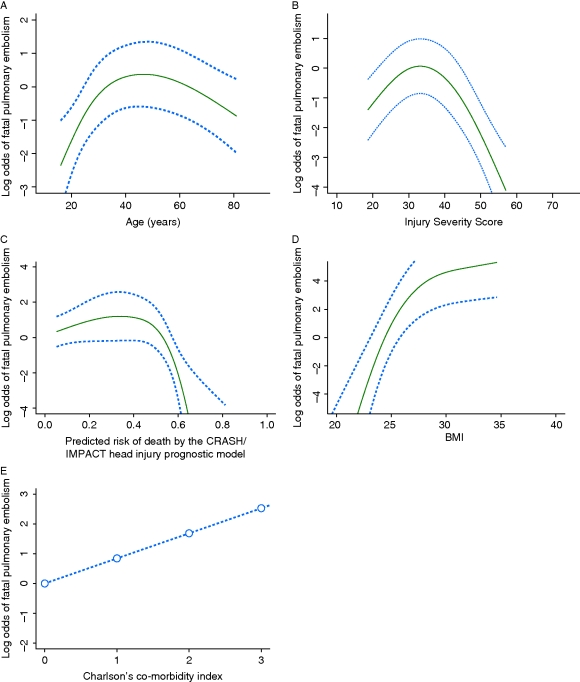
Methods: Using linked data from the intensive care unit, trauma registry, Western Australian Death Registry, and post-mortem reports, the incidence and risk factors for fatal PE in a consecutive cohort of major trauma patients, admitted between 1994 and 2002, were assessed. Non-linear relationships between continuous predictors and risk of fatal PE were modelled by logistic regression.
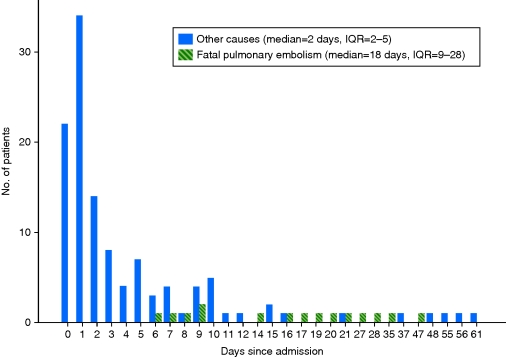
Results: Of the 971 consecutive trauma patients considered in the study, 134 (13.8%) died after their injuries. Fatal PE accounted for 11.9% of all deaths despite unfractionated heparin prophylaxis being used in 44% of these patients. Fatal PE occurred in those who were older (mean age 51- vs 37-yr-old, P=0.01), with more co-morbidities (Charlson's co-morbidity index 1.1 vs 0.2, P=0.01), had a larger BMI (31.8 vs 24.5, P=0.01), and less severe head and systemic injuries when compared with those who died of other causes. Sites of injuries were not significantly related to the risk of fatal PE. Fatal PE occurred much later than deaths from other causes (median 18 vs 2 days, P=0.01), and the estimated attributable mortality of PE was 49% (95% confidence interval 36-62%).
Conclusions: Fatal PE appeared to be a potential preventable cause of late mortality after major trauma. Severity of injuries, co-morbidity, and BMI were important risk factors for fatal PE after major trauma.
Figures
References
-
- Rogers FB, Cipolle MD, Velmahos G, et al. Practice management guidelines for the prevention of venous thromboembolism in trauma patients: the EAST practice management guidelines work group. J Trauma. 2002;53:142–64. doi:10.1097/00005373-200207000-00032. - DOI - PubMed
-
- Rogers FB, Shackford SR, Ricci MA, et al. Prophylactic vena cava filter insertion in selected high-risk orthopaedic trauma patients. J Orthop Trauma. 1997;11:267–72. doi:10.1097/00005131-199705000-00006. - DOI - PubMed
-
- Rosenthal D, McKinsey JF, Levy AM, et al. Use of the Greenfield filter in patients with major trauma. Cardiovasc Surg. 1994;2:52–5. - PubMed
-
- Shackford SR, Cook A, Rogers FB, et al. The increasing use of vena cava filters in adult trauma victims: data from the American College of Surgeons National Trauma Data Bank. J Trauma. 2007;63:764–9. doi:10.1097/01.ta.0000240444.14664.5f. - DOI - PubMed
-
- Kaufman JA, Kinney TB, Streiff MB, et al. Guidelines for the use of retrievable and convertible vena cava filters: report from the Society of Interventional Radiology multidisciplinary consensus conference. Surg Obes Relat Dis. 2006;2:200–12. doi:10.1016/j.soard.2006.03.009. - DOI - PubMed
Publication types
MeSH terms
Grants and funding
LinkOut - more resources
Full Text Sources
Medical
