Improved detection of five major gastrointestinal pathogens by use of a molecular screening approach
- PMID: 20861334
- PMCID: PMC3020836
- DOI: 10.1128/JCM.01124-10
Improved detection of five major gastrointestinal pathogens by use of a molecular screening approach
Abstract
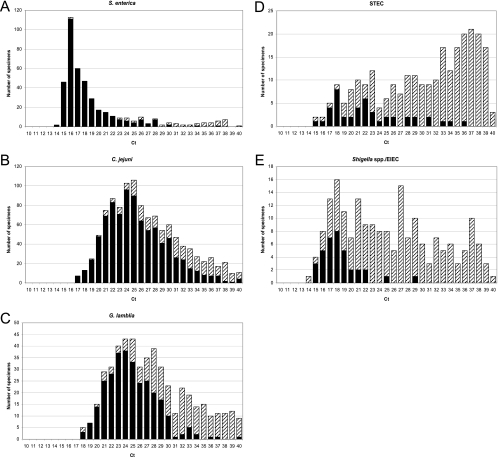
The detection of bacterial and parasitic gastrointestinal pathogens through culture and microscopy is laborious and time-consuming. We evaluated a molecular screening approach (MSA) for the detection of five major enteric pathogens: Salmonella enterica, Campylobacter jejuni, Giardia lamblia, Shiga toxin-producing Escherichia coli (STEC), and Shigella spp./enteroinvasive E. coli (EIEC), for use in the daily practice of a clinical microbiology laboratory. The MSA consists of prescreening of stool specimens with two real-time multiplex PCR (mPCR) assays, which give results within a single working day, followed by guided culture/microscopy of the positive or mPCR-inhibited samples. In the present 2-year overview, 28,185 stool specimens were included. The MSA was applied to 13,974 stool samples (49.6%), whereas 14,211 samples were tested by conventional methods only (50.4%). The MSA significantly increased the total detection rate compared to that of conventional methods (19.2% versus 6.4%). The detection of all included pathogens, with the exception of S. enterica, significantly improved. MSA detection frequencies were as follows: C. jejuni, 8.1%; G. lamblia, 4.7%; S. enterica, 3.0%; STEC, 1.9%; and Shigella spp./EIEC, 1.4%. The guided culture/microscopy was positive in 76.8%, 58.1%, 88.9%, 16.8%, and 18.1% of mPCR-positive specimens, respectively. Of all mPCRs, only 1.8% was inhibited. Other findings were that detection of mixed infections was increased (0.9% versus 0.02%) and threshold cycle (C(T)) values for MSA guided culture/microscopy-positive samples were significantly lower than those for guided culture/microscopy-negative samples. In conclusion, an MSA for detection of gastrointestinal pathogens resulted in markedly improved detection rates and a substantial decrease in time to reporting of (preliminary) results.
Figures
References
-
- Amar, C., C. East, J. Gray, M. Iturriza-Gomara, E. Maclure, and J. McLauchlin. 2007. Detection by PCR of eight groups of enteric pathogens in 4,627 faecal samples: re-examination of the English case-control Infectious Intestinal Disease Study (1993-1996). Eur. J. Clin. Microbiol. Infect. Dis. 26:311-323. - PubMed
-
- Bennett-Wood, V. R., J. Russell, A. M. Bordun, P. D. R. Johnson, and R. M. Robins-Browne. 2004. Detection of enterohaemorrhagic Escherichia coli in patients attending hospital in Melbourne, Australia. Pathology 36:345-351. - PubMed
-
- Best, E. L., E. J. Powell, C. Swift, K. A. Grant, and J. A. Frost. 2003. Applicability of a rapid duplex real-time PCR assay for speciation of Campylobacter jejuni and Campylobacter coli directly from culture plates. FEMS Microbiol. Lett. 229:237-241. - PubMed
-
- Blanco, J. E., M. Blanco, M. P. Alonso, A. Mora, G. Dahbi, M. A. Coira, and J. Blanco. 2004. Serotypes, virulence genes, and intimin types of Shiga toxin (verotoxin)-producing Escherichia coli isolates from human patients: prevalence in Lugo, Spain, from 1992 through 1999. J. Clin. Microbiol. 42:311-319. - PMC - PubMed
Publication types
MeSH terms
LinkOut - more resources
Full Text Sources
Other Literature Sources
Miscellaneous