


Gaze cueing elicited by emotional faces is influenced by affective context
- PMID: 20862193
- PMCID: PMC2938312
- DOI: 10.1080/13506285.2010.484657
Gaze cueing elicited by emotional faces is influenced by affective context
Abstract
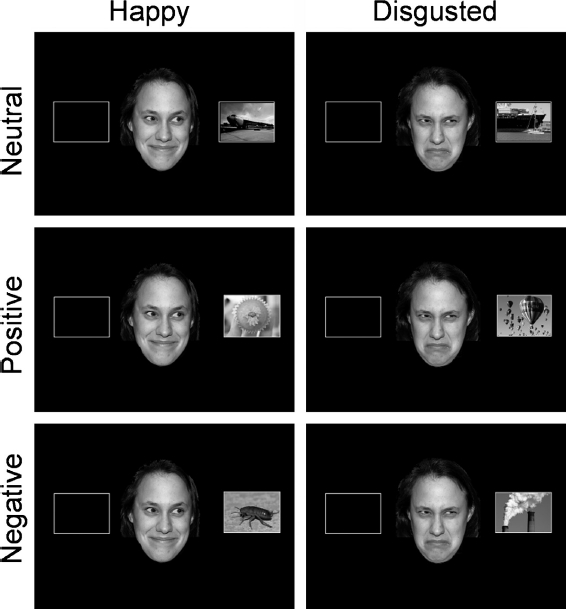
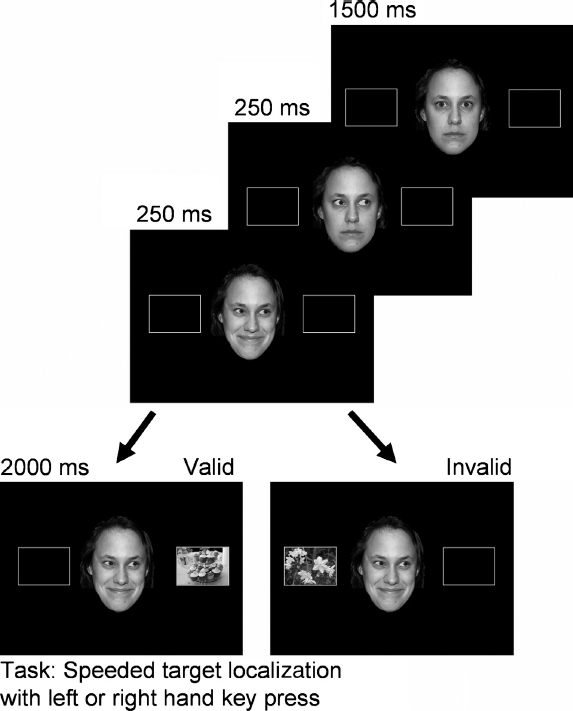
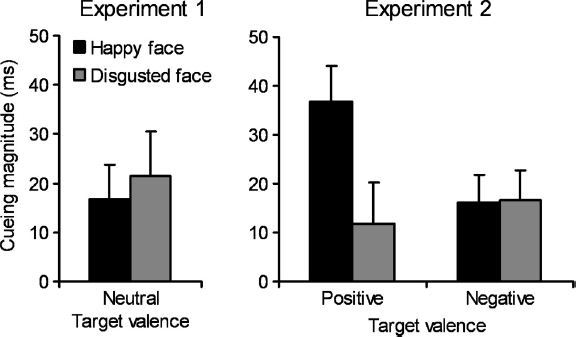
When we observe someone shift their gaze to a peripheral event or object, a corresponding shift in our own attention often follows. This social orienting response, joint attention, has been studied in the laboratory using the gaze cueing paradigm. Here, we investigate the combined influence of the emotional content displayed in two critical components of a joint attention episode: The facial expression of the cue face, and the affective nature of the to-be-localized target object. Hence, we presented participants with happy and disgusted faces as cueing stimuli, and neutral (Experiment 1), pleasant and unpleasant (Experiment 2) pictures as target stimuli. The findings demonstrate an effect of 'emotional context' confined to participants viewing pleasant pictures. Specifically, gaze cueing was boosted when the emotion of the gazing face (i.e., happy) matched that of the targets (pleasant). Demonstrating modulation by emotional context highlights the vital flexibility that a successful joint attention system requires in order to assist our navigation of the social world.
Figures
References
-
- Adams R. B., Gordon H. L., Baird A. A., Ambady N., Kleck R. E. Effects of gaze on amygdala sensitivity to anger and fear faces. Science. 2003;300:1536. - PubMed
-
- Adams R. B., Kleck R. E. Perceived gaze direction and the processing of facial displays of emotion. Psychological Science. 2003;14:644–647. - PubMed
-
- Argyle M., Dean J. Eye contact, distance and affiliation. Sociometry. 1965;28(3):289–304. - PubMed
-
- Bayliss A. P., di Pellegrino G., Tipper S. P. Sex differences in eye-gaze and symbolic cueing of attention. Quarterly Journal of Experimental Psychology. 2005;58A(4):631–650. - PubMed
-
- Bayliss A. P., Frischen A., Fenske M. J., Tipper S. P. Affective evaluations of objects are influenced by observed gaze direction and emotional expression. Cognition. 2007;104(3):644–653. - PubMed
LinkOut - more resources
Full Text Sources