. 2010 Oct 15;82(20):8510-8.
doi: 10.1021/ac101388b.

Integrated post-experiment monoisotopic mass refinement: an integrated approach to accurately assign monoisotopic precursor masses to tandem mass spectrometric data

Affiliations

Integrated post-experiment monoisotopic mass refinement: an integrated approach to accurately assign monoisotopic precursor masses to tandem mass spectrometric data

Hee-Jung Jung et al. Anal Chem. .

Abstract

Accurate assignment of monoisotopic precursor masses to tandem mass spectrometric (MS/MS) data is a fundamental and critically important step for successful peptide identifications in mass spectrometry based proteomics. Here we describe an integrated approach that combines three previously reported methods of treating MS/MS data for precursor mass refinement. This combined method, "integrated post-experiment monoisotopic mass refinement" (iPE-MMR), integrates steps (1) generation of refined MS/MS data by DeconMSn; (2) additional refinement of the resultant MS/MS data by a modified version of PE-MMR; and (3) elimination of systematic errors of precursor masses using DtaRefinery. iPE-MMR is the first method that utilizes all MS information from multiple MS scans of a precursor ion including multiple charge states, in an MS scan, to determine precursor mass. With the combination of these methods, iPE-MMR increases sensitivity in peptide identification and provides increased accuracy when applied to complex high-throughput proteomics data.


Figures

Figure 1
Figure 1
(A) Overall data flow chart of iPE-MMR pipeline. (B) An expanded flow chart of the dotted box of Figure 1a.
Figure 1
Figure 1
(A) Overall data flow chart of iPE-MMR pipeline. (B) An expanded flow chart of the dotted box of Figure 1a.
Figure 2
Figure 2
Improvement in sensitivity and accuracy of peptide identifications by iPE-MMR. (A) Comparison of number of unique peptide identifications from different methods. (B) Comparison of mass measurement accuracy (MMA) distributions of peptide identifications from different methods. (C) Comparison of distributions of peptide-spectral matches from different methods.
Figure 3
Figure 3
Examples of improved peptide identifications after iPE-MMR. (A) The annotated spectrum of Extract_MSn generated DTA. The resultant peptide identification was a reverse sequence peptide. (B) The annotated spectrum of the iPE-MMR generated DTA using the same DTA. The precursor mass was replaced by a UMC mass that was ca. 1 Da smaller. (C) The annotated MS/MS spectrum after DeconMSn. (D) The annotated MS/MS spectrum of the same DTA but after iPE-MMR.
Figure 4
Figure 4
(A) Mass extracted chromatogram of +2 state precursor ions. (B) A spectral summed MS spectrum of the +2 charge state. (C) An annotated MS/MS spectrum of the +2 charge state ion using a DTA mass of 2792.4337. (D) An annotated MS/MS spectrum of the +2 charge state ion after correcting the DTA mass by −1.00235 Da. (E) Mass extracted chromatogram of the +3 state precursor ions. (F) A spectral summed MS spectrum of the +3 charge state. (G) An annotated MS/MS spectrum of a +3 charge state ion using DeconMSn generated DTA. ○ denotes theoretical abundances of the corresponding peptide.
Figure 5
Figure 5
Comparison of plots of mass differential (DelM) versus SEQUEST Xcorr for filtered peptide identification from Extract_MSn generated DTAs (A), iPE-MMR generated DTAs (B), and iPE-MMR generated DTAs with consideration of deamidation (C). Static filters used: ΔCn ≥0.1, Xcorr≥1.9 for +1 peptides, Xcorr≥2.2 for +2 peptides, Xcorr≥3.2 for ≥+3 peptides. Comparison of mass measurement accuracy distributions around each unit bin of DelM of Extract_MSn generated DTAs (D), iPE-MMR generated DTAs (E), and iPE-MMR generated DTAs with consideration of deamidation (F). The numbers are the amount of non-redundant peptide identifications within ±10 ppm of DelM = 0, 1, 2. Peptide identifications around other DelM were not considered as they exhibited complete randomness. For clarity, MS/MS data from the 50% salt fraction was used for this figure.
Figure 6
Figure 6
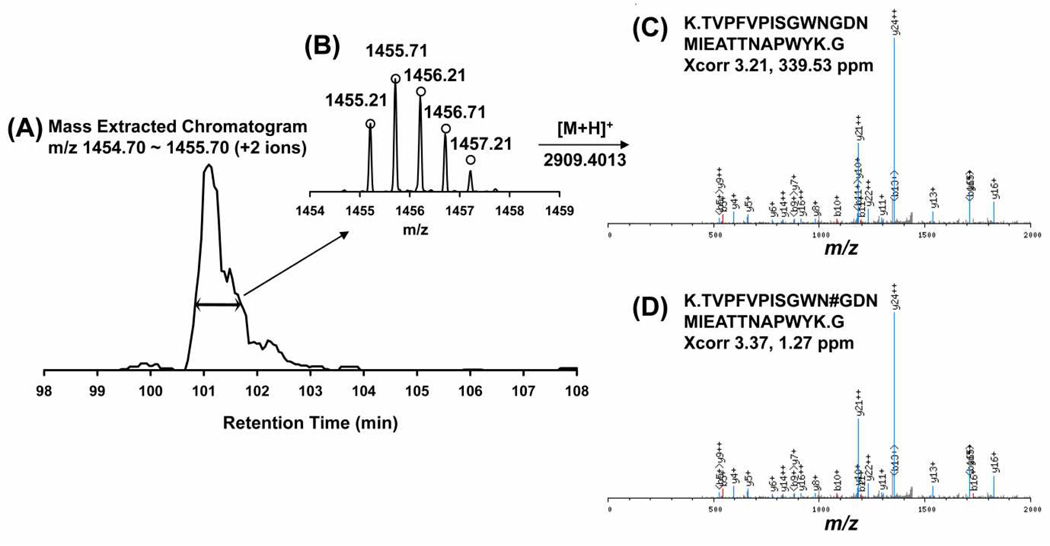
(A) Mass extracted chromatogram of a +2 precursor ion. (B) An averaged isotopic distribution of the corresponding precursor ion. ○ denotes the theoretical isotopic distribution of the predicted peptide (R.NMIIVPEMIGSVVGIYN#GK.A, #=deamidation). (C) Peptide identification without consideration of deamidation. (D) Peptide identification with consideration of deamidation.

References

    1. Shin B, Jung H-J, Hyung S-W, Kim H, Lee D, Lee C, Yu M-H, Lee S-W. Mol. Cell. Proteomics. 2008;7:1124–1134. - PubMed
    1. Luethy R, Kessner DE, Katz JE, McLean B, Grothe R, Kani K, Faca V, Pitteri S, Hanash S, Agus DB, Mallick P. J. Proteome Res. 2008;7:4031–4039. - PMC - PubMed
    1. Hsieh EJ, Hoopmann MR, MacLean B, MacCoss MJ. J. Proteome Res. 2010;9:1138–1143. - PMC - PubMed
    1. Beausoleil SA, Villen J, Gerber SA, Rush J, Gygi SP. Nat. Biotechnol. 2006;24:1285–1292. - PubMed
    1. Bakalarski CE, Haas W, Dephoure NE, Gygi SP. Anal. Bioanal. Chem. 2007;389:1409–1419. - PubMed

Publication types

LinkOut - more resources