. 2010 Sep;8(3):155-64.
doi: 10.1089/lrb.2010.0004.

Differential cytokine responses in human and mouse lymphatic endothelial cells to cytokines in vitro

Affiliations

Differential cytokine responses in human and mouse lymphatic endothelial cells to cytokines in vitro

G V Chaitanya et al. Lymphat Res Biol. 2010 Sep.

Abstract

Background: Inflammatory cytokines dysregulate microvascular function, yet how cytokines affect lymphatic endothelial cells (LEC) are unclear.

Methods and results: We examined effects of TNF-α, IL-1 beta, and IFN-gamma on LEC proliferation, endothelial cell adhesion molecule (ECAM) expression, capillary formation, and barrier changes in murine (SV-LEC) and human LECs (HMEC-1a).

Results: All cytokines induced ICAM-1, VCAM-1, MAdCAM-1, and E-selectin in SV-LECs; TNF-α, IL-1 beta; and IFN-gamma induced ECAMs (but not MAdCAM-1) in HMEC-1a. IL-1 beta increased, while IFN-gamma and TNF-α reduced SV-LEC proliferation. While TNF-α induced, IFN-gamma decreased, and IL-1 beta did not show any effect on HMEC-1a proliferation. TNF-α, IL-1 beta, and IFN-gamma each reduced capillary formation in SV-LEC and in HMEC-1a. TNF-α and IL-1 beta reduced barrier in SV-LEC and HMEC-1a; IFN-gamma did not affect SV-LEC barrier, but enhanced HMEC-1a barrier. Inflammatory cytokines alter LEC growth, activation and barrier function in vitro and may disturb lymphatic clearance increasing tissue edema in vivo.

Conclusion: Therapies that maintain or restore lymphatic function (including cytokines blockade), may represent important strategies for limiting inflammation.


Figures
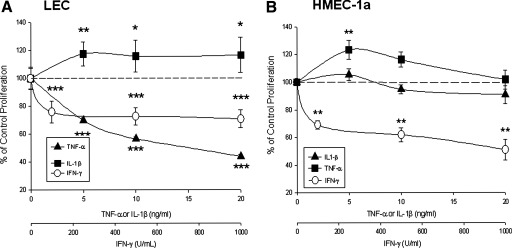
FIG. 1.
FIG. 1.
SV-LEC proliferation and cytokines. (A) TNF-α, IFN-γ inhibited, IL-1β stimulated LEC proliferation (72 h). TNF-α, (5–20 ng/ml), IFN-γ (100–1000 U/ml) decreased LEC proliferation. IL-1β increased LEC proliferation: IL-1β, (5- 20 ng/ml). (B) HMEC-1a proliferation and cytokines: IFN-γ (100–1000 U/ml) dose dependently decreased HMEC-1a proliferation. IL-1β did not affect HMEC-1a proliferation. At 72 h, 5 ng/ml TNF-α increased HMEC-1a proliferation; (10 and 20 ng/ml:not significant).
FIG. 2.
FIG. 2.
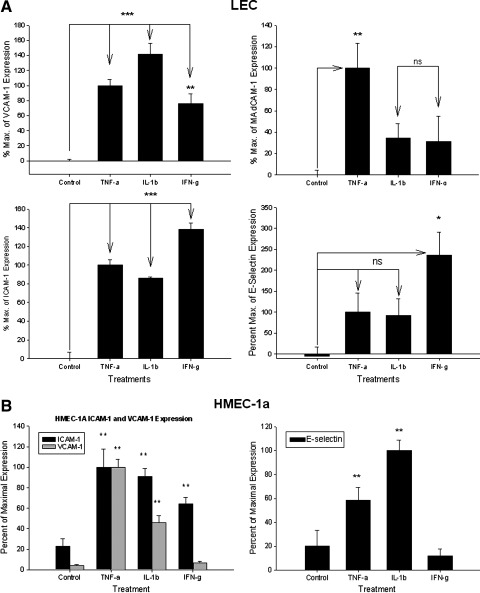
(A) ECAM expression in SV-LEC. ICAM-1. TNF-α (20 ng/ml) induced ICAM-1 over untreated controls; IL-1β (10 ng/ml) and IFN-γ (1000 U/ml) induced ICAM-1. VCAM-1. TNF-α (20 ng/ml) and IL-1β (10 ng/ml) and IFN-γ (1000 U/ml) induced VCAM-1. MAdCAM-1. TNF-α (20 ng/ml) significantly induced MAdCAM-1 expression. Neither IL-1β, nor IFN-γ induced MAdCAM-1. E-Selectin. Only IFN-γ (1000 U/ml) induced E-selectin on LEC. TNF-α (20 ng/ml) or IL-1β (10 ng/ml) slightly, (n.s.) increased E-selectin. (B) HMEC-1a ECAM expression. ICAM-1. TNF-α (20 ng/ml), IL-1β (10 ng/ml), and IFN-γ (1000 U/ml) each induced ICAM-1. VCAM-1. TNF-α (20 ng/ml), IL-1β (10 ng/ml) but not IFN-γ (1000 U/ml) induced VCAM-1. E-selectin. IL-1β and TNF-α induced E-Selectin on HMEC-1a cells.
FIG. 3.
FIG. 3.
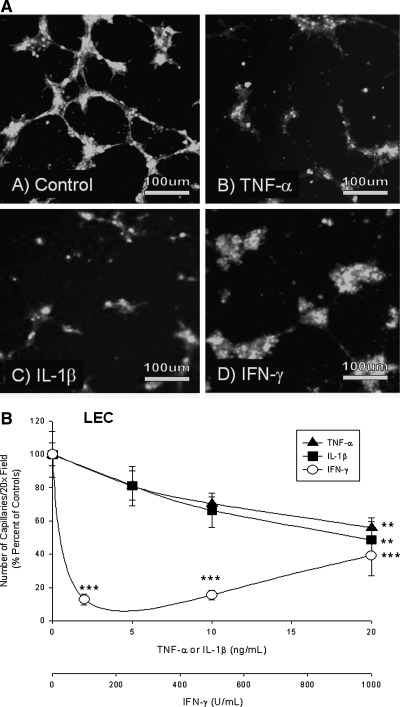
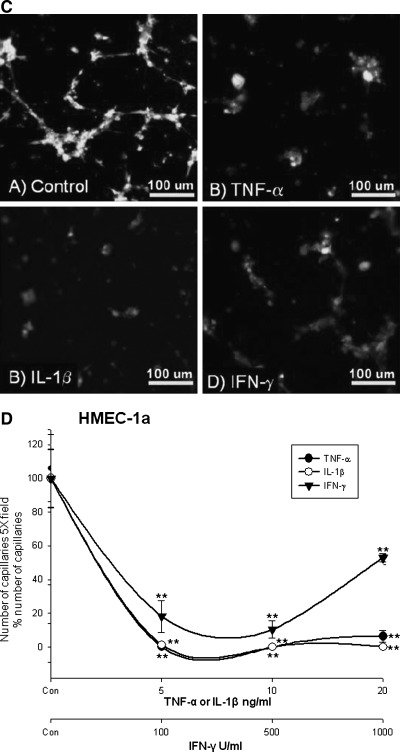
(A) Cytokines reduce SV-LEC capillary tube formation. TNF-α and IL-1β, (not IFN-γ) reduced numbers of lymphatic capillaries. TNF-α, IL-1β, and IFN-γ significantly decreased the number of lymphatic capillaries (all concentrations). (B) Micrographs of SV-LEC capillary tube formation. (C) HMEC-1a. TNF-α and IL-1β completely inhibited HMEC-1a tube formation. IFN- γ partly decreased lymphatic tube formation but was less effective than TNF-α/IL-1β. (D) Micrographs of HMEC-1a capillary tube formation.
FIG. 3.
FIG. 3.
(A) Cytokines reduce SV-LEC capillary tube formation. TNF-α and IL-1β, (not IFN-γ) reduced numbers of lymphatic capillaries. TNF-α, IL-1β, and IFN-γ significantly decreased the number of lymphatic capillaries (all concentrations). (B) Micrographs of SV-LEC capillary tube formation. (C) HMEC-1a. TNF-α and IL-1β completely inhibited HMEC-1a tube formation. IFN- γ partly decreased lymphatic tube formation but was less effective than TNF-α/IL-1β. (D) Micrographs of HMEC-1a capillary tube formation.
FIG. 4.
FIG. 4.
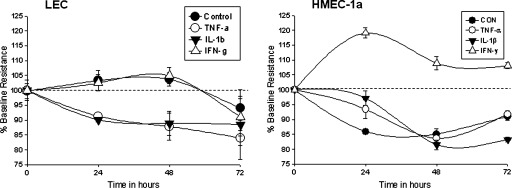
SV-LEC and HMEC-1a barrier. SV-LEC TEER of control cells was constant throughout the study. TNF-α and IL-1β time-dependently decreased SV-LEC TEER. IFN-γ did not alter TEER. HMEC-1a TEER. Control TEER of control cells decreased slightly over 72 h. TNF-α: TNF-α decreased TEER at 48–72 h. IL-1β: No significant alterations in HMEC-1a TEER with IL-1b (10 ng/ml). IFN-γ: IFN-γ significantly increased HMEC-1a TEER at 24–72 h.

References

    1. Adams RH. Alitalo K. Molecular regulation of angiogenesis and lymphangiogenesis. Nat Rev Mol Cell Biol. 2007;8:464–478. - PubMed
    1. Ali H. Haribabu B. Richardson RM. Snyderman R. Mechanisms of inflammation and leukocyte activation. Med Clin North Am. 1997;81:1–28. - PubMed
    1. Granger DN. Kubes P. The microcirculation and inflammation: Modulation of leukocyte-endothelial cell adhesion. J Leukoc Biol. 1994;55:662–675. - PubMed
    1. Connor TJ. Harkin A. Kelly JP. Leonard BE. Olfactory bulbectomy provokes a suppression of interleukin-1beta and tumour necrosis factor-alpha production in response to an in vivo challenge with lipopolysaccharide: Effect of chronic desipramine treatment. Neuroimmunomodulation. 2000;7:27–35. - PubMed
    1. Shigematsu T. Specian RD. Wolf RE. Grisham MB. Granger DN. MAdCAM mediates lymphocyte-endothelial cell adhesion in a murine model of chronic colitis. Am J Physiol Gastrointest Liver Physiol. 2001;281:G1309–G1315. - PubMed

MeSH terms

LinkOut - more resources