


Efficacy of different strategies to treat anemia in children: a randomized clinical trial
- PMID: 20863398
- PMCID: PMC2955680
- DOI: 10.1186/1475-2891-9-40
Efficacy of different strategies to treat anemia in children: a randomized clinical trial
Abstract
Background: Anemia continues to be a major public health problem among children in many regions of the world, and it is still not clear which strategy to treat it is most effective.
Objective: To evaluate the efficacy and children's acceptance of several recognized strategies to treat anemia.
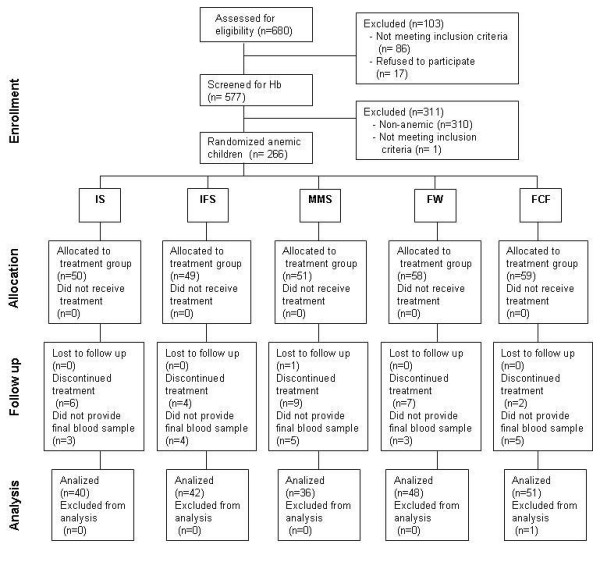
Methods: Non-breastfed children (n = 577), 6 to 43 mo of age, were screened for the trial; 267 were anemic (hemoglobin < 11.7 g/dL), and 266 of those were randomized into 1 of 5 treatments to received daily either: an iron supplement (IS), an iron+folic acid supplement (IFS), a multiple micronutrient supplement (MMS), a micronutrient-fortified complementary food as porridge powder (FCF), or zinc+iron+ascorbic acid fortified water (FW). The iron content of each daily dose was 20, 12.5, 10, 10 and 6.7 mg respectively. Hemoglobin (Hb), ferritin, total iron, weight and height were measured at baseline and after 4 months of treatment. Morbidity, treatment acceptability and adherence were recorded during the intervention.
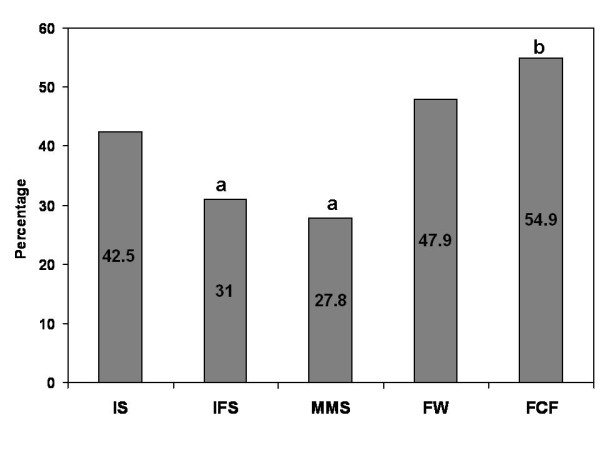
Results: All treatments significantly increased Hb and total iron concentration; ferritin did not change significantly. Groups MMS, IS and IFS increased Hb (g/dL) [1.50 (95%CI: 1.17, 1.83), 1.48 [(1.18, 1.78) and 1.57 (1.26, 1.88), respectively] and total iron ((μg/dL) [0.15 (0.01, 0.29), 0.19 (0.06, 0.31) and 0.12(-0.01, 0.25), respectively] significantly more than FCF [0.92 (0.64, 1.20)] but not to FW group [0.14 (0.04, 0.24)]. The prevalence of anemia was reduced to a greater extent in the MMS and IFS groups (72% and 69%, respectively) than in the FCF group (45%) (p < 0.05). There were no significant differences in anthropometry or in the number of episodes of diarrhea and respiratory infections among treatment groups. The supplements MMS and IS were less acceptable to children, than IFS, FCF and FW.
Conclusion: The three supplements IS, ISF and MMS increased Hb more than the FCF; the supplements that contained micronutrients (IFS and MMS) were more effective for reducing the prevalence of anemia. In general, fortified foods were better accepted by the study participants than supplements. CLINICALTRIAL.GOV IDENTIFIER: NCT00822380.
Figures
References
Publication types
MeSH terms
Substances
Associated data
LinkOut - more resources
Full Text Sources
Medical
