


Individual (N-of-1) trials can be combined to give population comparative treatment effect estimates: methodologic considerations
- PMID: 20863658
- PMCID: PMC2963698
- DOI: 10.1016/j.jclinepi.2010.04.020
Individual (N-of-1) trials can be combined to give population comparative treatment effect estimates: methodologic considerations
Abstract
Objective: To compare different statistical models for combining N-of-1 trials to estimate a population treatment effect.
Study design and setting: Data from a published series of N-of-1 trials comparing amitriptyline (AMT) therapy and combination treatment (AMT+fluoxetine [FL]) were analyzed to compare summary and individual participant data meta-analysis; repeated-measure models; Bayesian hierarchical models; and single-period, single-pair, and averaged outcome crossover models.
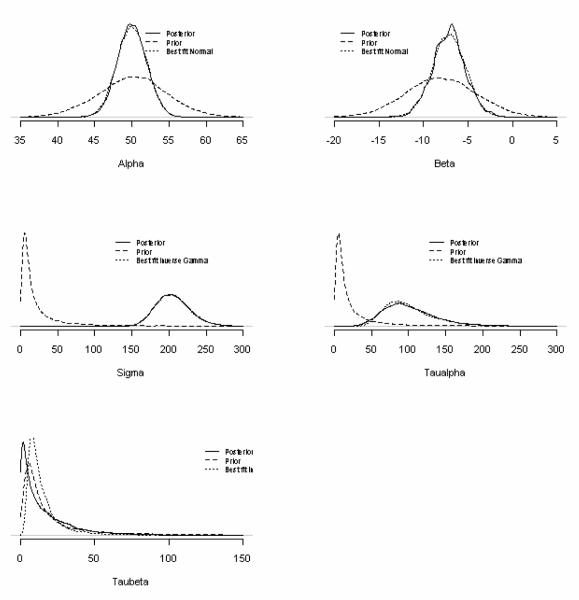
Results: The best-fitting model included a random intercept (response on AMT) and fixed treatment effect (added FL). Results supported a common, uncorrelated within-patient covariance structure that is equal between treatments and across patients. Assuming unequal within-patient variances, a random-effect model was favored. Bayesian hierarchical models improved precision and were highly sensitive to within-patient variance priors.
Conclusion: Optimal models for combining N-of-1 trials need to consider goals, data sources, and relative within- and between-patient variances. Without sufficient patients, between-patient variation will be hard to explain with covariates. N-of-1 data with few observations per patients may not support models with heterogeneous within-patient variation. With common variances, models appear robust. Bayesian models may improve parameter estimation but are sensitive to prior assumptions about variance components. With limited resources, improving within-patient precision must be balanced by increased participants to explain population variation.
Copyright © 2010 Elsevier Inc. All rights reserved.
Figures
Comment in
-
N-of-1 clinical trials should be incorporated into clinical practice.J Clin Epidemiol. 2010 Dec;63(12):1283-4. doi: 10.1016/j.jclinepi.2010.05.006. Epub 2010 Aug 30. J Clin Epidemiol. 2010. PMID: 20800449
References
-
- Guyatt G, Sackett D, Taylor DW, Chong J, Roberts R, Pugsley S. Determining optimal therapyrandomized trials in individual patients. N Engl J Med. 1986 April 3;314(14):889–92. - PubMed
-
- Zucker DR, Schmid CH, McIntosh MW, D’Agostino RB, Selker HP, Lau J. Combining single patient (N-of-1) trials to estimate population treatment effects and to evaluate individual patient responses to treatment. J Clin Epidemiol. 1997;50(4):401–10. - PubMed
-
- Jaeschke R, Adachi J, Guyatt G, Keller J, Wong B. Clinical usefulness of amitriptyline in fibromyalgia: the results of 23 N-of-1 randomized controlled trials. J Rheumatol. 1991 March;18(3):447–51. - PubMed
-
- Zucker DR, Ruthazer R, Schmid CH, Feuer JM, Fischer PA, Kieval RI, Mogavero N, Rapoport RJ, Selker HP, Stotsky SA, Winston E, Goldenberg DL. Lessons learned combining N-of-1 trials to assess fibromyalgia therapies 1. J Rheumatol. 2006 October;33(10):2069–77. - PubMed
Publication types
MeSH terms
Substances
Grants and funding
LinkOut - more resources
Full Text Sources
Other Literature Sources
Medical
