. 2010 Nov;154(3):1220-31.
doi: 10.1104/pp.110.160796. Epub 2010 Sep 23.

Two coordinately regulated homologs of FLOWERING LOCUS T are involved in the control of photoperiodic flowering in soybean

Affiliations

Two coordinately regulated homologs of FLOWERING LOCUS T are involved in the control of photoperiodic flowering in soybean

Fanjiang Kong et al. Plant Physiol. 2010 Nov.

Abstract

FLOWERING LOCUS T (FT) is a key flowering integrator in Arabidopsis (Arabidopsis thaliana), with homologs that encode florigens in many plant species regardless of the type of photoperiodic response. We identified 10 FT homologs, which were arranged as five pairs of linked genes in different homoeologous chromosomal regions, in soybean (Glycine max), a paleopolyploid species. Two of the FT homologs, GmFT2a and GmFT5a, were highly up-regulated under short-day (SD) conditions (inductive for flowering in soybean) and had diurnal expression patterns with the highest expression 4 h after dawn. Under long-day (LD) conditions, expression of GmFT2a and GmFT5a was down-regulated and did not follow a diurnal pattern. Flowering took much longer to initiate under LD than under SD, and only the GmFT5a transcript accumulated late in development under LD. Ectopic expression analysis in Arabidopsis confirmed that both GmFT2a and GmFT5a had the same function as Arabidopsis FT, but the effect of GmFT5a was more prominent. A double-mutant soybean line for two PHYTOCHROME A (PHYA) genes expressed high levels of GmFT2a and GmFT5a under LD, and it flowered slightly earlier under LD than the wild type grown under SD. The expression levels of GmFT2a and GmFT5a were regulated by the PHYA-mediated photoperiodic regulation system, and the GmFT5a expression was also regulated by a photoperiod-independent system in LD. Taken together, our results suggest that GmFT2a and GmFT5a coordinately control flowering and enable the adaptation of soybean to a wide range of photoperiodic environments.


Figures
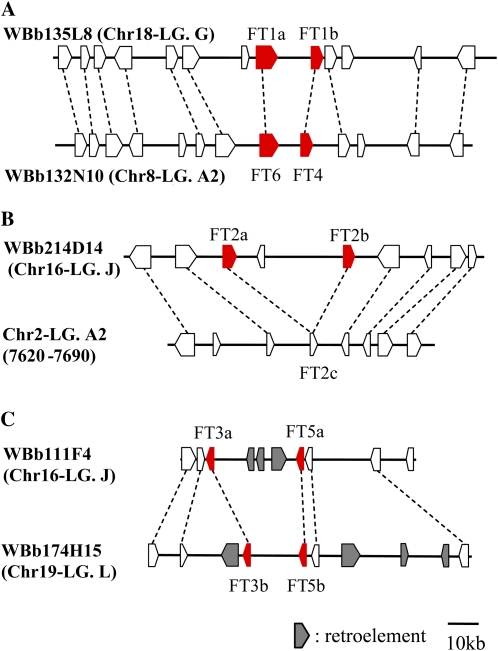
Figure 1.
Figure 1.
Soybean FT homologs arranged as tandemly linked genes in different pairs of homoeologous BAC clones. A, Linked pairs GmFT1a/GmFT1b in WBb135L8 (Chr18-LG G) and GmFT4/GmFT6 in WBb132N10 (Chr8-LG A2). B, A linked pair, GmFT2a/GmFT2b in WBb214D14 (Chr16-LG J), and a pseudogene of FT (GmFT2c) in chromosome 2 (Chr2-LG D1b). C, Linked pairs GmFT3a/GmFT5a in WBb174H15 (Chr16-LG J) and GmFT3/GmFT5b in WBb111F4 (Chr19-LG L).
Figure 2.
Figure 2.
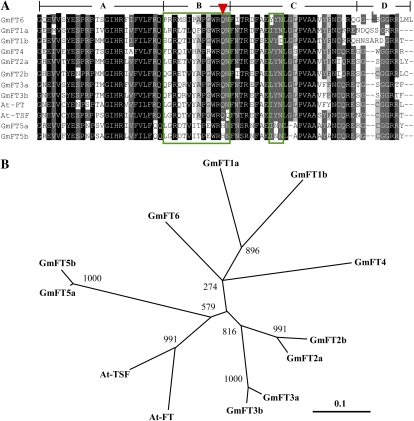
Similarity of the predicted amino acid sequences of Arabidopsis FT and TSF and 10 soybean FT homologs. A, Multiple alignment of the predicted amino acid sequences in exon 4 of Arabidopsis FT (NM105222) and TSF (AF152907) and soybean FT homologs. The cDNAs for six FT homologs were isolated from cv Harosoy in this study: GmFT1a (AB550120; Glyma18g53680), GmFT1b (AB550121; Glyma18g53690), GmFT2a (AB550122; Glyma16g26660), GmFT3a (AB550124; Glyma16g04840), GmFT3b (AB550125; Glyma19g28390), and GmFT5a (AB550126; Glyma16g04830). The cDNA sequences for GmFT2b (Glyma16g26690), GmFT4 (Glyma08g47810), GmFT5b (Glyma19g28400), and GmFT6 (Glyma08g47820) were taken from the Williams 82 genome database. Highly conserved amino acids are in black, dark gray, or light gray depending on the level of identity (darker = higher level). Green boxes and the red arrowhead indicate the 14-amino acid stretch (segment B) and the LYN triad in segment C and a crucial amino acid identified as diagnostic of FT genes (Ahn et al., 2006). B, Phylogenetic relationships of Arabidopsis and soybean FT proteins constructed using the neighbor-joining method with the program ClustalW. Bootstrap percentage supports are indicated at the branches of the tree.
Figure 3.
Figure 3.
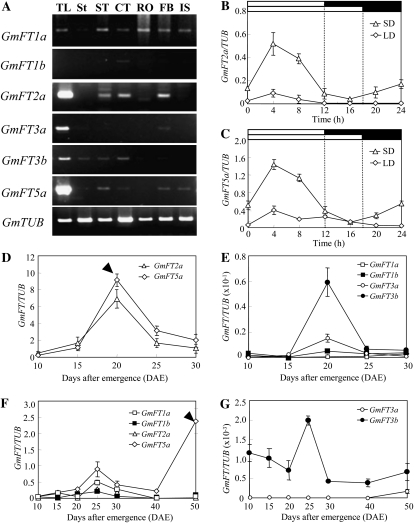
Transcription profiles of soybean FT homologs. A, Tissue-specific expression in SD. Tissues tested are trifoliate leaf (TL), stem (St), stem tip (ST), cotyledon (CT), root (RO), flower bud (FB), and immature seed (IS). B and C, Diurnal expression of GmFT2a and GmFT5a under SD and LD. Trifoliate leaves were sampled every 4 h at 15 DAE. White and black bars at the top represent light and dark phases, respectively. D to G, Time course-dependent expression in SD (D and E) and LD (F and G). Relative transcript levels were analyzed by quantitative RT-PCR and normalized to β-tubulin (TUB). Average and se values for three replications are given for each data point. Arrowheads indicate the time of flower bud formation.
Figure 4.
Figure 4.
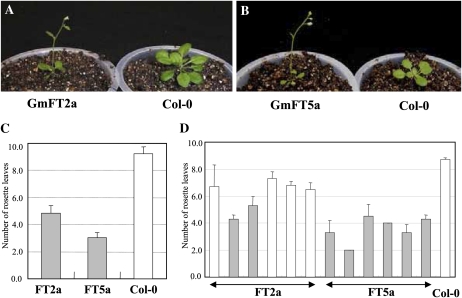
Effect of ectopic expression analyses of GmFT2a and GmFT5a on Arabidopsis. A and B, Premature flowering induced by ectopic expression of GmFT2a and GmFT5a. C, Number of rosette leaves when the first flower bud appears in T1 and Col-0 plants. Average and se values are calculated from six independent T1 plants for each construct and 10 Col-0 plants. D, Number of rosette leaves in T2 and Col-0 plants. PCR with primers specific to the 35S promoter was carried out to confirm the presence of the transgene in each T2 plant derived from independent T1 plants. Gray bars indicate mean values significantly different from Col-0 by the Tukey-Kramer method.
Figure 5.
Figure 5.
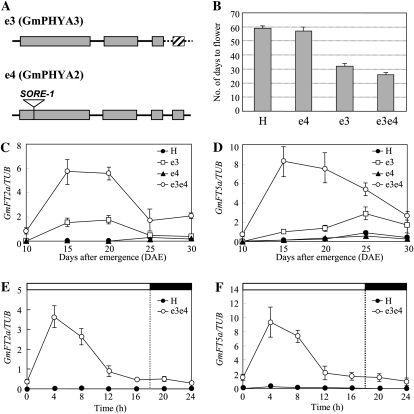
Expression of GmFT2a and GmFT5a in Harosoy and its PHYA mutant isolines under LD conditions. A, Dysfunctional alleles at the E3 and E4 loci encoding the PHYA genes, GmPHYA3 and GmPHYA2, respectively. The mutation in e3 is caused by the deletion of a 13-kb region including the fourth exon (Watanabe et al., 2009), whereas e4 contains an insertion of a Ty1/copia-like retrotransposon (SORE-1) in the first exon (Liu et al., 2008; Kanazawa et al., 2009). B, Flowering dates under LD of Harosoy (E3E3E4E4; H) and its NILs for e3 (e3), e4 (e4), and e3 and e4 (e3e4). C and D, Time course-dependent expression of GmFT2a and GmFT5a. E and F, Diurnal expression of GmFT2a and GmFT5a. White and black bars at the top represent light and dark phases, respectively. Relative transcript levels were analyzed by quantitative RT-PCR and normalized to β-tubulin (TUB). Average and se values for three replications (six plants for the evaluation of flowering time) are given for each data point.
Figure 6.
Figure 6.
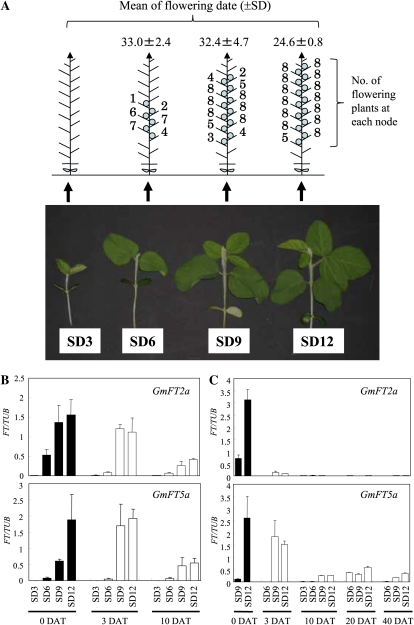
Expression of GmFT2a and GmFT5a in soybean plants upon transferring from SD to LD conditions. A, Flowering responses of Harosoy exposed to different durations of SD after emergence in LD. Seedlings of Harosoy grown in SD conditions for 3, 6, 9, and 12 d, from left to right, after emergence were transferred to LD. B, Expression of GmFT2a and GmFT5a in primary leaves. C, Expression of GmFT2a and GmFT5a in trifoliate leaves. DAT, Days after transferring to LD conditions. SD3, SD6, SD9, and SD12 indicate that plants were exposed to SD conditions for 3, 6, 9, and 12 d, respectively. Relative transcript levels were analyzed by quantitative RT-PCR and normalized to β-tubulin (TUB). Average and se values for three replications are given for each data point.

References

    1. Abe M, Kobayashi Y, Yamamoto S, Daimon Y, Yamaguchi A, Ikeda Y, Ichinoki H, Notaguchi M, Goto K, Araki T. (2005) FD, a bZIP protein mediating signals from the floral pathway integrator FT at the shoot apex. Science 309: 1052–1056 - PubMed
    1. Ahn JH, Miller D, Winter VJ, Banfield MJ, Lee JH, Yoo SY, Henz SR, Brady RL, Weigel D. (2006) A divergent external loop confers antagonistic activity on floral regulators FT and TFL1. EMBO J 25: 605–614 - PMC - PubMed
    1. Böhlenius H, Huang T, Charbonnel-Campaa L, Brunner AM, Jansson S, Strauss SH, Nilsson O. (2006) CO/FT regulatory module controls timing of flowering and seasonal growth cessation in trees. Science 312: 1040–1043 - PubMed
    1. Borthwick HA, Parker MW. (1938) Effectiveness of photoperiodic treatments of plants of different age. Bot Gaz 100: 245–249
    1. Buzzell RI. (1971) Inheritance of a soybean flowering response to fluorescent-daylength conditions. Can J Genet Cytol 13: 703–707

Publication types