


The impact of Massachusetts' smoke-free workplace laws on acute myocardial infarction deaths
- PMID: 20864706
- PMCID: PMC2951939
- DOI: 10.2105/AJPH.2009.189662
The impact of Massachusetts' smoke-free workplace laws on acute myocardial infarction deaths
Abstract
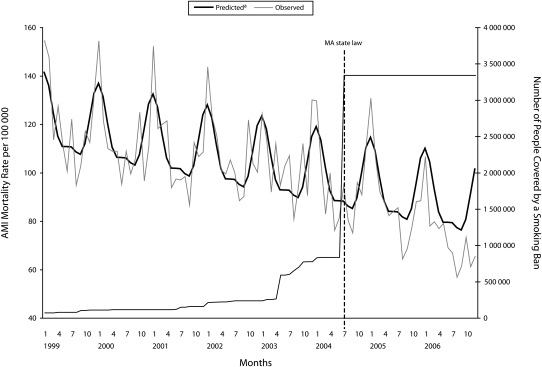
Objectives: We examined the rate of acute myocardial infarction (AMI) deaths in Massachusetts before and after the implementation of a comprehensive smoke-free workplace law in July 2004.
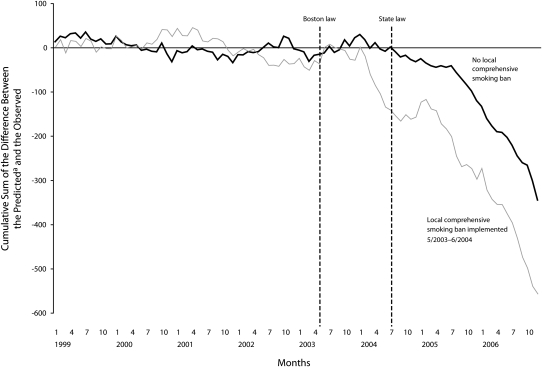
Methods: We used Poisson regression models to examine the impact of the state law in cities and towns with and without previous local smoking bans and the effect of the local laws for the period of 1999 through 2006.
Results: The AMI mortality rate decreased by 7.4% (95% confidence interval [CI] = 3.3%, 11.4%) after implementation of the state law. The state ban had an impact in cities and towns with no prior local smoking ban (9.2% decrease; P < .001) but not cities and towns with a prior local smoking ban. However, there was a nonsignificant 4.9% (95% CI = -5.0%, 13.9%) decrease associated with the local smoking ban that preceded the effect of the state ban. The effect of the state ban was modest (-1.6%) in the first 12 months after implementation but much larger after the first 12 months (-18.6%; P < .001).
Conclusions: Comprehensive statewide smoke-free workplace laws in Massachusetts were associated with an estimated 270 fewer AMI deaths per year. These results add to the evidence suggesting that smoke-free air laws are associated with lower rates of AMI.
Figures
References
-
- US Department of Health and Human Services The Health Consequences of Involuntary Exposure to Tobacco Smoke: A Report of the Surgeon General. Atlanta, GA: Centers for Disease Control and Prevention, Office on Smoking and Health; 2006
-
- Meyers DG, Neuberger JS, He J. Cardiovascular effect of bans on smoking in public places. J Am Coll Cardiol. 2009;54(14):1249–1255 - PubMed
Publication types
MeSH terms
Grants and funding
LinkOut - more resources
Full Text Sources
Medical
