Mutation in the gene encoding ubiquitin ligase LRSAM1 in patients with Charcot-Marie-Tooth disease
- PMID: 20865121
- PMCID: PMC2928813
- DOI: 10.1371/journal.pgen.1001081
Mutation in the gene encoding ubiquitin ligase LRSAM1 in patients with Charcot-Marie-Tooth disease
Abstract
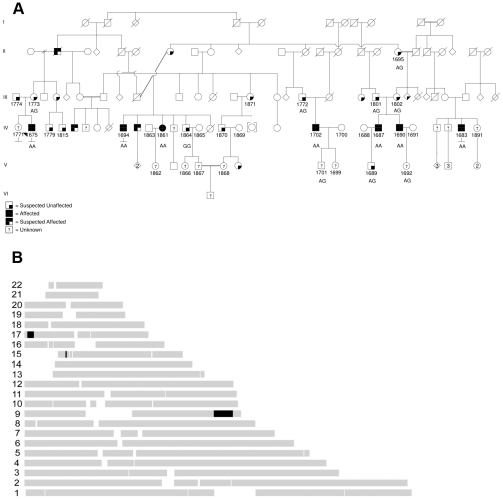
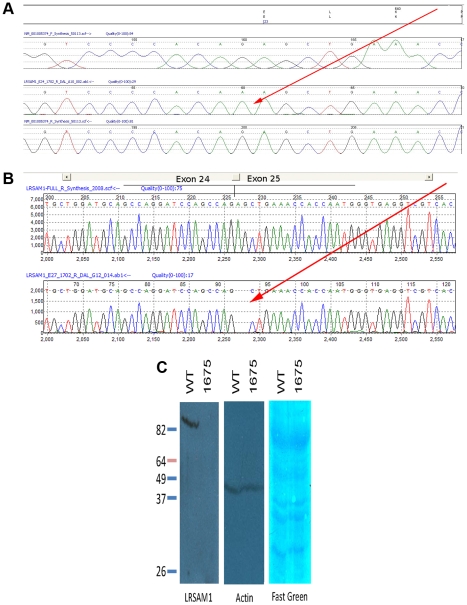
Charcot-Marie-Tooth disease (CMT) represents a family of related sensorimotor neuropathies. We studied a large family from a rural eastern Canadian community, with multiple individuals suffering from a condition clinically most similar to autosomal recessive axonal CMT, or AR-CMT2. Homozygosity mapping with high-density SNP genotyping of six affected individuals from the family excluded 23 known genes for various subtypes of CMT and instead identified a single homozygous region on chromosome 9, at 122,423,730-129,841,977 Mbp, shared identical by state in all six affected individuals. A homozygous pathogenic variant was identified in the gene encoding leucine rich repeat and sterile alpha motif 1 (LRSAM1) by direct DNA sequencing of genes within the region in affected DNA samples. The single nucleotide change mutates an intronic consensus acceptor splicing site from AG to AA. Direct analysis of RNA from patient blood demonstrated aberrant splicing of the affected exon, causing an obligatory frameshift and premature truncation of the protein. Western blotting of immortalized cells from a homozygous patient showed complete absence of detectable protein, consistent with the splice site defect. LRSAM1 plays a role in membrane vesicle fusion during viral maturation and for proper adhesion of neuronal cells in culture. Other ubiquitin ligases play documented roles in neurodegenerative diseases. LRSAM1 is a strong candidate for the causal gene for the genetic disorder in our kindred.
Conflict of interest statement
The authors have declared that no competing interests exist.
Figures
References
-
- Reilly MM, Shy ME. Diagnosis and new treatments in genetic neuropathies. J Neurol Neurosurg Psychiatry. 2009;80:1304–1314. - PubMed
-
- Pareyson D, Marchesi C, Salsano E. Hereditary predominantly motor neuropathies. Curr Opin Neurol. 2009;22:451–459. - PubMed
-
- Kabzinska D, Hausmanowa-Petrusewicz I, Kochanski A. Charcot-Marie-Tooth disorders with an autosomal recessive mode of inheritance. Clin Neuropathol. 2008;27:1–12. - PubMed
-
- Jani-Acsadi A, Krajewski K, Shy ME. Charcot-Marie-Tooth neuropathies: diagnosis and management. Semin Neurol. 2008;28:185–194. - PubMed
Publication types
MeSH terms
Substances
LinkOut - more resources
Full Text Sources
Medical
Molecular Biology Databases
Research Materials
Miscellaneous