. 2011 Sep;21(9):968-79.
doi: 10.1002/hipo.20808. Epub 2010 May 20.

Pattern separation deficits associated with increased hippocampal CA3 and dentate gyrus activity in nondemented older adults

Affiliations

Pattern separation deficits associated with increased hippocampal CA3 and dentate gyrus activity in nondemented older adults

Michael A Yassa et al. Hippocampus. 2011 Sep.

Abstract

There is widespread evidence that memory deteriorates with aging, however the exact mechanisms that underlie these changes are not well understood. Given the growing size of the aging population, there is an imperative to study age-related neurocognitive changes in order to better parse healthy from pathological aging. Using a behavioral paradigm that taxes pattern separation (the ability to differentiate novel yet similar information from previously learned information and thus avoid interference), we investigated age-related neural changes in the human hippocampus using high-resolution (1.5 mm isotropic) blood-oxygenation level-dependent fMRI. Recent evidence from animal studies suggests that hyperactivity in the CA3 region of the hippocampus may underlie behavioral deficits in pattern separation in aged rats. Here, we report evidence that is consistent with findings from the animal studies. We found a behavioral impairment in pattern separation in a sample of healthy older adults compared with young controls. We also found a related increase in CA3/dentate gyrus activity levels during an fMRI contrast that stresses pattern separation abilities. In a detailed analysis of behavior, we also found that the pattern of impairment was consistent with the predictions of the animal model, where larger changes in the input (greater dissimilarity) were required in order for elderly adults to successfully encode new information as distinct from previously learned information. These findings are also consistent with recent fMRI and behavioral reports in healthy aging, and further suggest that a specific functional deficit in the CA3/dentate network contributes to memory difficulties with aging.


Figures

Figure 1
Figure 1
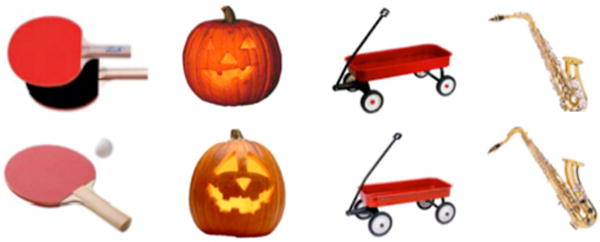
Sample behavioral task stimuli ranked in order of mnemonic similarity with highly dissimilar object pairs at the far left and highly similar object pairs at the far right.
Figure 2
Figure 2
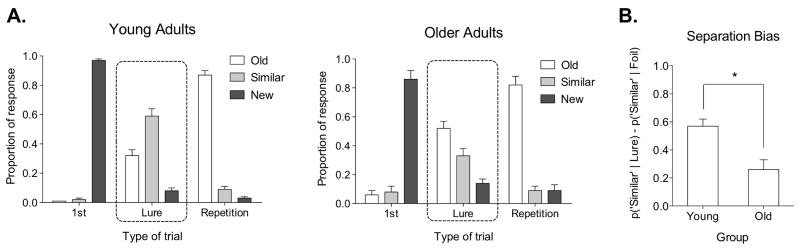
Experiment 1 behavioral data. Panel (A) shows response proportions on different trial types in young and old participants. Performance on repeated and new items was similar in both groups, while performance on lure items was not. Young adults tended to perform better (59% correctly identified as similar) than older adults (33% correctly identified as similar). Panel (B) shows the difference between young and old separation bias. Older adults had a significantly lower bias score than young adults. Data plotted as mean ± s.e.m.
Figure 3
Figure 3
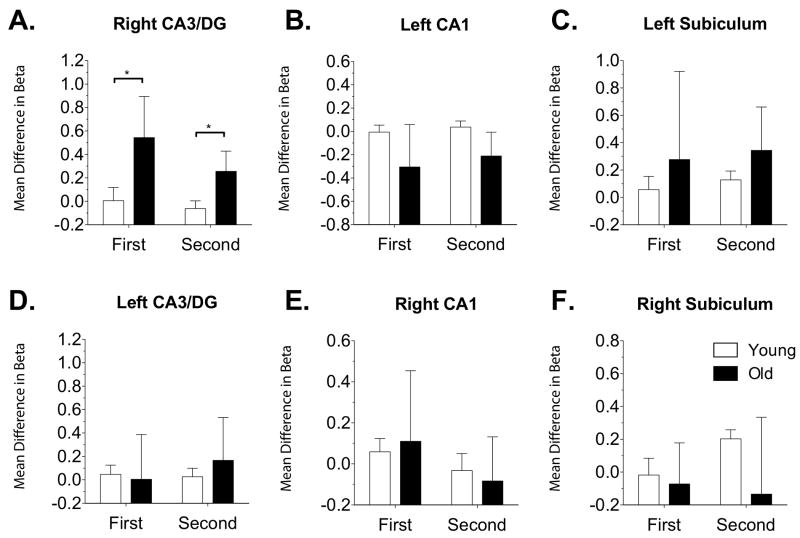
Hippocampal subfield BOLD activity on the critical lure contrasts based on hybrid anatomical / functional ROIs. The x-axis represents (1) activity during the first presentation of an item that was subsequently tested with a lure (first) and (2) the presentation of the lure itself (second). The y-axis mean difference in beta is the difference between lures called “similar” and lures called “old”. There were no significant differences between groups in any of the subregions or the contrasts except in the right CA3/DG region. This region showed a larger difference between correct rejections and false alarms during first and subsequent presentations. Data plotted as mean ± s.e.m.
Figure 4
Figure 4
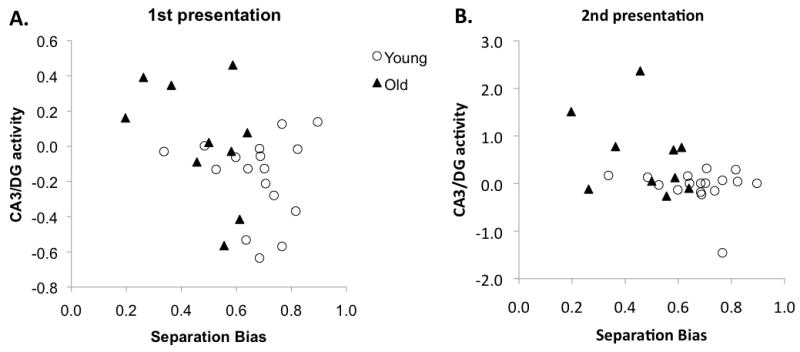
Correlations between CA3/DG activity during the critical 1st and 2nd presentations of lures labeled as “similar” versus lures labeled as “old” and behavioral separation bias scores.
Figure 5
Figure 5
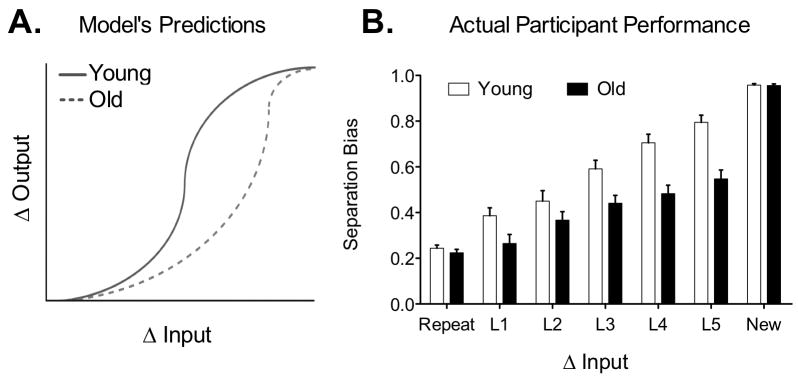
Parametric analysis of behavioral data based on binned mnemonic similarity ratings in Experiment 2. (A) Model predictions for young and old separation and completion behavior. (B) As predicted, older adults performance diverges from the young such that larger changes in input are required for them to successfully separate (label lure items as “similar” instead of “old”). Data plotted as mean ± s.e.m.
Figure 6
Figure 6
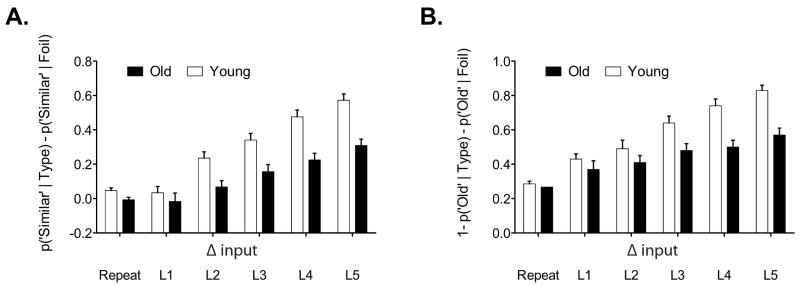
Response-bias corrected versions of the behavioral performance plot in Figure 4. (A) Bias metric = [p(“Similar”∣Lure) – p(“Similar”∣Foil)] for Lure bins 1-5 and [p(“Similar”∣Target) – p(“Similar”∣ Foil)] for repeated hits. Foils (1st presentations) are not plotted because they would by definition be zero. (B) Bias metric = 1-[p(“Old”∣Lure) – p(“Old”∣Foil)] for Lure bins 1-5 and 1-[p(“Old”∣Target) – p(“Old”∣Foil)] for repeated hits. Foils are again not plotted because by definition they would be 1.
Figure 7
Figure 7
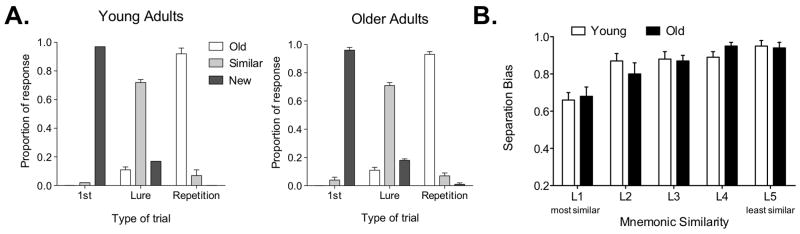
Results of the perceptual similarity / working memory task. Panel A shows results in the same format as Figure 2, illustrating the lack of age group differences on any of the task conditions. Panel B shows the breakdown by lure bins according to our mnemonic similarity ratings. There is clearly no group difference on any of the lure bins, suggesting that our aging effect is primarily driven by differences in mnemonic and not perceptual processing.

References

    1. Ances BM, Liang CL, Leontiev O, Perthen JE, Fleisher AS, Lansing AE, Buxton RB. Effects of aging on cerebral blood flow, oxygen metabolism, and blood oxygenation level dependent responses to visual stimulation. Human Brain Mapping. 2009;30(4):1120–1132. - PMC - PubMed
    1. Bakker A, Kirwan CB, Miller NI, Stark CEL. Pattern separation in the human hippocampal CA3 and dentate gyrus. Science. 2008;319:1640–1642. - PMC - PubMed
    1. Bassett SS, Yousem DM, Cristinzio C, Kusevic I, Yassa MA, Caffo BS, Zeger SL. Familial risk for Alzheimer's disease alters fMRI activation patterns. Brain. 2006;129:1229–1239. - PMC - PubMed
    1. Bookheimer SY, Strojwas MH, Cohen MS, Saunders AM, Pericak-Vance MA, Mazziotta JC, Small GW. Patterns of brain activation in people at risk for Alzheimer's disease. N Engl J Med. 2000;343:450–456. - PMC - PubMed
    1. Brandt J, Spencer M, Folstein M. The Telephone Interview for Cognitive Status. Neuropsychiatry, Neuropsychol Behav Neurol. 1988;1:111–117.

Publication types

MeSH terms