


Family-focused treatment for caregivers of patients with bipolar disorder
- PMID: 20868461
- PMCID: PMC2947337
- DOI: 10.1111/j.1399-5618.2010.00852.x
Family-focused treatment for caregivers of patients with bipolar disorder
Abstract
Objectives: Family members of patients with bipolar disorder experience high rates of subjective and objective burden which place them at risk for adverse physical health and mental health outcomes. We present preliminary efficacy data from a novel variation of Family Focused Treatment [Miklowitz DJ. Bipolar Disorder: A Family-Focused Treatment Approach (2(nd) ed.). New York: The Guilford Press, 2008] that aimed to reduce symptoms of bipolar disorder by working with caregivers to enhance illness management skills and self-care.
Methods: The primary family caregivers of 46 patients with bipolar I (n = 40) or II (n = 6) disorder, diagnosed by the Structured Clinical Interview for DSM-IV Axis I Disorders, were assigned randomly to receive either: (i) a 12-15-session family-focused, cognitive-behavioral intervention designed to provide the caregiver with skills for managing the relative's illness, attaining self-care goals, and reducing strain, depression, and health risk behavior [Family-Focused Treatment-Health Promoting Intervention (FFT-HPI)]; or (ii) an 8- to 12-session health education (HE) intervention delivered via videotapes. We assessed patients pre- and post-treatment on levels of depression and mania and caregivers on levels of burden, health behavior, and coping.
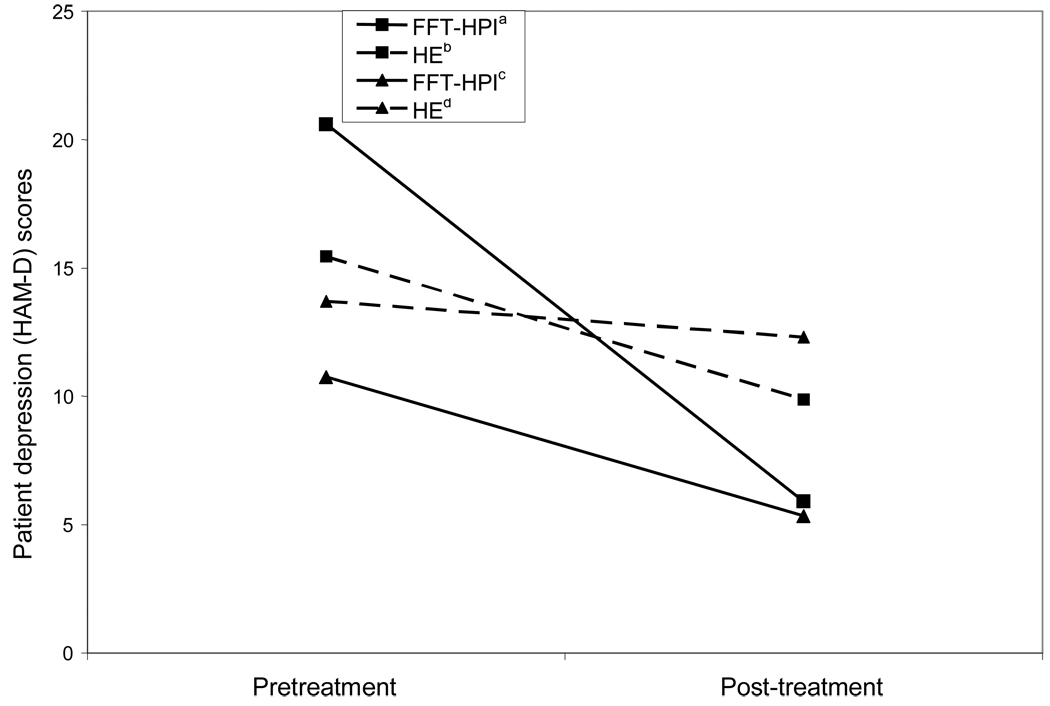
Results: Randomization to FFT-HPI was associated with significant decreases in caregiver depressive symptoms and health risk behavior. Greater reductions in depressive symptoms among patients were also observed in the FFT-HPI group. Reduction in patients' depression was partially mediated by reductions in caregivers' depression levels. Decreases in caregivers' depression were partially mediated by reductions in caregivers' levels of avoidance coping.
Conclusions: Families coping with bipolar disorder may benefit from family interventions as a result of changes in the caregivers' ability to manage stress and regulate their moods, even when the patient is not available for treatment.
© 2010 John Wiley and Sons A/S.
Conflict of interest statement
The authors of this paper do not have any commercial associations that might pose a conflict of interest in connection with this manuscript.
Figures
References
-
- Perlick DA, Clarkin JF, Sirey J, et al. Burden experienced by caregivers of persons with bipolar affective disorder. Br J Psychiatry. 1999;174:56–62. - PubMed
-
- Perlick DA, Rosenheck RA, Miklowitz DJ, et al. Prevalence and correlates of burden among caregivers of patients with bipolar disorder enrolled in the Systematic Treatment Enhancement Program for Bipolar Disorder. Bipolar Disord. 2007;9:262–273. - PubMed
-
- Chessick CA, Perlick DA, Miklowitz DJ, et al. Current suicide ideation and prior suicide attempts of bipolar patients as influences on caregiver burden. Suicide Life Threat Behav. 2007;37:482–491. - PubMed
-
- Russo J, Vitaliano PP, Brewer DD, Katon W, Becker J. Psychiatric disorders in spouse caregivers of care recipients with Alzheimer’s disease and matched controls: A diathesis-stress model of psychopathology. J Abnorm Psychology. 1995;104:197–204. - PubMed
-
- Scazufca M, Kuipers E. Coping strategies in relatives of people with schizophrenia before and after psychiatric admission. Br J Psychiatry. 1999;174:154–158. - PubMed
