


Evaluation of [(11)C]MRB for assessment of occupancy of norepinephrine transporters: Studies with atomoxetine in non-human primates
- PMID: 20869448
- PMCID: PMC3710586
- DOI: 10.1016/j.neuroimage.2010.09.040
Evaluation of [(11)C]MRB for assessment of occupancy of norepinephrine transporters: Studies with atomoxetine in non-human primates
Abstract
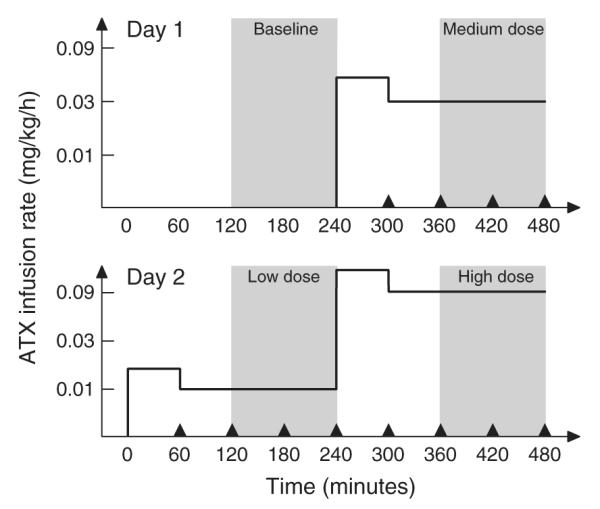
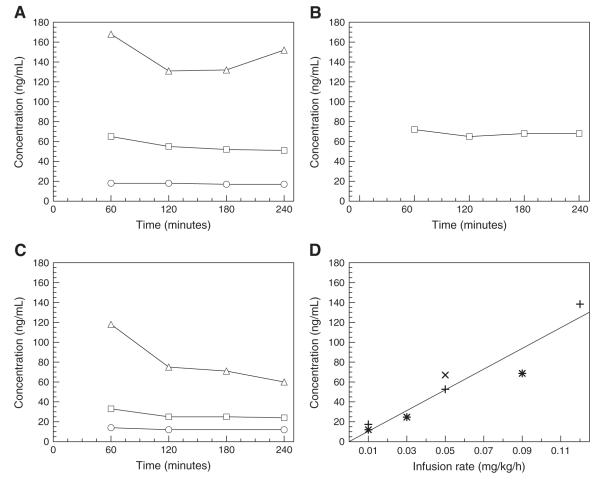
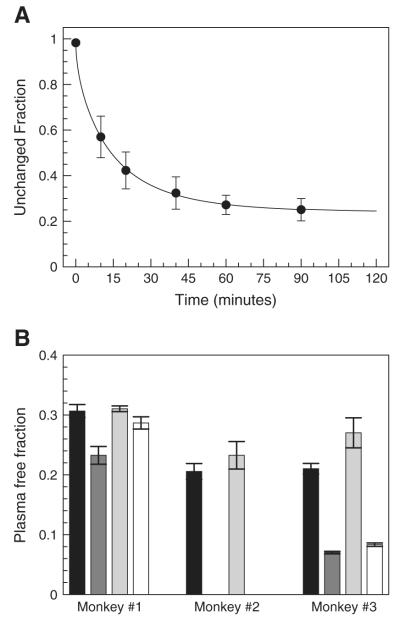
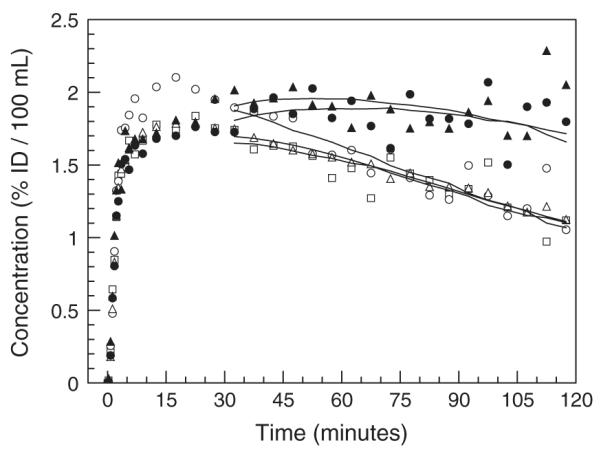
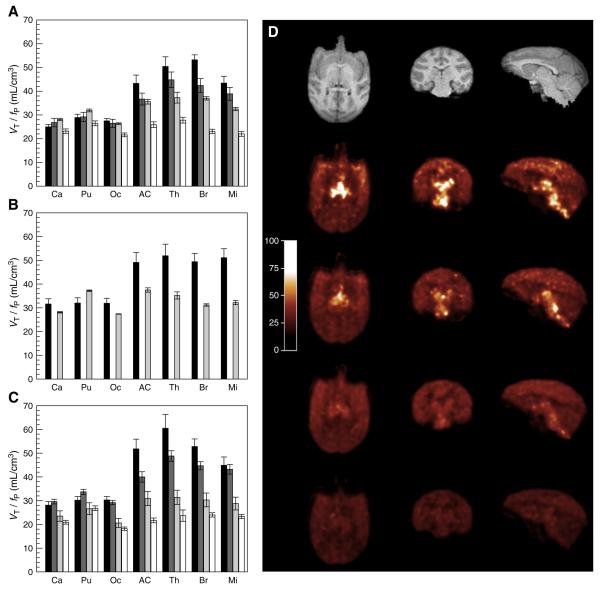
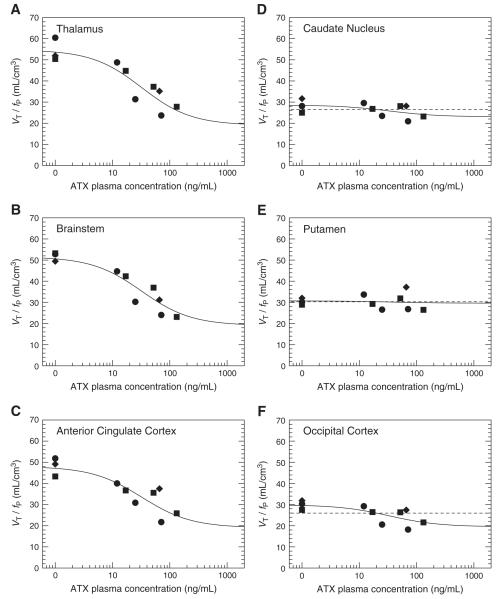
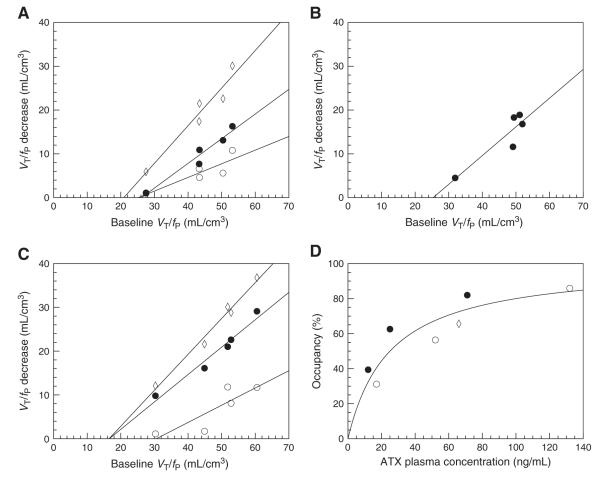
[(11)C]MRB is one of the most promising radioligands used to measure brain norepinephrine transporters (NET) with positron emission tomography (PET). The objective of this study was to evaluate the suitability of [(11)C]MRB for drug occupancy studies of NET using atomoxetine (ATX), a NET uptake inhibitor used in the treatment of depression and attention-deficit hyperactivity disorder (ADHD). A second goal of the study was identification of a suitable reference region. Ten PET studies were performed in three anesthetized rhesus monkeys following an infusion of ATX or placebo. [(11)C]MRB arterial input functions and ATX plasma levels were also measured. A dose-dependent reduction of [(11)C]MRB volume of distribution was observed after correction for [(11)C]MRB plasma free fraction. ATX IC(50) was estimated to be 31 ± 10ng/mL plasma. This corresponds to an effective dose (ED(50)) of 0.13mg/kg, which is much lower than the therapeutic dose of ATX in ADHD (1.0-1.5mg/kg). [(11)C]MRB binding potential BP(ND) in the thalamus was estimated to be 1.8 ± 0.3. Defining a reference region for a NET radiotracer is challenging due to the widespread and relatively uniform distribution of NET in the brain. Three regions were evaluated for use as reference region: caudate, putamen and occipital cortex. Caudate was found to be the most suitable for preclinical drug occupancy studies in rhesus monkeys. The IC(50) estimate obtained using MRTM2 BP(ND) without arterial blood sampling was 21 ± 3ng/mL (using caudate as the reference region). This study demonstrated that [(11)C]MRB is suitable for drug occupancy studies of NET.
Copyright © 2010 Elsevier Inc. All rights reserved.
Figures
References
-
- Arakawa R, Okumura M, Ito H, Seki C, Takahashi H, Takano H, Nakao R, Suzuki K, Okubo Y, Halldin C, Suhara T. Quantitative analysis of norepinephrine transporter in the human brain using PET with (S, S)-18F-FMeNER-D2. J. Nucl. Med. 2008;49:1270–1276. - PubMed
-
- Barker EL, Blakely RD. Norepinephrine and serotonin transporters: molecular targets of antidepressant drugs. In: Bloom FE, Kupfer DJ, editors. Psychopharmacology: the fourth generation of progress. Raven Press; New York, NY: 1995. pp. 321–334.
-
- Beck J, Arnold K. Parameter estimation in engineering and science. Wiley; New York, NY: 1977.
-
- Bymaster FP, Katner JS, Nelson DL, Hemrick-Luecke SK, Threlkeld PG, Heiligenstein JH, Morin SM, Gehlert DR, Perry KW. Atomoxetine increases extracellular levels of norepinephrine and dopamine in prefrontal cortex of rat: A potential mechanism for efficacy in attention deficit/hyperactivity disorder. Neuropsychopharmacology. 2002;27:699–711. - PubMed
-
- Carson RE, Barker WC, Liow J, Johnson CA. Design of a motion-compensation OSEM list-mode algorithm for resolution-recovery reconstruction for the HRRT. IEEE Nucl. Sci. Symp. Conf. Rec. 2003;5:3281–3285.
Publication types
MeSH terms
Substances
Grants and funding
LinkOut - more resources
Full Text Sources
