


Perceived barriers mediate the association between self-efficacy and fruit and vegetable consumption among students attending alternative high schools
- PMID: 20869495
- PMCID: PMC2976479
- DOI: 10.1016/j.jada.2010.07.001
Perceived barriers mediate the association between self-efficacy and fruit and vegetable consumption among students attending alternative high schools
Abstract
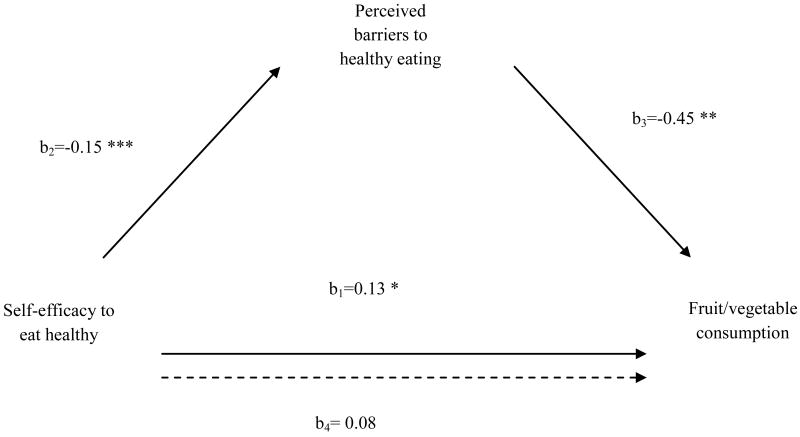
Compared to students attending regular high schools, alternative high school students are more likely to be racial/ethnic minorities, have higher levels of poverty, and higher rates of risky and poor health behaviors, including weight-related behaviors like limited fruit and vegetable intake. However, little is known about fruit/vegetable intake among alternative high school students. This study examined whether perceived barriers to healthy eating mediated the association between self-efficacy to eat healthy foods and fruit/vegetable consumption among alternative high school students. The cross-sectional study population consisted of students (N=145) attending six alternative high schools in the St Paul-Minneapolis, MN, area who were participants in an obesity prevention pilot study and completed a baseline survey during fall 2006. Mixed model linear regression, adjusting for sociodemographic characteristics, was used to test a series of regression models performed according to mediation analysis procedures. Students' mean age was 17.3 years; 52% were male, 63% were low-income, and 61% were from racial/ethnic minorities. Students reported a mean fruit/vegetable intake of 3.6 servings per day, mean self-efficacy to eat healthy score of 22.2 (range 3 to 35), and mean barriers to eating healthy score of 6.9 (range 3 to 13). Perceived barriers to healthy eating fully mediated the relationship between self-efficacy and fruit/vegetable consumption (Sobel test statistic 2.7, P=0.007). Interventions targeting the dietary practices of alternative high school students should include components to decrease perceived barriers as a way to increase self-efficacy and ultimately fruit/vegetable intake.
Copyright © 2010 American Dietetic Association. Published by Elsevier Inc. All rights reserved.
Figures
References
-
- The US Department of Health and Human Services. Healthy People 2010. second. II. Washington: US Government Printing Office; 2005. Nutrition and overweight.
-
- The US Department of Health and Human Services and US Department of Agriculture. Dietary Guidelines for Americans 2005. 6th. Washington: US Government Printing Office; 2005.
-
- Centers for Disease Control and Prevention. Youth risk behavior surveillance —United States, 2007. MMWR CDC Surveill Summ. 2008;57(SS-4)
-
- Larson NI, Neumark-Sztainer DR, Harnack LJ, Wall MM, Story MT, Eisenberg ME. Fruit and vegetable intake correlates during the transition to young adulthood. Am J Prev Med. 2008;35(1):33–37. - PubMed
-
- Drewnowski A, Specter SE. Poverty and obesity: the role of energy density and energy costs. Am J Clin Nutr. 2004;79(1):6–16. - PubMed
Publication types
MeSH terms
Grants and funding
LinkOut - more resources
Full Text Sources
