


Arrestin translocation is stoichiometric to rhodopsin isomerization and accelerated by phototransduction in Drosophila photoreceptors
- PMID: 20869596
- PMCID: PMC2946946
- DOI: 10.1016/j.neuron.2010.08.024
Arrestin translocation is stoichiometric to rhodopsin isomerization and accelerated by phototransduction in Drosophila photoreceptors
Abstract
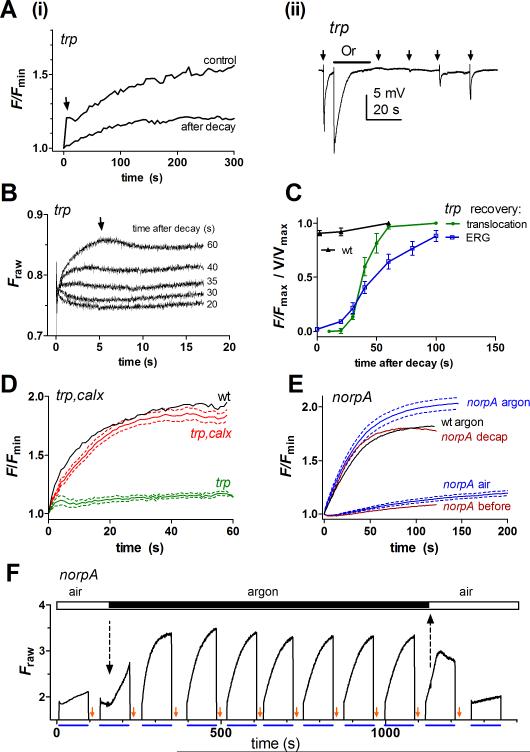
Upon illumination, visual arrestin translocates from photoreceptor cell bodies to rhodopsin and membrane-rich photosensory compartments, vertebrate outer segments or invertebrate rhabdomeres, where it quenches activated rhodopsin. Both the mechanism and function of arrestin translocation are unresolved and controversial. In dark-adapted photoreceptors of the fruitfly Drosophila, confocal immunocytochemistry shows arrestin (Arr2) associated with distributed photoreceptor endomembranes. Immunocytochemistry and live imaging of GFP-tagged Arr2 demonstrate rapid reversible translocation to stimulated rhabdomeres in stoichiometric proportion to rhodopsin photoisomerization. Translocation is very rapid in normal photoreceptors (time constant <10 s) and can also be resolved in the time course of electroretinogram recordings. Genetic elimination of key phototransduction proteins, including phospholipase C (PLC), Gq, and the light-sensitive Ca2+-permeable TRP channels, slows translocation by 10- to 100-fold. Our results indicate that Arr2 translocation in Drosophila photoreceptors is driven by diffusion, but profoundly accelerated by phototransduction and Ca2+ influx.
Copyright © 2010 Elsevier Inc. All rights reserved.
Figures



References
-
- Alloway PG, Howard L, Dolph PJ. The formation of stable rhodopsinarrestin complexes induces apoptosis and photoreceptor cell degeneration. Neuron. 2000;28:129–138. - PubMed
-
- Arikawa K, Matsushita A. Immunogold localization of opsin and actin in Drosophila photoreceptors that undergo active rhabdomere morphogenesis. Zool. Soc. Japan. 1994;11:391–398.
-
- Broekhuyse RM, Tolhuizen EF, Janssen AP, Winkens HJ. Light induced shift and binding of S-antigen in retinal rods. Curr. Eye Res. 1985;4:613–618. - PubMed
Publication types
MeSH terms
Substances
Grants and funding
LinkOut - more resources
Full Text Sources
Molecular Biology Databases
Miscellaneous
