Comparative Study
. 2011 Jan;97(3):406-15.
doi: 10.1016/j.pbb.2010.09.013. Epub 2010 Sep 24.

Comparison of the elevated plus and elevated zero mazes in treated and untreated male Sprague-Dawley rats: effects of anxiolytic and anxiogenic agents

Affiliations
Comparative Study

Comparison of the elevated plus and elevated zero mazes in treated and untreated male Sprague-Dawley rats: effects of anxiolytic and anxiogenic agents

Amanda A Braun et al. Pharmacol Biochem Behav. 2011 Jan.

Abstract

The elevated plus and zero mazes (Plus and Zero, respectively) are used to assess behavior related to anxiety in rodents but direct comparisons of the two tests are lacking for rats. We compared the two methods in adult male Sprague-Dawley rats. Untreated rats in the Zero spent more time in open zones and exhibited more head dips than in the Plus whereas start latency and closed area entries were lower in the Zero than in the Plus. Diazepam (1 mg/kg) exposure increased time in the open in both mazes. Restraint (60 min prior to testing), yohimbine (2.5 mg/kg), and caffeine (100 mg/kg) had the opposite effect, significantly decreasing time spent in open zones in both mazes. No sexual dimorphism in behavior was seen in either maze in untreated rats. Although more open area time was evident in untreated animals in the Zero, after drug challenge both mazes detected anxiolytic and anxiogenic effects equally. Zero maze data can be analyzed directly because no center region exists; otherwise the two methods appear comparable following challenge.


Conflict of interest statement

Declaration

The authors report no conflicts of interest in this research. The authors alone are responsible for the content and writing of this paper.

Figures
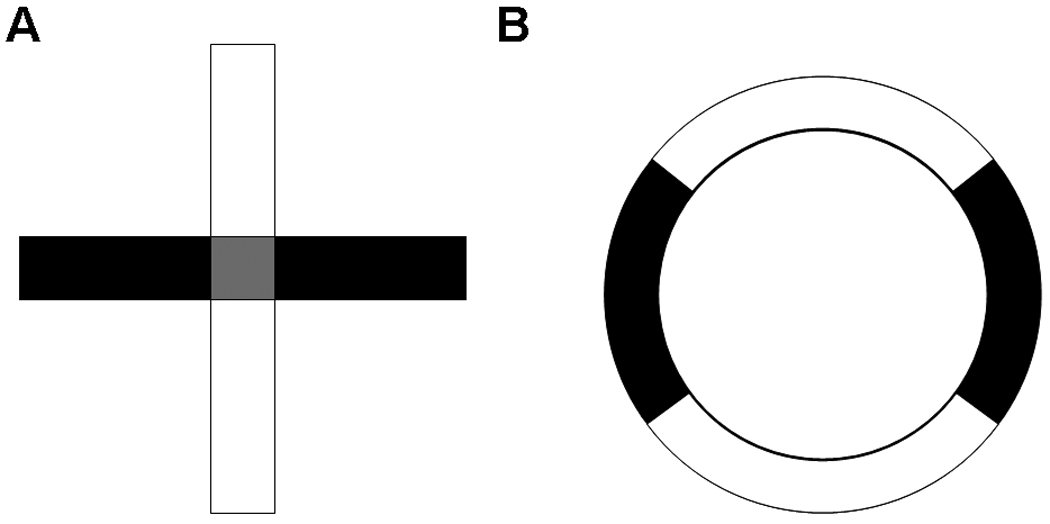
Figure 1
Figure 1
(A) Elevated Plus Maze. (B) Elevated Zero Maze. Black indicates enclosed areas, white indicates open areas, and gray represents center region in the Plus.
Figure 2
Figure 2
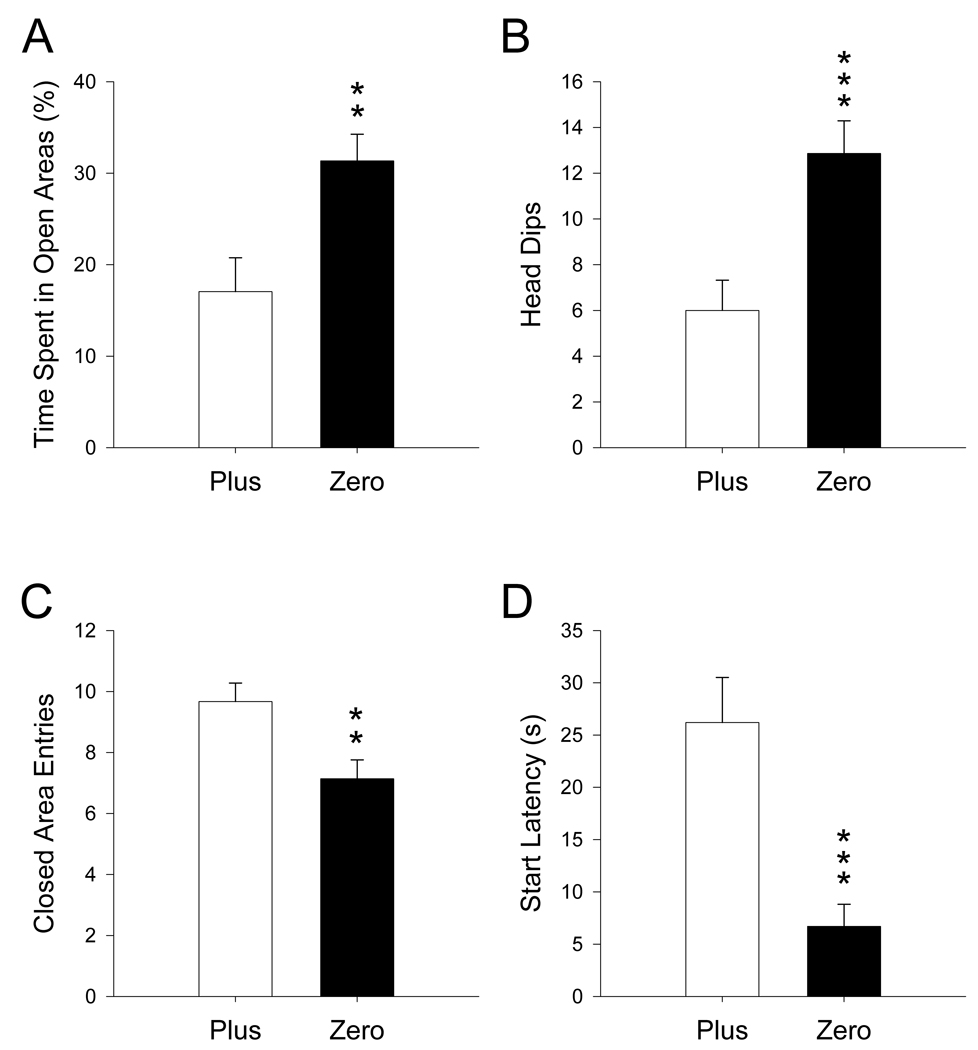
Maze comparison in untreated male rats: Untreated rats tested in the Zero spent a larger percentage of time in the open (A) and exhibited more head dips (B) than rats in the Plus. Rats tested in the Plus had increased closed area entries (C) and start latencies (D) compared to rats tested in the Zero. **p ≤ 0.01; ***p ≤ 0.001. Zero N = 21; Plus N = 22.
Figure 3
Figure 3
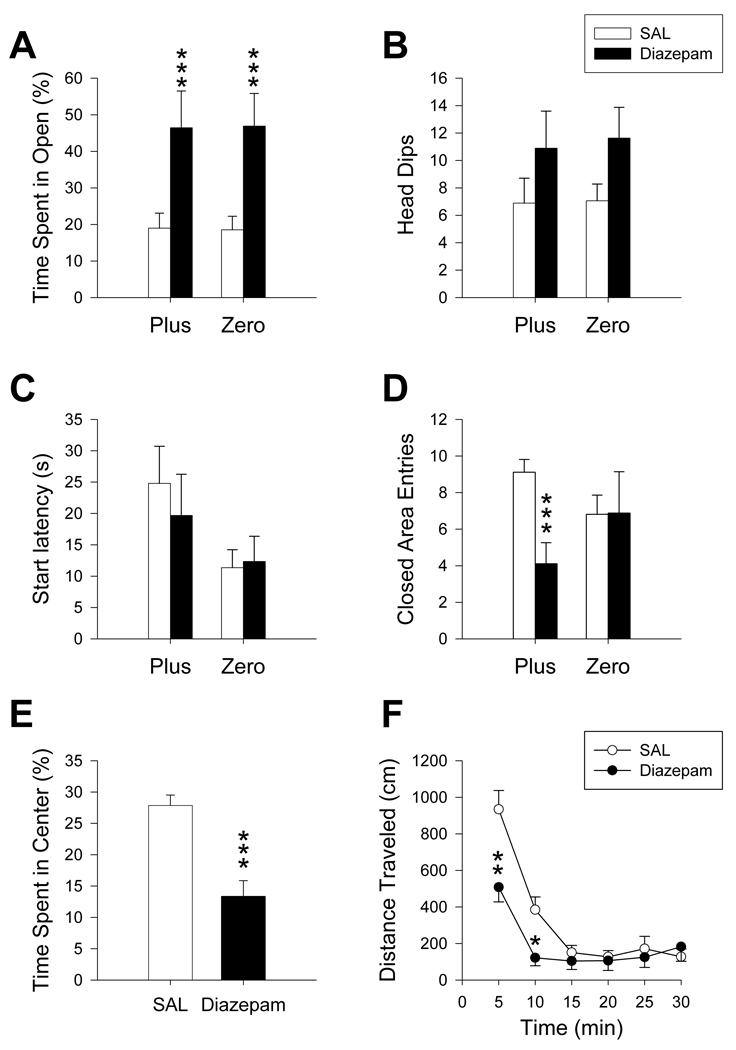
Maze comparison after diazepam treatment: Regardless of maze, diazepam increased percent time in open (A), but did not alter the number of head dips (B) or start latency (C) compared to SAL-treated controls. Number of closed area entries (D) was decreased in animals treated with diazepam in the Plus, but not the Zero, compared to controls. In the Plus, diazepam decreased the percent time animals spent in the center region of the maze (E). Total distance traveled in the open-field locomotor test (F) decreased after diazepam treatment during the first 10 min. ANCOVA revealed that maze findings were unaltered using open-field locomotion as a covariate. *p ≤ 0.05; **p ≤ 0.01; ***p ≤ 0.001. Diazepam: Zero N = 8; Plus N = 9; SAL: Zero N = 16; Plus N = 18.
Figure 4
Figure 4
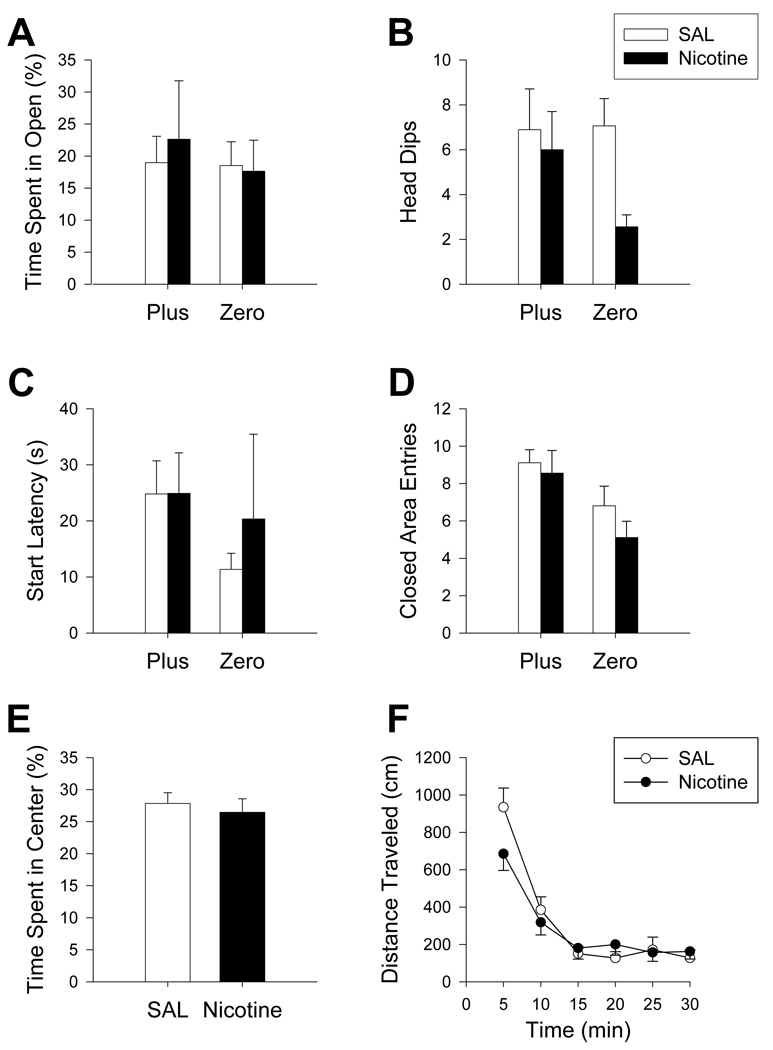
Maze comparison after nicotine treatment: Regardless of maze, percentage of time animals spent in the open areas (A), number of head dips (B), start latency (C) and number of closed area entries (D) were not altered by nicotine treatment. In the Plus, no difference was seen in the percentage of time animals spent in the center region (E) between nicotine and SAL treatment. Nicotine treatment did not produce differences in distance traveled (F) in the open-field. Nicotine: N = 9/maze; Zero N = 16; Plus N = 18.
Figure 5
Figure 5
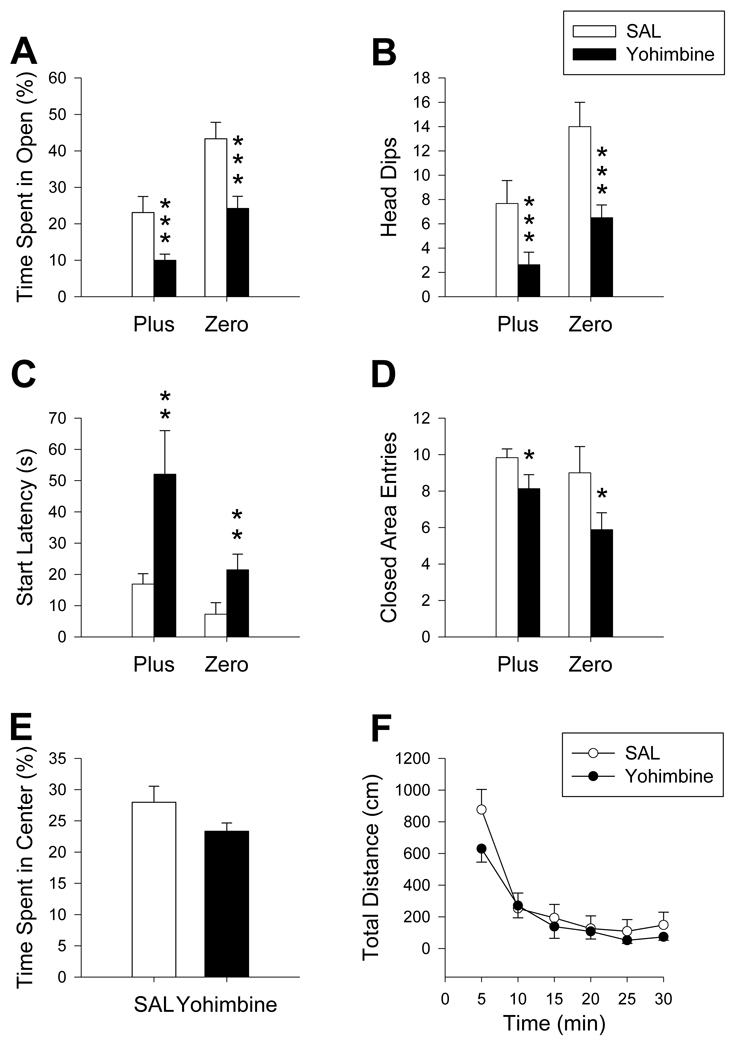
Maze comparison after yohimbine treatment: In both mazes, percentage of time animals spent in the open areas (A) and number of head dips (B) were decreased following yohimbine exposure. Start latencies (C) were increased in yohimbine-treated animals compared to SAL controls. The number of closed area entries (D) in both mazes was reduced after yohimbine treatment compared to controls. In the Plus, yohimbine-treated animals exhibited a trend towards significance in percentage of time spent in the center region (E). No difference in distance traveled (F) in the open-field was observed. *p ≤ 0.05; **p ≤ 0.01; ***p ≤ 0.001. Yohimbine: N = 8/maze; SAL: N = 6/maze.
Figure 6
Figure 6
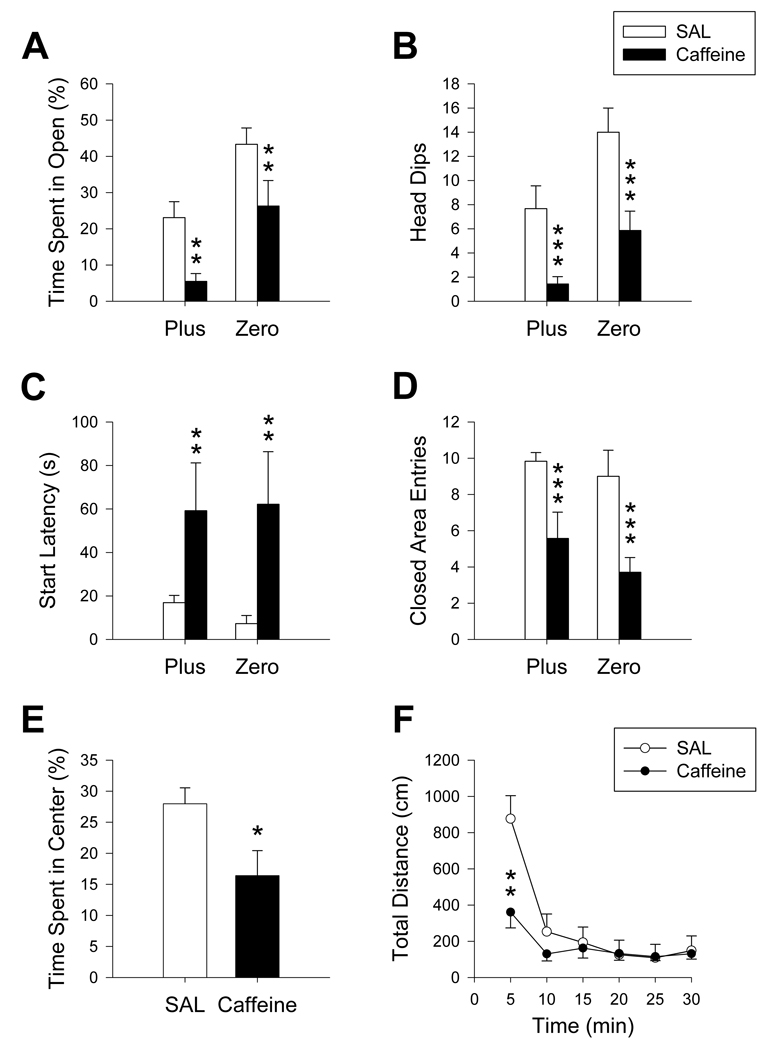
Maze comparison after caffeine treatment: Decreases in percent time spent in open areas (A) and number of head dips (B) were seen following caffeine treatment. Start latencies (C) were increased in caffeine-treated animals in both mazes compared to controls while the number of closed area entries (D) decreased. In the Plus, caffeine-treated animals spent less time in the center region (E) than controls. Caffeine decreased distance traveled (F) in the first 5 min of open-field testing. *p ≤ 0.05; **p ≤ 0.01; ***p ≤ 0.001. Caffeine: N= 7/maze; SAL: N = 6/maze.
Figure 7
Figure 7
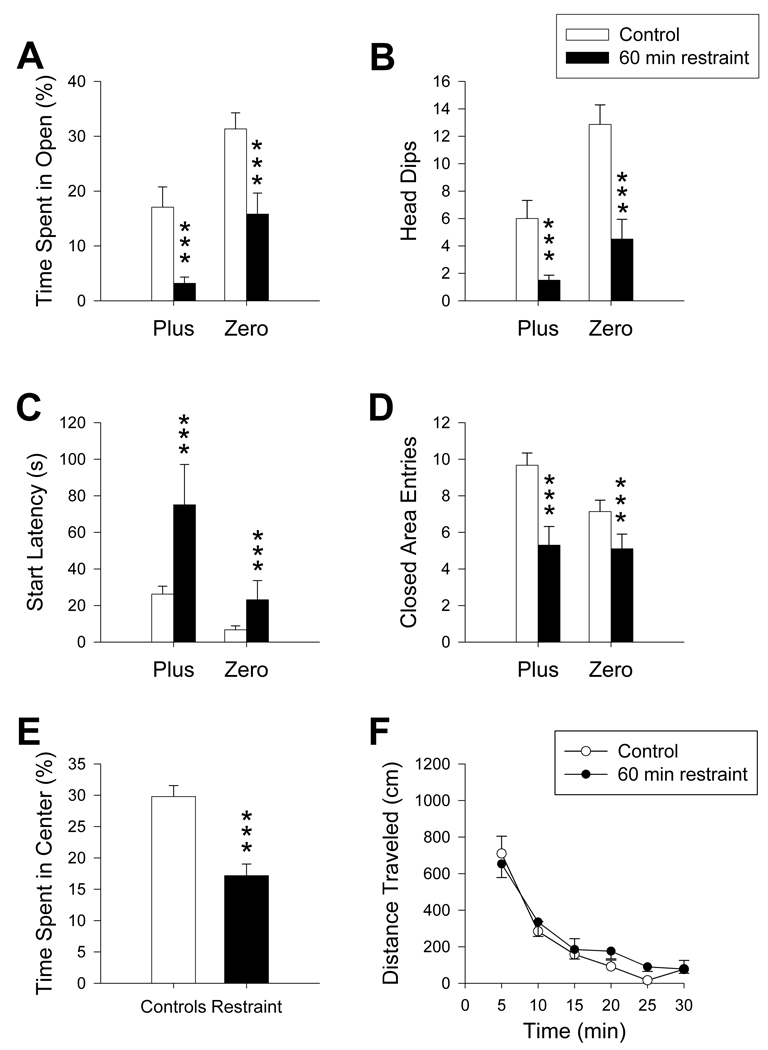
Maze comparison after restraint stress: 60 min restraint decreased both percent time spent in open areas (A) and number of head dips (B) compared to controls regardless of maze. Start latency (C) increased after restraint stress compared to controls in both mazes. Animals under restraint stress decreased the number of closed area entries (D) made compared to controls. In the Plus, restraint stress decreased the percentage of time animals spent in the center region of the maze (E). Distance traveled (F) in the open-field was not altered from restraint stress. ***p ≤ 0.001. Restraint stress: N = 10/maze; Control: Zero N= 21; Plus N = 22.
Figure 8
Figure 8
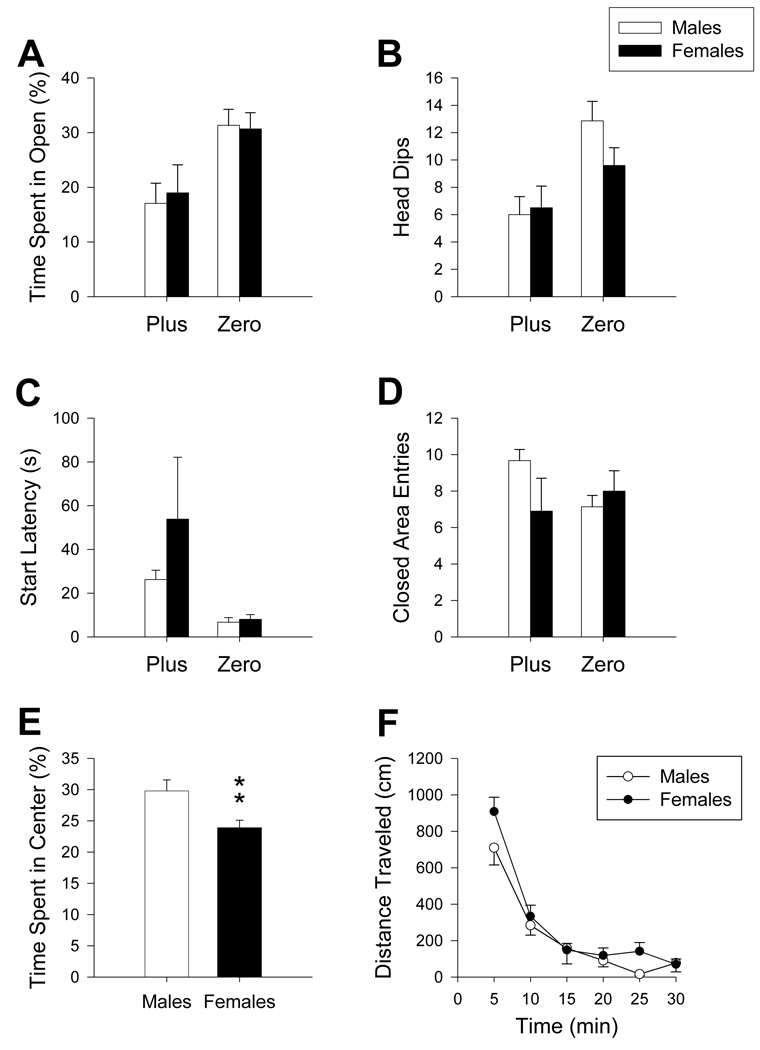
Maze comparison between sexes: No difference between males and females was observed in percent time animals spent in the open (A), number of head dips made (B), latency to start (C), or number of closed area entries (D) regardless of maze. Untreated females spent less time in the center platform (E) than untreated males did in the Plus. No difference in total distance traveled (F) in locomotor testing was observed. **p ≤ 0.01. Females: N=10/maze; Males: Zero N= 21; Plus N = 22.

References

    1. Banna KM, Back SE, Do P, See RE. Yohimbine stress potentiates conditioned cue-induced reinstatement of heroin-seeking in rats. Behav. Brain Res. 2010;208:144–148. - PMC - PubMed
    1. Bhattacharya SK, Satyan KS, Chakrabarti A. Anxiogenic action of caffeine: an experimental study in rats. J. Psychopharmacol. 1997;11:219–224. - PubMed
    1. Carobrez AP, Bertoglio LJ. Ethological and temporal analyses of anxiety-like behavior: the elevated plus-maze model 20 years on. Neurosci. Biobehav. Rev. 2005;29:1193–1205. - PubMed
    1. Cole JC, Rodgers RJ. Ethological comparison of the effects of diazepam and acute/chronic imipramine on the behaviour of mice in the elevated plus-maze. Pharmacol. Biochem. Behav. 1995;52:473–478. - PubMed
    1. Cruz AP, Frei F, Graeff FG. Ethopharmacological analysis of rat behavior on the elevated plus-maze. Pharmacol. Biochem. Behav. 1994;49:171–176. - PubMed

Publication types