


Frontal EEG asymmetry during emotional challenge differentiates individuals with and without lifetime major depressive disorder
- PMID: 20870293
- PMCID: PMC3021630
- DOI: 10.1016/j.jad.2010.08.029
Frontal EEG asymmetry during emotional challenge differentiates individuals with and without lifetime major depressive disorder
Abstract
Background: Although it has been argued that frontal electroencephalographic (EEG) asymmetry at rest may be a risk marker for major depressive disorder (MDD), it is unclear whether a pattern of relatively less left than right activity characterizes depressed individuals during emotional challenges. Examination of frontal asymmetry during emotion task manipulations could provide an assessment of the function of systems relevant for MDD, and test the limits of frontal EEG asymmetry as a marker of risk for depression.
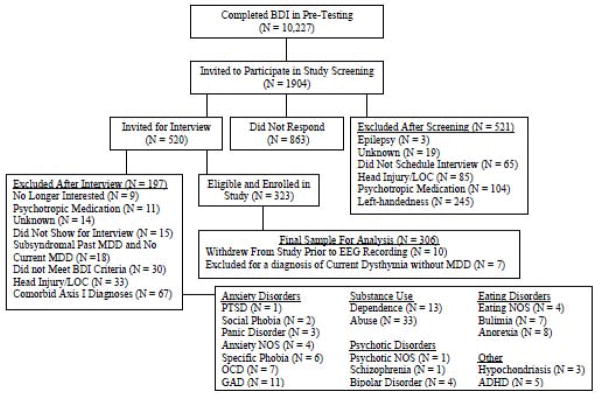
Methods: EEG data were assessed during a facial emotion task, wherein 306 individuals age 18-34 (31% male) with (n=143) and without (n=163) DSM-IV defined lifetime MDD made directed facial actions of approach (angry and happy) and withdrawal (afraid and sad) expressions.
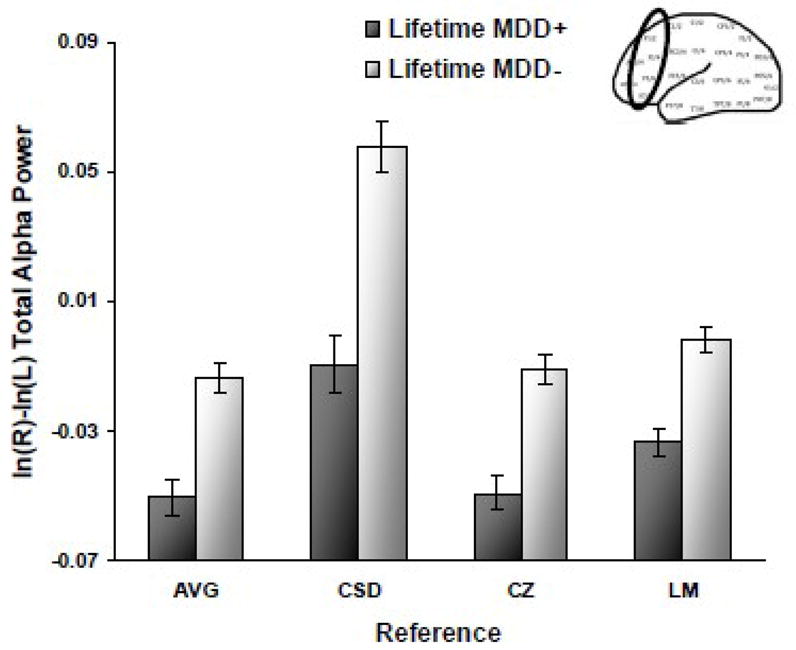
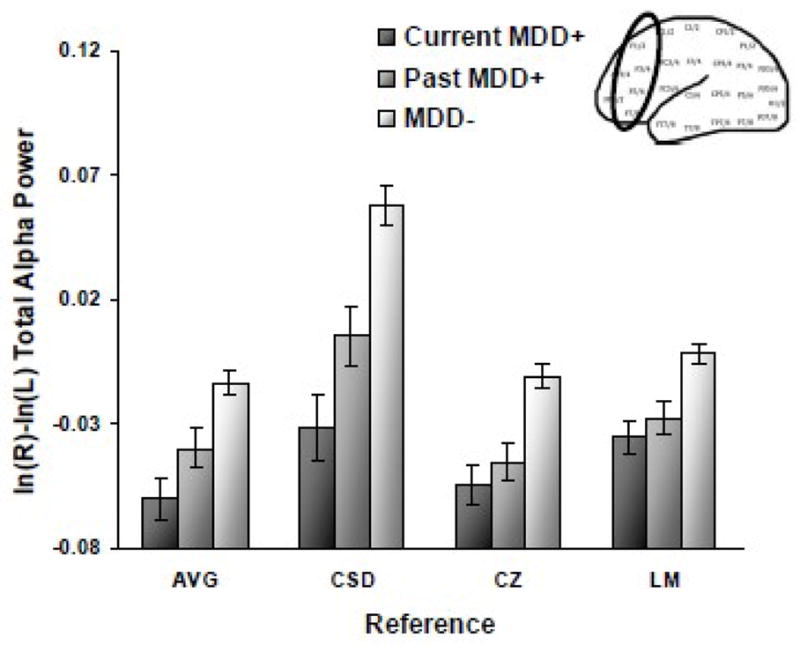
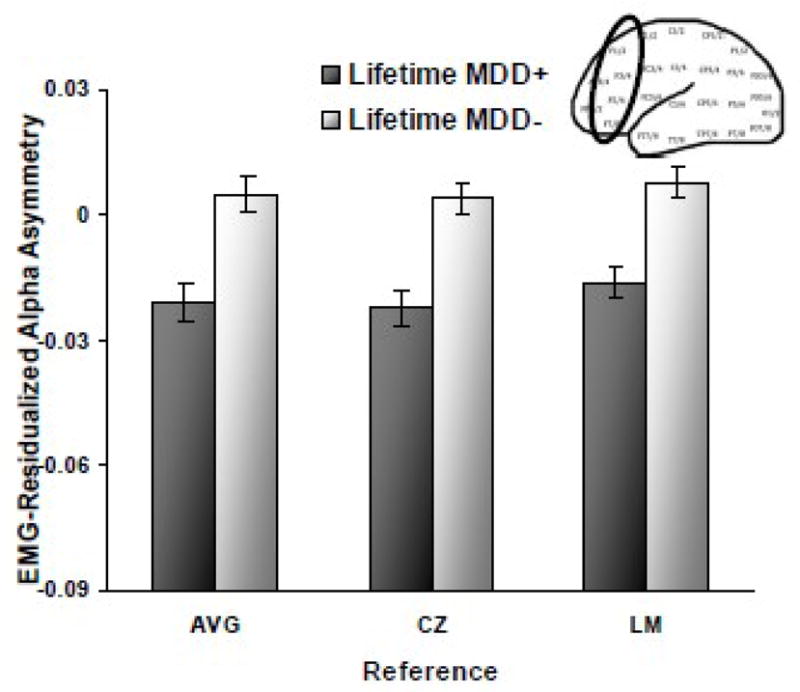
Results: Lifetime depressed individuals displayed less relative left frontal activity than never-depressed individuals during all facial expressions across four EEG reference montages, findings that were not due to emotional experience, facial expression quality, electromyographic (EMG) activity, or current depression status.
Limitations: Although this was a sizable sample, only one emotion task was utilized.
Conclusions: Results provide further support for frontal EEG asymmetry as a risk marker for MDD.
Copyright © 2010 Elsevier B.V. All rights reserved.
Conflict of interest statement
All authors declare that they have no conflicts of interest.
Figures
References
-
- Allen JJB, Coan JA, Nazarian M. Issues and assumptions on the road from raw signals to metrics of frontal EEG asymmetry in emotion. Biological Psychology. 2004a;67:183–218. - PubMed
-
- Allen JJB, Urry HL, Hitt SK, Coan JA. The stability of resting frontal electroencephalographic asymmetry in depression. Psychophysiology. 2004b;41:269–280. - PubMed
-
- Allen NB, Di Parsia P. Effects of mood induction on startle modulation by social threat in individuals with and without a history of depression. Psychophysiology. 2002;39:S5.
-
- Beck AT, Ward CH, Mendelson M, Mock J, Erbaugh J. An inventory for measuring depression. Archives of General Psychiatry. 1961;4:561–571. - PubMed
Publication types
MeSH terms
Substances
Grants and funding
LinkOut - more resources
Full Text Sources
