. 2010 Nov;28(11):1418-24.
doi: 10.1002/jor.21149.

Periprosthetic osteolysis: characterizing the innate immune response to titanium wear-particles

Affiliations

Periprosthetic osteolysis: characterizing the innate immune response to titanium wear-particles

Christine A St Pierre et al. J Orthop Res. 2010 Nov.

Erratum in

  • J Orthop Res. 2011 Jan;29(1):154

Abstract

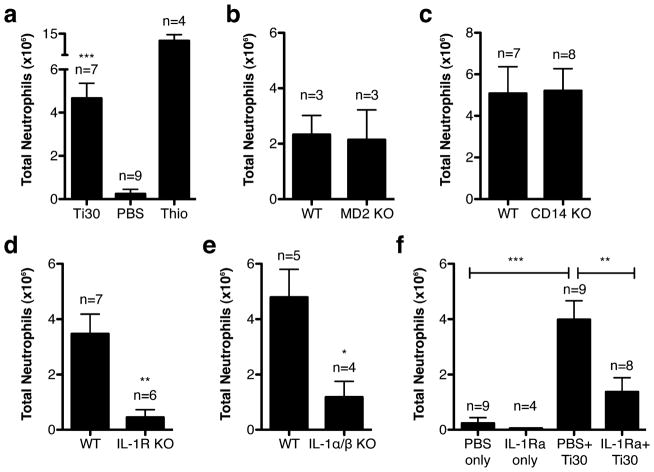
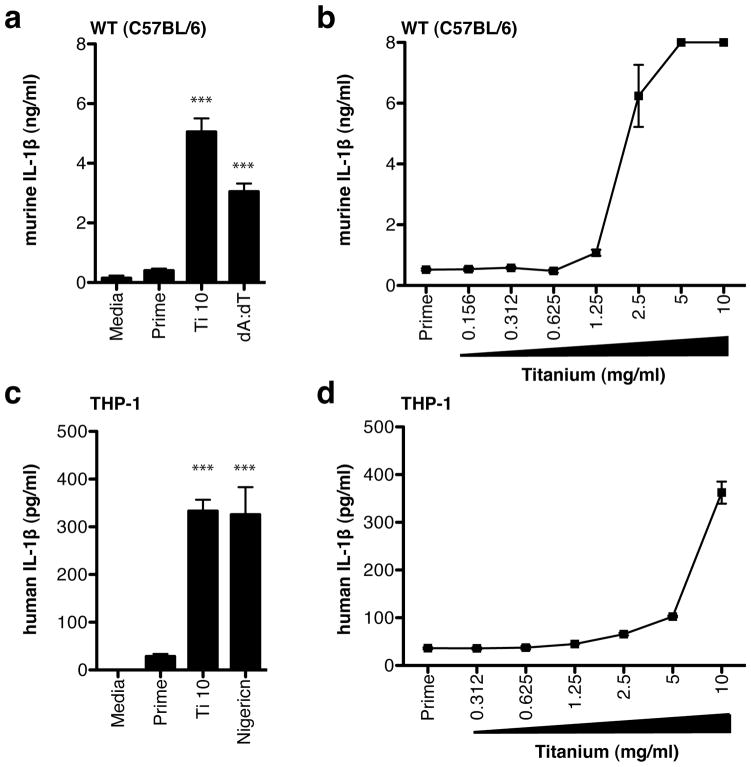
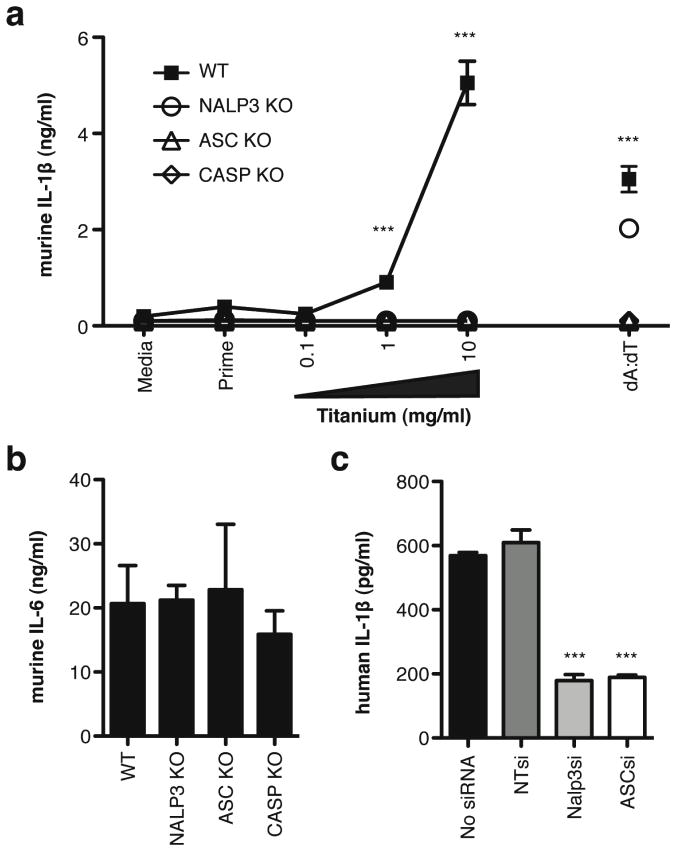
Osteolysis of bone following total hip replacement is a major clinical problem. Examination of the areas surrounding failed implants has indicated an increase in the bone-resorption-inducing cytokine, interleukin 1β (IL-1β). NALP3, a NOD-like receptor protein located in the cytosol of macrophages, signals the cleavage of pro-IL-1β into its mature, secreted form, IL-1β. Here we showed that titanium particles stimulate the NALP3 inflammasome. We demonstrated that titanium induces IL-1β secretion from macrophages. This response depended on the expression of components of the NALP3 inflammasome, including NALP3, ASC, and Caspase-1. We also showed that titanium particles trigger the recruitment of neutrophils and that this acute inflammatory response depends on the expression of the IL-1 receptor and IL-1α/β. Moreover, administration of the IL-1 receptor antagonist (IL-1Ra) diminished neutrophil recruitment in response to titanium particles. Together, these results suggest that titanium particle-induced acute inflammation is due to activation of the NALP3 inflammasome, which leads to increased IL-1β secretion and IL-1-associated signaling, including neutrophil recruitment. Efficacy of IL-1Ra treatment introduces the potential for antagonist-based therapies for implant osteolysis.


Figures

Figure 1
Figure 1
Neutrophil recruitment following titanium injections in various mouse strains. (a) WT (b) MD2 KO (c) CD14 KO (d) IL-1R KO and (e) IL-1α/β KO. (f) Effect of IL-1Ra treatment on neutrophil recruitment. Graphs show the mean ± s.e.m. from the total number of mice indicated. P-values are shown as *** ≤ 0.0001; ** < 0.01; * < 0.05
Figure 2
Figure 2
IL-1β secretion following titanium stimulation in (a) WT immortalized mouse macrophages and (b) THP-1 human macrophages. Dose-response curves to titanium in (c) WT immortalized mouse macrophages and (d) THP-1 human macrophages. Secreted IL-1β levels are mean ± s.e.m. Significance values are shown relative to Prime levels. P-values are shown as *** ≤ 0.0001
Figure 3
Figure 3
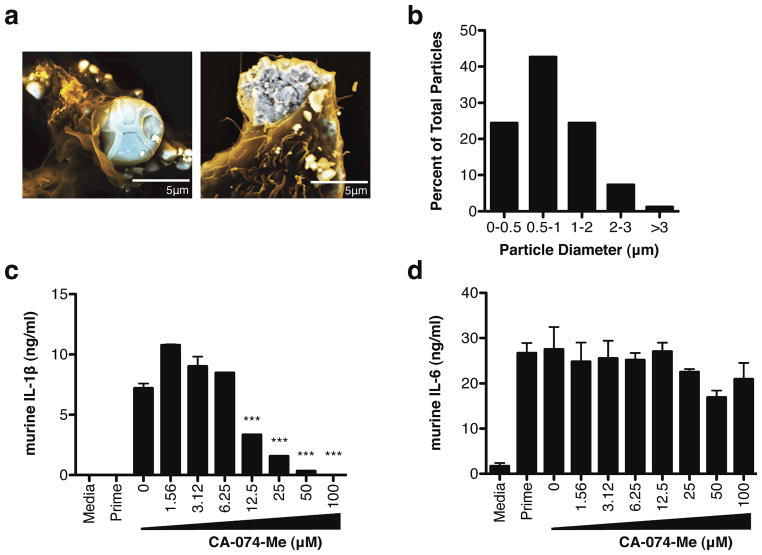
Response to titanium particle uptake is cathepsin B dependent. (a) SEM image of immortalized mouse macrophages incubated with titanium particles for 30 min. (b) Diameter of macrophage-associated particles (n = 82) as determined by confocal microscopy and NIH ImageJ software. (c) IL-1β and (d) IL-6 secretion following titanium stimulation in WT immortalized mouse macrophages treated with the cathepsin-B inhibitor, CA-074-Me. Secreted cytokine levels are mean ± s.e.m. Significance values are shown relative to untreated (0 uM) samples. P-values are shown as *** ≤ 0.0001; ** < 0.01
Figure 4
Figure 4
Titanium-induced IL-1β secretion is inflammasome dependent. (a) IL-1β and (b) IL-6 secretion in WT, NALP3 KO, ASC KO, and CASP KO immortalized mouse macrophages. (c) IL-1β secretion following titanium stimulation in THP-1 human macrophages transfected with siRNA pools specific for NALP3, ASC, or luciferase (NT). Secreted cytokine levels are means ± s.e.m. P-values are shown as *** ≤ 0.0001; ** < 0.01
Figure 5
Figure 5
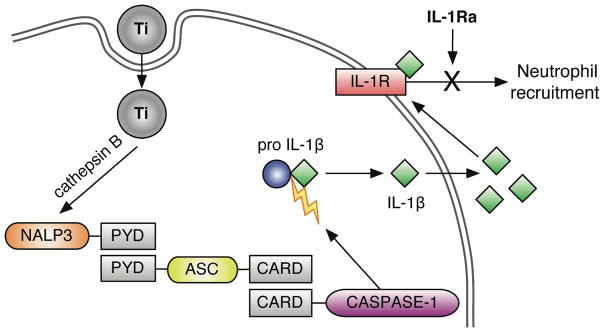
Titanium triggers inflammasome activation. Titanium particle internalization triggers the release of Cathepsin B from lysosomes, which together activate Nalp3. Activated Nalp3 recruits ASC through PYD domain interactions. This complex triggers cleavage and recruitment of activated Caspase-1 through CARD domain interactions. This inflammasome complex then cleaves pro-IL-1β into its active, secreted form IL-1β, which can trigger downstream IL-1 associated signaling, including neutrophil recruitment, through activation of the IL-1R. This acute inflammatory response can be inhibited with IL-1Ra treatment.

References

    1. Ingham E, Fisher J. The role of macrophages in osteolysis of total joint replacement. Biomaterials. 2005;26:1271–1286. - PubMed
    1. Jacobs JJ, Roebuck KA, Archibeck M, et al. Osteolysis: basic science. Clin Orthop Relat Res. 2001;393:71–77. - PubMed
    1. Saeed S, Revell PA. Production and distribution of interleukin 15 and its receptors (IL-15Ralpha and IL-R2beta) in the implant interface tissues obtained during revision of failed total joint replacement. Int J Exp Pathol. 2001;82:201–209. - PMC - PubMed
    1. Revell PA. The combined role of wear particles, macrophages and lymphocytes in the loosening of total joint prostheses. J R Soc Interface. 2008;5:1263–1278. - PMC - PubMed
    1. Stea S, Visentin M, Granchi D, et al. Cytokines and osteolysis around total hip prostheses. Cytokine. 2000;12:1575–1579. - PubMed

Publication types