


Isolation and characterization of bacteria from the gut of Bombyx mori that degrade cellulose, xylan, pectin and starch and their impact on digestion
- PMID: 20874394
- PMCID: PMC3016902
- DOI: 10.1673/031.010.10701
Isolation and characterization of bacteria from the gut of Bombyx mori that degrade cellulose, xylan, pectin and starch and their impact on digestion
Abstract
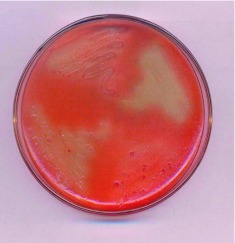
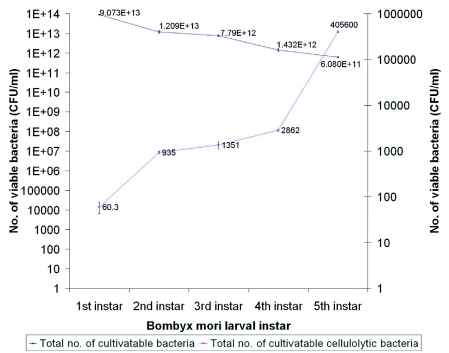
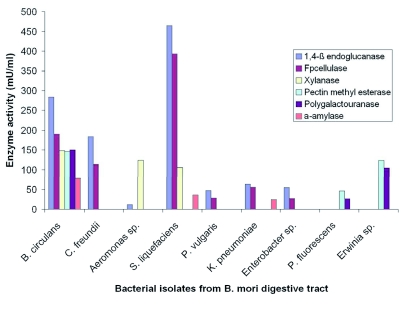
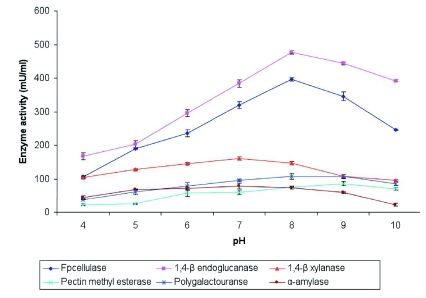
Bombyx mori L. (Lepidoptera: Bombycidae) have been domesticated and widely used for silk production. It feeds on mulberry leaves. Mulberry leaves are mainly composed of pectin, xylan, cellulose and starch. Some of the digestive enzymes that degrade these carbohydrates might be produced by gut bacteria. Eleven isolates were obtained from the digestive tract of B. mori, including the Gram positive Bacillus circulans and Gram negative Proteus vulgaris, Klebsiella pneumoniae, Escherichia coli, Citrobacter freundii, Serratia liquefaciens, Enterobacter sp., Pseudomonas fluorescens, P. aeruginosa, Aeromonas sp., and Erwinia sp.. Three of these isolates, P. vulgaris, K. pneumoniae, C. freundii, were cellulolytic and xylanolytic, P. fluorescens and Erwinia sp., were pectinolytic and K. pneumoniae degraded starch. Aeromonas sp. was able to utilize the CMcellulose and xylan. S. liquefaciens was able to utilize three polysaccharides including CMcellulose, xylan and pectin. B. circulans was able to utilize all four polysaccharides with different efficacy. The gut of B. mori has an alkaline pH and all of the isolated bacterial strains were found to grow and degrade polysaccharides at alkaline pH. The number of cellulolytic bacteria increases with each instar.
Figures
References
-
- Alwin Prem Anand A, Sripathi K. Digestion of cellulose and xylan by symbiotic bacteria in the intestine of the Indian flying fox (Pteropus giganteus). Comparative Biochemistry and Physiology. 2004;139B:65–69. - PubMed
-
- Appel HM. The chewing herbivore gut lumen: physicochemical conditions and their impact on plant nutrients, allelochemicals and insect pathogens. In: Bernays EA, editor. Insect-Plant Interactions. Vol. 5. CRC; 1994. pp. 209–221.
-
- Aruga H. Principles of Sericulture. Oxford: 1994. pp. 97–99.
-
- Azevedo TR, Terra WR, Ferreira C. Purification and characterization of three βglycosidases from midgut of the sugar cane borer, Diatraea saccharalis. Insect Biochemistry and Molecular Biology. 2003;33(1):81–92. - PubMed
MeSH terms
Substances
LinkOut - more resources
Full Text Sources
