


Sublingual microcirculatory changes during high-volume hemofiltration in hyperdynamic septic shock patients
- PMID: 20875109
- PMCID: PMC3219271
- DOI: 10.1186/cc9271
Sublingual microcirculatory changes during high-volume hemofiltration in hyperdynamic septic shock patients
Abstract
Introduction: Previous studies have suggested that high volume hemofiltration (HVHF) may contribute to revert hypotension in severe hyperdynamic septic shock patients. However, arterial pressure stabilization occurs due to an increase in systemic vascular resistance, which could eventually compromise microcirculatory blood flow and perfusion. The goal of this study was to determine if HVHF deteriorates sublingual microcirculation in severe hyperdynamic septic shock patients.
Methods: This was a prospective, non-randomized study at a 16-bed, medical-surgical intensive care unit of a university hospital. We included 12 severe hyperdynamic septic shock patients (norepinephrine requirements > 0.3 μg/kg/min and cardiac index > 3.0 L/min/m2) who underwent a 12-hour HVHF as a rescue therapy according to a predefined algorithm. Sublingual microcirculation (Microscan for NTSC, Microvision Medical), systemic hemodynamics and perfusion parameters were assessed at baseline, at 12 hours of HVHF, and 6 hours after stopping HVHF.
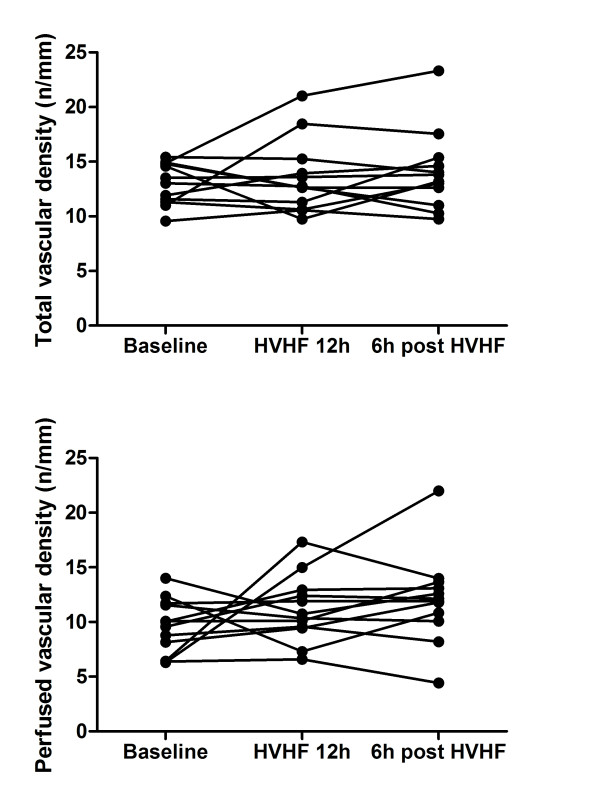
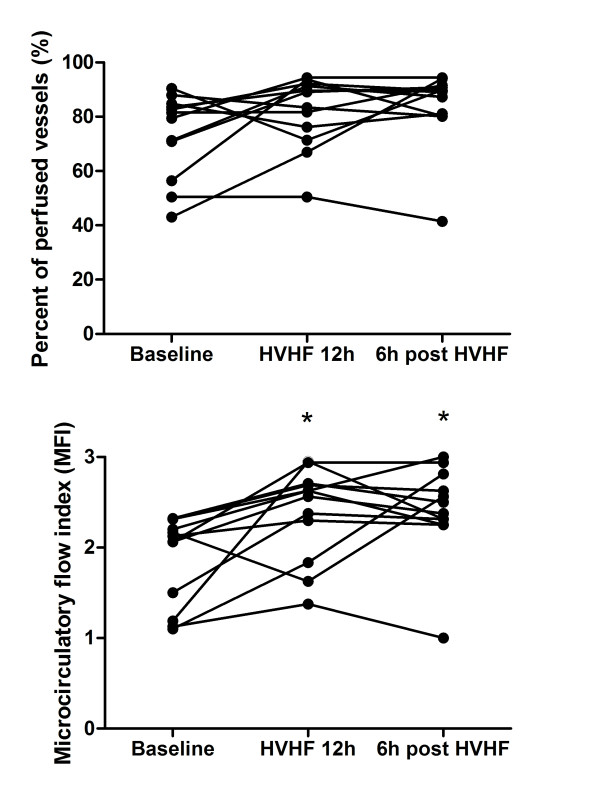
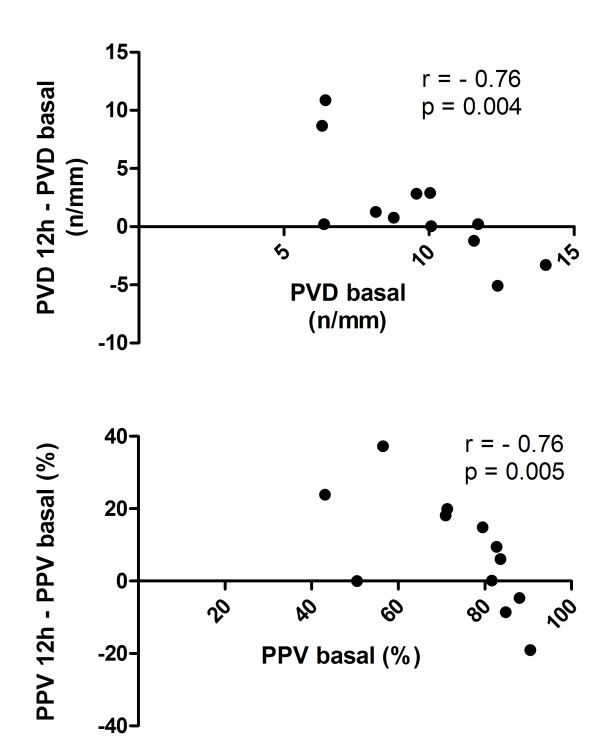
Results: Microcirculatory flow index increased after 12 hours of HVHF and this increase persisted 6 hours after stopping HVHF. A similar trend was observed for the proportion of perfused microvessels. The increase in microcirculatory blood flow was inversely correlated with baseline levels. There was no significant change in microvascular density or heterogeneity during or after HVHF. Mean arterial pressure and systemic vascular resistance increased while lactate levels decreased after the 12-hour HVHF.
Conclusions: The use of HVHF as a rescue therapy in patients with severe hyperdynamic septic shock does not deteriorate sublingual microcirculatory blood flow despite the increase in systemic vascular resistance.
Figures
References
-
- Honore PM, Jamez J, Wauthier M, Lee PA, Dugernier T, Pirenne B, Hanique G, Matson JR. Prospective evaluation of short-term, high-volume isovolemic hemofiltration on the hemodynamic course and outcome in patients with intractable circulatory failure resulting from septic shock. Crit Care Med. 2000;28:3581–3587. doi: 10.1097/00003246-200011000-00001. - DOI - PubMed
-
- Lopez A, Lorente JA, Steingrub J, Bakker J, McLuckie A, Willatts S, Brockway M, Anzueto A, Holzapfel L, Breen D, Silverman MS, Takala J, Donaldson J, Arneson C, Grove G, Grossman S, Grover R. Multiple-center, randomized, placebo-controlled, double-blind study of the nitric oxide synthase inhibitor 546C88: effect on survival in patients with septic shock. Crit Care Med. 2004;32:21–30. doi: 10.1097/01.CCM.0000105581.01815.C6. - DOI - PubMed
Publication types
MeSH terms
LinkOut - more resources
Full Text Sources
Other Literature Sources
Medical
