


Serotonin selectively influences moral judgment and behavior through effects on harm aversion
- PMID: 20876101
- PMCID: PMC2951447
- DOI: 10.1073/pnas.1009396107
Serotonin selectively influences moral judgment and behavior through effects on harm aversion
Abstract
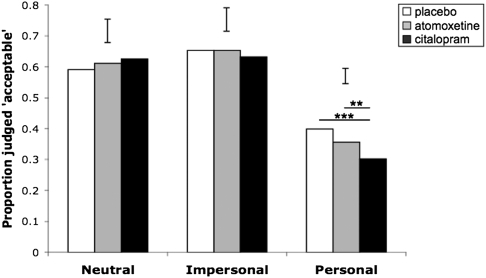
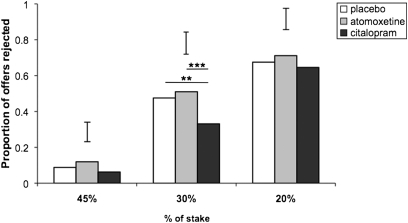
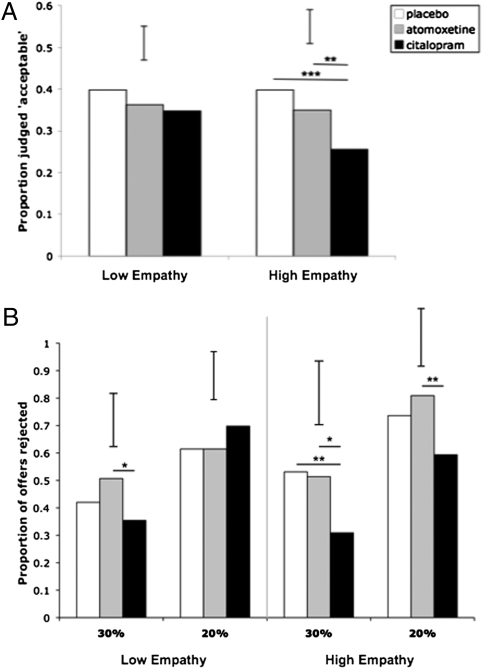
Aversive emotional reactions to real or imagined social harms infuse moral judgment and motivate prosocial behavior. Here, we show that the neurotransmitter serotonin directly alters both moral judgment and behavior through increasing subjects' aversion to personally harming others. We enhanced serotonin in healthy volunteers with citalopram (a selective serotonin reuptake inhibitor) and contrasted its effects with both a pharmacological control treatment and a placebo on tests of moral judgment and behavior. We measured the drugs' effects on moral judgment in a set of moral 'dilemmas' pitting utilitarian outcomes (e.g., saving five lives) against highly aversive harmful actions (e.g., killing an innocent person). Enhancing serotonin made subjects more likely to judge harmful actions as forbidden, but only in cases where harms were emotionally salient. This harm-avoidant bias after citalopram was also evident in behavior during the ultimatum game, in which subjects decide to accept or reject fair or unfair monetary offers from another player. Rejecting unfair offers enforces a fairness norm but also harms the other player financially. Enhancing serotonin made subjects less likely to reject unfair offers. Furthermore, the prosocial effects of citalopram varied as a function of trait empathy. Individuals high in trait empathy showed stronger effects of citalopram on moral judgment and behavior than individuals low in trait empathy. Together, these findings provide unique evidence that serotonin could promote prosocial behavior by enhancing harm aversion, a prosocial sentiment that directly affects both moral judgment and moral behavior.
Conflict of interest statement
Conflict of interest statement: T.W.R. consults for Cambridge Cognition, Pfizer, GlaxoSmithKline, E. Lilly Inc., Lundbeck, Roche, Allon Therapeutics, and Pangenics.
Figures
Comment in
-
I fear for you: a role for serotonin in moral behavior.Proc Natl Acad Sci U S A. 2010 Oct 5;107(40):17071-2. doi: 10.1073/pnas.1012545107. Epub 2010 Sep 27. Proc Natl Acad Sci U S A. 2010. PMID: 20876090 Free PMC article. No abstract available.
-
Moral behavior is not what it seems.Proc Natl Acad Sci U S A. 2010 Dec 14;107(50):E183; author reply E184. doi: 10.1073/pnas.1015001107. Epub 2010 Nov 23. Proc Natl Acad Sci U S A. 2010. PMID: 21098659 Free PMC article. No abstract available.
References
-
- Haidt J. The new synthesis in moral psychology. Science. 2007;316:998–1002. - PubMed
-
- Davis MH. The effects of dispositional empathy on emotional reactions and helping: A multidimensional approach. J Pers. 1983;51:167–184.
-
- Singer T, Lamm C. The social neuroscience of empathy. Ann N Y Acad Sci. 2009;1156:81–96. - PubMed
-
- Hare RD. The Hare Psychopathy Checklist—Revised. 2nd Ed. Toronto: Multi-Health Systems; 2003.
-
- Blair RJR. The amygdala and ventromedial prefrontal cortex in morality and psychopathy. Trends Cogn Sci. 2007;11:387–392. - PubMed
Publication types
MeSH terms
Substances
Grants and funding
LinkOut - more resources
Full Text Sources
