


The Diesel Exhaust in Miners Study: IV. Estimating historical exposures to diesel exhaust in underground non-metal mining facilities
- PMID: 20876235
- PMCID: PMC2953557
- DOI: 10.1093/annhyg/meq025
The Diesel Exhaust in Miners Study: IV. Estimating historical exposures to diesel exhaust in underground non-metal mining facilities
Abstract
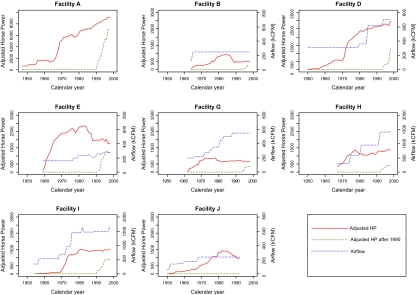
We developed quantitative estimates of historical exposures to respirable elemental carbon (REC) for an epidemiologic study of mortality, including lung cancer, among diesel-exposed miners at eight non-metal mining facilities [the Diesel Exhaust in Miners Study (DEMS)]. Because there were no historical measurements of diesel exhaust (DE), historical REC (a component of DE) levels were estimated based on REC data from monitoring surveys conducted in 1998-2001 as part of the DEMS investigation. These values were adjusted for underground workers by carbon monoxide (CO) concentration trends in the mines derived from models of historical CO (another DE component) measurements and DE determinants such as engine horsepower (HP; 1 HP = 0.746 kW) and mine ventilation. CO was chosen to estimate historical changes because it was the most frequently measured DE component in our study facilities and it was found to correlate with REC exposure. Databases were constructed by facility and year with air sampling data and with information on the total rate of airflow exhausted from the underground operations in cubic feet per minute (CFM) (1 CFM = 0.0283 m³ min⁻¹), HP of the diesel equipment in use (ADJ HP), and other possible determinants. The ADJ HP purchased after 1990 (ADJ HP₁₉₉₀(+)) was also included to account for lower emissions from newer, cleaner engines. Facility-specific CO levels, relative to those in the DEMS survey year for each year back to the start of dieselization (1947-1967 depending on facility), were predicted based on models of observed CO concentrations and log-transformed (Ln) ADJ HP/CFM and Ln(ADJ HP₁₉₉₀(+)). The resulting temporal trends in relative CO levels were then multiplied by facility/department/job-specific REC estimates derived from the DEMS surveys personal measurements to obtain historical facility/department/job/year-specific REC exposure estimates. The facility-specific temporal trends of CO levels (and thus the REC estimates) generated from these models indicated that CO concentrations had been generally greater in the past than during the 1998-2001 DEMS surveys, with the highest levels ranging from 100 to 685% greater (median: 300%). These levels generally occurred between 1970 and the early 1980s. A comparison of the CO facility-specific model predictions with CO air concentration measurements from a 1976-1977 survey external to the modeling showed that our model predictions were slightly lower than those observed (median relative difference of 29%; range across facilities: 49 to -25%). In summary, we successfully modeled past CO concentration levels using selected determinants of DE exposure to derive retrospective estimates of REC exposure. The results suggested large variations in REC exposure levels both between and within the underground operations of the facilities and over time. These REC exposure estimates were in a plausible range and were used in the investigation of exposure-response relationships in epidemiologic analyses.
Figures


Comment in
-
Comments on the Diesel Exhaust in Miners Study.Ann Occup Hyg. 2011 Apr;55(3):339-42; author reply 343-6. doi: 10.1093/annhyg/mer005. Ann Occup Hyg. 2011. PMID: 21402871 No abstract available.
References
-
- Adelroth E, Hedlund U, Blomberg A, et al. Airway inflammation in iron ore miners exposed to dust and diesel exhaust. Eur Respir J. 2006;27:714–9. - PubMed
-
- Astrakianakis G, Seixas NS, Camp JE, et al. Modeling, estimation and validation of cotton dust and endotoxin exposures in Chinese textile operations. Ann Occup Hyg. 2006;50:573–82. - PubMed
-
- Backe E, Lotz G, Tittelbach U, et al. Immunological biomarkers in salt miners exposed to salt dust, diesel exhaust and nitrogen oxides. Int Arch Occup Environ Health. 2004;77:319–27. - PubMed
-
- Birch ME, Noll JD. Submicrometer elemental carbon as a selective measure of diesel particulate matter in coal mines. J Environ Monit. 2004;6:799–806. - PubMed
-
- Burgess JL, Fleming JE, Mulenga EM, et al. Acute changes in sputum IL-10 following underground exposure to diesel exhaust. Clin Toxicol. 2007;45:255–60. - PubMed
Publication types
MeSH terms
Substances
Grants and funding
LinkOut - more resources
Full Text Sources
Medical
Research Materials
Miscellaneous
